1 May 2020
Editor's Choice
Electrical switching & drive systems & components
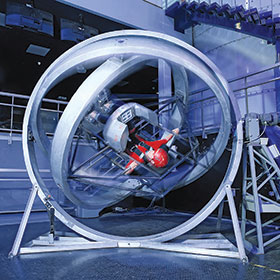
The adventure park Euro Space Centre in Transinne in Belgium is home to a number of different simulators, including the original NASA multi-axis chair dating back to the 1960s which was used to familiarise astronauts with the sensation of disorientation. Today, visitors to the park have the chance to tread in the footsteps of the early space pioneers for a few moments. To make this possible, the chair has been automated using the latest technology, with a control system supplied by Siemens.
Every child has dreamt of following in the footsteps of Neil Armstrong or Buzz Aldrin and discovering space as an astronaut. It has now been made possible to at least experience some of the same sensations, if only for a short time, in the Euro Space Centre. Using simulators, visitors can experience the moonwalk or find out what a disorientation exercise felt like on the multi-axis chair. This chair was used by NASA to prepare astronauts for life in space, and the original is now in operation in Transinne.
The former manual control of the chair, which swivels around three axes using two aluminium rings, has now been replaced and automated using the Logo! 8 logic module from Siemens.
Always perfectly oriented
“Our employees always used to have to start the simulator, then regulate the speed, decelerate the chair and stop it using a simple hand wheel,” recalls Catherine Vuidar, marketing manager of the Euro Space Centre. The use of Logo! 8 has not only improved equipment handling for the operators, it has also increased the chair’s steerability, efficiency and safety. Placed in charge of upgrading the chair was the company Heinen, which did the calculating, testing and adjusting the settings for the new control program. “To improve the system’s safety, we mounted two sensors at precisely defined positions in the simulator,” says head development engineer Marc Radoux. The sensors are connected to Logo! 8, and ensure optimum positioning of the chair both at the start of the cycle and, most importantly, when stopping. This prevents errors such as the chair coming to a standstill with the visitor upside down.
Additional projects in the pipeline
The turning movement itself is powered by an induction motor with a maximum speed of 3600 revolutions per minute (rpm) which is connected to a frequency control. The current program offers three speed levels – slow, fast and very fast – with up to 30 revolutions of the chair per minute. This is enough to challenge the stomach and equilibrium organ of any test candidate. The chair can be brought to a standstill at any time using an emergency stop button, and the voltage and speed parameters can be viewed in real time at the control system’s display panel throughout the sequence. “The project has been so successful that we’ve actually developed a mobile multi-axis chair, and a third one is currently in progress,” concludes Radoux.
From the editor's desk: A new era Technews Publishing
Editor's Choice
After fifteen years as editor of Motion Control, the time has come for me to hand over to Andrew Seldon. It has been a privilege to be part of this publication and to witness not only the remarkable advances in motion control, fluid power and automation, but also the enormous changes in the world around us.
Read more...OMRON Robotics demos next-generation autonomous mobile robots
Editor's Choice News & events Robotics & Mechatronics
Advancing smarter material flow with the all-new LD-150 and LD-300 AMRs, OMRON Robotics demonstrated the next generation of its flagship LD series autonomous mobile robots (AMRs) at Automate 2026 in June.
Read more...The hidden heroes who shape Africa’s industrial future Bosch Rexroth Africa
Editor's Choice News & events
Behind every industrial success story, there’s a human one. Their names may never appear on a project signboard or in a headline. Yet their expertise and determination keep industries moving every day.
Read more...Bühler Southern Africa leads industry dialogue on apprenticeships
Editor's Choice News & events
Bühler Southern Africa brought together representatives from industry, government and international organisations on 30 June 2026 to explore how quality apprenticeships can help bridge the gap between high youth unemployment and industry demand for skilled technical workers.
Read more...Why lubrication fails in mining and what to do about it
Editor's Choice Electrical switching & drive systems & components
Lubrication Engineers explains the recurring failure points behind mining lubrication problems and how the right product, storage and application practices can improve equipment reliability.
Read more...AI-powered on-premises analytics for industrial drives Siemens South Africa
Electrical switching & drive systems & components
Siemens is introducing a new on-premises analytics solution for industrial drive systems. The software enables users to evaluate drive data entirely within their own infrastructure and meet stringent data-sovereignty requirements.
Read more...Solving common automation challenges with Festo’s servo drive and servo motor solutions Festo
Editor's Choice Electrical switching & drive systems & components
Automation projects face challenges that include limited installation space, the need for precise and repeatable linear motion, rising cycle-speed demands, and seamless integration with existing control architectures. Festo’s servo portfolio directly addresses these issues with compact, modular drive and motor solutions designed for specific applications.
Read more...Inside the Giant Magellan Telescope with mechanical engineering at astronomical scale
Editor's Choice Electrical switching & drive systems & components
Construction of the Giant Magellan Telescope, set to become the world’s largest Gregorian optical infrared telescope, is well underway. While its scientific mission is to transform astronomy, its performance depends heavily on advanced mechanical, hydraulic and pneumatic engineering.
Read more...Jendamark catalyst shrinking technology leverages SEW-EURODRIVE precision SEW-EURODRIVE
Editor's Choice Electrical switching & drive systems & components
Innovative technology for shrinking catalytic converters, designed and built in South Africa by Jendamark Automation for the global market, relies on the precision of SEW-EURODRIVE’s highly dynamic servo-geared units and software.
Read more...Motion control for flight simulators Beckhoff Automation
Editor's Choice Electrical switching & drive systems & components
Turkish specialist, SANLAB is a leader in motion platforms and simulation technologies. At the heart of these platforms are application-specific servo drives, servomotors and industrial PCs for real-time control, which are supplied by Beckhoff.
While every effort has been made to ensure the accuracy of the information contained herein, the publisher and its agents cannot be held responsible for any errors contained, or any loss incurred as a result. Articles published do not necessarily reflect the views of the publishers. The editor reserves the right to alter or cut copy. Articles submitted are deemed to have been cleared for publication. Advertisements and company contact details are published as provided by the advertiser. Technews Publishing (Pty) Ltd cannot be held responsible for the accuracy or veracity of supplied material.










 printer friendly version