


Under the motto ‘Partnering for the next step to industrialise additive manufacturing’, Siemens will present its Digital Enterprise Portfolio for the industrialisation of additive manufacturing at Formnext Connect, as well as various innovations with its partners in additive manufacturing technologies.
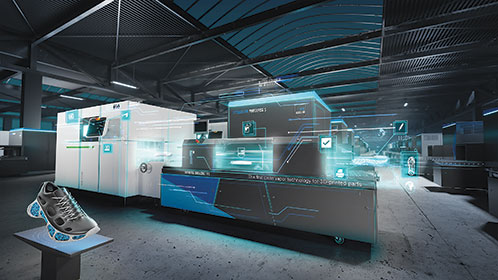
One highlight is the partnership with EOS and DyeMansion. Together, the three companies will present the first virtual additive manufacturing reference factory for selective laser sintering with polymers. Using the example of a midsole for footwear applications in which parameters such as design, fit and colour are individually and economically taken into account, Siemens, EOS and DyeMansion will demonstrate what the next step towards the industrialisation of selective laser sintering with polymers can look like along the entire production chain.
“The automated chain of coordinated production steps from all suppliers, from design and printing to post-processing, as well as end-to-end IT integration, is crucial for high productivity and maximum flexibility. This applies to series parts as well as to a highly flexible lot-size-1 production for individualised products or spare parts,” explains Dr Karsten Heuser, vice president of additive manufacturing at Siemens Digital Industries. “With end-to-end digitalisation and automation solutions from Siemens, we have succeeded, together with our partners, in creating a seamlessly integrated end-to-end value chain for industrial additive manufacturing with selective laser sintering and industrial post-processing solutions using polymers.”
For volume production, the EOS P 500, which can be seamlessly integrated into an automated production line, is being used within this cooperation. Markus Glasser, senior vice president for EMEA at EOS, explains: “Our EOS P 500 manufacturing platform is ideally suited for laser-sintering of plastic parts on an industrial scale. One of the key advantages is the extensive automation capability for comprehensive productivity while maintaining consistently high part quality. This ensures economical component costs and allows the production of additive-manufactured components, even overnight.”
For small, highly flexible AM factory cells, the FORMIGA P 110 systems are being used, which can now also access the Siemens NX design tools directly, thanks to the EOSPRINT integration. With the NX design tools, users can design complex lattice structures and, using the example of the footwear application, simulate the digital twin of the created midsole in action on the people who wear it. Starting in December, NX will allow the seamless integration of arbitrarily complex shapes and structures into the design process using mathematical equations in order to make even greater use of the advantages of additive manufacturing for product design.
When it comes to post-processing, DyeMansion’s coordinated three-step print-to-product workflow allows scaling from prototyping or small series production to additive series production. The integrated Siemens automation can be implemented in industrial shop-floor IT and offers optimised maintenance and operator handling. Felix Ewald, CEO and co-founder of DyeMansion, says: “Bringing the manufacturing technology of the future to series production level together with Siemens and EOS is a major task that we are proud to have accomplished. Digitally integrated, automated and with the clear goal of providing solutions at the highest industrial level, we are united on this path. When three market leaders in their field join forces and take on a pioneering role together, it is not only a strong signal for international industry, but also for Germany as a business location.”
With its Digital Enterprise Portfolio, Siemens offers the full use of digital twins, which reflect the real world for technology providers and users, to ensure that a component is manufactured right the first time it is printed. Based on the digital twin, a flexible and scalable manufacturing concept is being developed and validated that meets the productivity and cost requirements of traditional mass production, even before production starts. Siemens will present the first virtual additive manufacturing reference factory for selective laser sintering with EOS and DyeMansion at its virtual Siemens Additive Manufacturing Summit @ Formnext Connect. With the virtual reference factory, Siemens is also simultaneously expanding its digital Additive Manufacturing Experience Centre and opening it with the beginning of Formnext Connect. In 2021, Siemens also plans to install the key processes along the value chain of this use case in its physical Additive Manufacturing Experience Centre, in order to further accelerate the industrialisation of additive manufacturing.
| Tel: | +27 11 652 2000 |
| Fax: | 086 506 6149 |
| Email: | [email protected] |
| www: | www.siemens.co.za |
| Articles: | More information and articles about Siemens South Africa |






© Technews Publishing (Pty) Ltd | All Rights Reserved

 printer friendly version