



The phrase ‘lights-out factory’ is generally presented as something for manufacturers to aspire to. But is the concept – which essentially means manufacturing without humans – a realistic goal? The idea is finding traction in situations where a lack of human interaction is a benefit. This includes applications with a risk of contamination, such as food processing or specialist electronic component manufacturing. It also includes sectors where product margins are higher, such as pharmaceutical production – where a return on investment is more achievable.
However the 100% automated, fully lights-out factory is not a realistic goal for a large proportion of manufacturing businesses currently operating. A key reason is that manufacturing needs people. Human flexibility is still the best match to undertake complex processes – for example, where improvisation or complicated decision making is required to react to an unexpected event.
For example, in a bottle filling line if a bottle jams, it is easy for a human to rectify, but an automatic line would have difficulty dealing with this.
It is not practical to automate the last 10% of a production facility to achieve the fully lights-out factory. A critical step for manufacturers is to identify to what extent and in which areas automation will offer them the best return on investment. Omron, for example, has a dedicated proof of concept laboratory in Milton Keynes and other high-tech facilities available across the globe. These sites are used to construct a prototype system to offer a physical demonstration as part of the proof of concept process.
Machine vision is a great example. The development of 3D vision systems means that more complex pick-and-place operations are now feasible. Where previously items needed to be carefully presented to pick-and place systems, vision technology can now readily identify objects randomly positioned in transport bins.
A fundamental enabler of the automated factory and critical to any lights-out projects is robot technology. The movement of materials, sub-assemblies and other items around and within the production process − intra-logistics − is a key consideration. Instead of using forklift trucks, mobile robots can automate these tasks, managed by a supervisory control system that ensures materials are delivered to machines, that work in progress is transferred between production systems and that finished goods are taken back to the warehouse. Mobile robots can carry significant loads and work seamlessly with each other and humans in the same space.
For automating traditionally human-operated tasks, where a degree of dexterity is required, cobots are a good solution. They can also be a valuable addition to the lights-out scenario. Cobots are designed to carry out more complex tasks, so they lend themselves to replacing manual assembly or processing tasks. They are simple to program compared to traditional industrial robots. In a high mix environment with many products and tasks, the cost of reprogramming an industrial robot can outweigh its viability. A cobot is simple to redeploy for different tasks, which is a particular advantage in high product mix scenarios.
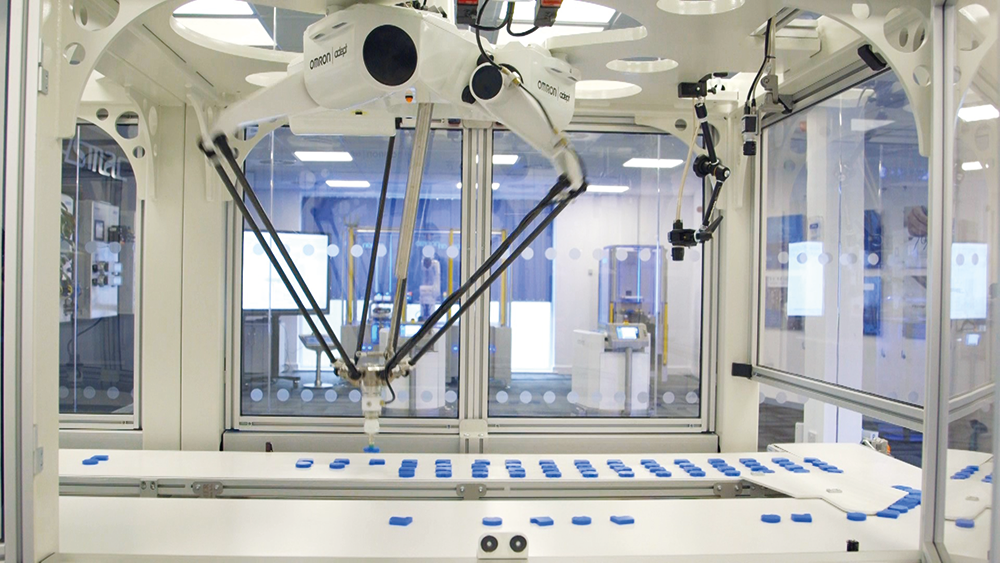
Where high speed repeatability is the goal, industrial robots such as delta robots are ideal. Here advances in tooling are opening new applications. An example is the automated packing of fruit. This is challenging due to the need for delicate handling. But developments in gripper designs have made automating soft fruit packing with industrial robots a practical option.
Recent developments in robotics have identified innovative ways of deploying the technology. Omron’s MoMa is a hybrid concept that combines a mobile robot, a cobot and a vision system, opening a whole new range of possible functions. The combination of mobility and dexterity means that tasks previously hard to automate – like dealing with a bottle in a jam bottle filling line – are much easier to tackle, taking a step closer to the lights-out factory.
The factory of the future
Will a lights-out factory be the norm in the future? While a rarity today, as automation technology continues to advance, fully lights-out operation will become more viable for a growing number of manufacturers in the years to come. What is important is that manufacturers fully understand where automation can best deliver value to their business today. And this is something that technology vendors and systems integrators are well equipped to support.
| Tel: | +27 11 579 2600 |
| Email: | [email protected] |
| www: | www.industrial.omron.co.za |
| Articles: | More information and articles about Omron Electronics |






© Technews Publishing (Pty) Ltd | All Rights Reserved

 printer friendly version