



The power usage of motors used in machinery totals 40 to 50% of the world’s electricity consumption, making these industry-essential devices a key energy reduction target. The market is seeing a proliferation of industrial motors claiming to offer improved energy efficiency. The latest inverter motors are also contributing to lower power consumption, as they adjust their rotational speed according to operating conditions. Furthermore, demand is ramping up for new-generation servo motors, which typically find use in industrial robots as they can rotate forwards and backwards for accurate positioning. These three motor types (high-efficiency, inverter and servo) all rely on one common component to help maximise performance and minimise energy consumption: bearings.
Worldwide endeavours to reduce power consumption have led to regulations requiring motor efficiency improvements. A motor’s energy loss comprises three factors: iron loss (heat generation from the iron core); copper loss (heat generation from the winding); and mechanical loss (due to bearing rotation, for instance). Although mechanical loss can be as small as 1% of motor power consumption, it accounts for 0,4 to 0,5% of global electricity use, which means the worldwide impact of any reduction is significant.
Low-torque bearings for high-efficiency motors
NSK evaluated mechanical loss from bearings using high efficiency motors. In a two-pole high-efficiency motor running at 3000 rpm, the cause of 80% of mechanical loss was lubrication resistance. Optimising the grease quantity reduced mechanical loss by 60% in comparison with conventional bearings. The low-torque bearing developed by NSK uses special grease, increasing seizure life more than 2,7 times; and NSK’s specially developed plastic cage reduces mechanical loss to half that of steel cages because the plastic cage supresses grease agitation resistance between the cage and balls.
Ceramic-coated bearings for inverter motors
Inverter motors are useful for delivering energy savings in pumps and blowers. The trend is to increase the frequency requiring control (known as the carrier frequency) so that the motor can operate with a higher degree of accuracy. However, as the carrier frequency increases, electrolytic corrosion may occur due to high-frequency current in the bearing. Here sparks generate through the lubricating oil film between the raceway surface and rolling elements, causing local melting and unevenness. This effect also leads to abnormal running noise and seizure.
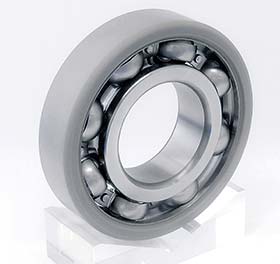
Some bearings for small motors feature ceramic balls that do not pass a current, to protect against electrolytic corrosion, but there are productivity issues with larger diameter ceramic balls required for medium and large inverter motors. To remediate this, NSK has developed an anti-electrolytic-corrosion, ceramic-coated bearing specifically for use in these inverter motors. The newly developed bearing exhibits excellent electrical insulation, with DC tests showing ten times more insulation than general ceramic-coated bearings. The NSK bearing demonstrates equivalent insulation with an AC power supply, satisfying an impedance of 100 Ω or more at 1 MHz frequency.
In terms of mechanical performance, the impact resistance of the coating is three times that of a general ceramic-coated bearing. Heat dissipation, which is a disadvantage of ceramic coatings, is suppressible using a relatively dense coating compared to that used on conventional bearings, extending both lubricant life and motor life. In tests, the temperature rise during bearing rotation was about 10°C lower than that exhibited by a general ceramic-coated bearing. The dense coating also means fewer voids and better durability.
Low particle emission bearings for servo motors
The precise positioning capability of a servo motor derives from transmitting or reflecting the LED’s light emission signal in the pattern engraved on the encoder plate, and feeding the received signal back to the motor controller. Contaminating the encoder plate’s surface with oil or other matter disables the signal reception and feedback of the position information to the motor controller, preventing regular operation.
In a servo motor for a robot, it is necessary to stop the arm and workpiece via an electromagnetic brake. Contaminating the brake plate with oil or other material causes brake slippage. Servo motors used in industrial robots and cobots must be highly reliable, so bearings should exhibit low particle emission to avoid contaminating the encoders or brakes. NSK has developed a bearing for servo motors that uses a low particle emission grease with optimised composition. The bearing provides excellent contamination protection.
The scattering of grease contamination decreases when using bearings with a non-contact seal and low emission. Furthermore, bearings with LGU grease and the light-contact DW seal show hardly any grease scattering – an effective countermeasure against encoder corrosion.






© Technews Publishing (Pty) Ltd | All Rights Reserved

 printer friendly version