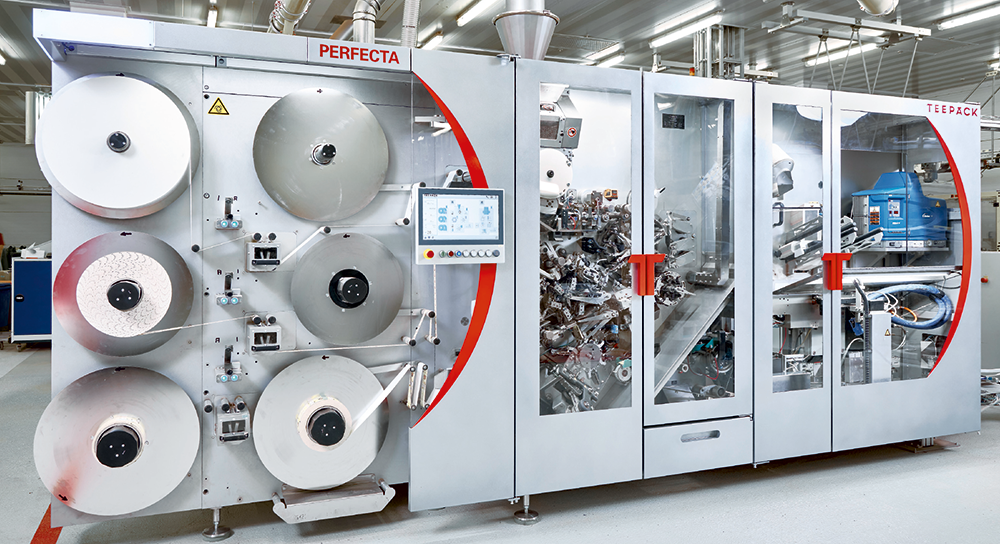


Did you ever stop and think about how tea gets into those tiny bags, or how the leaves stay inside when brewed? Teepack has been doing exactly that since 1948. The name says it all: Up to 450 teabags per minute are filled, folded and sealed with the utmost precision by this top model from the Meerbusch-based manufacturer of teabag packaging and form-fill-seal machines. “It’s important to bear in mind that absolute speed is by no means the only way to measure things,” says Franz Andel, head of automation technology at Teepack. For Andel and his colleagues, it is vital that the teabag packaging machines always produce flawless tea bags. This calls for a great deal of process expertise and precise automation technology.
The production process itself is already tricky enough, and this is compounded by the fact that the filter paper used for the tea bags has to be as thin as possible. “In addition to an accelerated machine cycle and lower energy consumption, we also need minimal material usage,” Andel explains, outlining an important market requirement. “The thinner the filter paper, the more sensitive it is to fluctuations in tension as a result of different web speeds in the individual production areas,” adds Sascha Theine, who is responsible for hardware and software development at Teepack.
Motion control replaces mechanical cam plate
The higher speed and precision compared to the previous model stems from switching to an electronic coupling of the main axes via servomotors and software. “Previously, we had the main process mechanically linked via cam plates,” recalls Andel. In the Perfecta 450, this is now handled by the AX8000 multi-axis servo system and AM8000 servomotors, in conjunction with TwinCAT NC I. “The web tension control implemented with Beckhoff technology across all drive axes prevents the filter paper from tearing – even with dynamic speed changes,” says Theine. Where previously the filter paper transport was rigidly coupled to the main movement, for example, the motion sequence is now controlled by two separate servo drives. “This allows us to vary the paper length of a teabag, for example, and also to adjust the speed in relation to the other drives,” notes Andel.
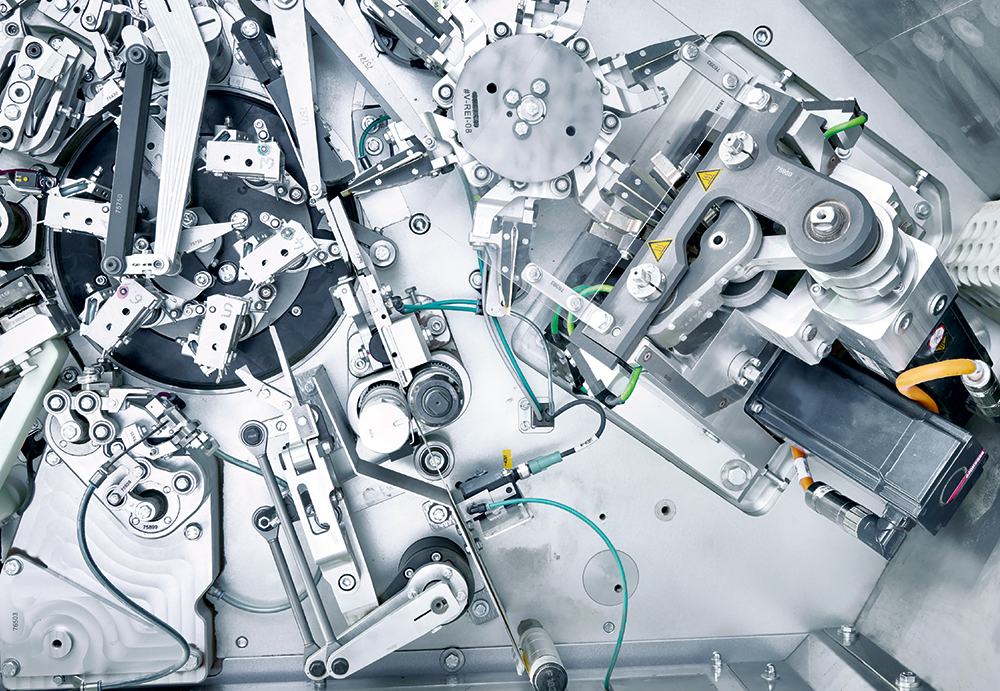
With up to 450 teabags being processed per minute, the actual process is no longer visible to the naked eye: The filter paper is drawn in from the feed unit and passes under the dosing station. Here, the tea is fed from the top and distributed via a dosing station with various dosing chambers on the filter paper. Teepack is renowned for the unmistakable shape of its tea bags: “We were the ones who invented the double-chamber principle,” Andel points out.
More surface area, more taste
In contrast to simple teabags, the tea in double-chamber bags is steeped from four sides, allowing it to release its aroma into the water better on account of the larger surface area. Experts have even recorded up to 30% more flavour for the same brewing time.
Once the portioning phase is complete, the filter paper is folded to form the double-chamber teabag, which is performed exclusively by means of mechanical forming and folding in the downstream station. This is also where the thread is fed and knotted through the bag. “We manage the whole process without the need for metal clamps,” says Andel. The individual teabags are then lined up and packed in the packaging cartons that have already been set up and glued in the Perfecta 450. This not only saves valuable space in production, but also increases process reliability, as the tea packs are already sealed when they are discharged via a conveyor belt.
The software-based axis synchronisation also increases flexibility in development and reduces the effort required for finetuning the motion sequence. Previously, the process involved calculating, milling and hardening a cam plate, which typically took three weeks. “Today, kinematics experts can calculate such a curve in two days, and give us a table that is loaded into the servo drives in two minutes,” reveals Theine. “This means we have to wait only two days to find out whether the motion sequence fits, and where readjustments could still be made.” Andel also notes, “We get results much faster and can optimise our processes much better than before. And with a performance increase of up to 20%, this optimisation is clear to see.”
More time for application creation
The Perfecta 450 is the first machine generation to be implemented completely with the Beckhoff platform. Teepack was looking for a supplier that could offer the entire portfolio of components: PLC, safety, motion including IPC technology, and an operator panel. Andel comments, “Before Beckhoff, we were 60% concerned with the automation system and only 40% with the application. Now, we can devote 98% of our time to the application. This is also due to the excellent support, which even extends to the development department if necessary. What’s more, application experts from Beckhoff can also provide support with the implementation and selection of suitable components and systems as required.”
“Since the beginning of the cooperation, our specialists have provided support in all technical areas for the implementation and optimisation of customer concepts,” explains Wilm Schadach, manager of the Beckhoff branch in Monheim.
In the Perfecta 450, all applications – from the control and synchronisation of all servo drives, safety and HMI, through to data acquisition and database application for monitoring – run on a single CX2043 Embedded PC with a multi-core CPU (AMD RyzenTM with four cores and a 3,35 GHz system clock). “The ability to still be able to run an HMI and a database along with the demanding motion control application without compromising real-time capability is not something we take for granted,” emphasises Schadach. In the maximum configuration, up to 30 AM8000 servomotors are controlled via the AX8000 multi-axis servo system or via the servomotor terminals in the ELM72xx series. As for the safety technology, this is system integrated with TwinSAFE. The entire TwinCAT automation project and the HMI can be flexibly assembled according to the selected machine configuration.
“Flexibility in project planning was a key objective when selecting our automation platform,” says Theine. Teepack can scale the hardware to match the machine configuration, without having to change the control platform. The benefits of compact automation technology are often underestimated. “Control cabinet volume is a big issue with packaging machines, and we’re actually always short on space,” says Theine. This is where the AX8000 multi-axis servo system and the compact ELM72xx drive technology, in combination with OCT connection technology, provide significant relief in the control cabinet and during assembly. Wilm Schadach confirms these advantages, “Over 90% of our drives are now supplied with Beckhoff’s One Cable Technology.”
Bursting with ideas for the next expansion stage
Further relief for crowded control cabinets can be expected from the distributed drives in the AMP8000 series with integrated servo amplifiers. The head of automation technology also sees the potential for further innovations based on Beckhoff technologies in the case of the carton erector. “XPlanar offers a host of different approaches as far as the different packaging formats are concerned.” With the free-floating movers, the cartons could be moved flexibly in front of the glue nozzle to apply individual glue dots, for example. This would simplify the mechanical structure of the gluing station significantly and also reduce the effort required for the heating station.
Ideas for the next Perfecta generation include the use of an image processing system for inline quality control. “Integrated into the system and coupled with the machine cycle in real-time via EtherCAT, Beckhoff Vision is an ideal fit, especially since the system does not take up any additional space in the control cabinet,” says Schadach. TwinCAT Analytics and TwinCAT Scope are also part of the concrete considerations for the next expansion stage. The plan is to collect additional operating data for machine status and key performance indicators. Andel is thinking of aspects such as motor temperatures, motor currents and torques. “We want to use the correlations to determine knowledge about wear and tear so that we can trigger preventive maintenance if necessary.”
| Tel: | +27 11 795 2898 |
| Fax: | 086 603 6868 |
| Email: | [email protected] |
| www: | www.beckhoff.com |
| Articles: | More information and articles about Beckhoff Automation |






© Technews Publishing (Pty) Ltd | All Rights Reserved

 printer friendly version