As a long-established importer and manufacturer of air dryers, Artic Dryers often sees the results of poor installation and issues with aftercoolers that create serious problems in air drying systems.
With any air dryer, the removal of liquid condensates before the inlet to the dryer is vital. With refrigeration dryers, liquids entering the dryer impose an extra heat load on the dryer’s refrigeration system. This wastes energy, as the freon system is designed to condense water vapour into a liquid. If we allow liquid condensates into the dryer at its inlet, the system is now working to condense water vapour into a liquid, and also cooling down actual liquid water to a temperature of 3°C.
This creates a problem in the main air-to-freon exchanger, and also in the condensate drain system. They are being forced to handle more actual liquid content than the dryer and its drain were designed for. This can lead to liquids being entrained in the air flow and pushed into the compressed air system. This automatically leads to a higher dewpoint, resulting in wet compressed air in the plant’s distribution system.
What is an aftercooler?
An air compressor’s aftercooler is the integral first stage in the air treatment system. It is essentially a radiator with hot compressed air inside the tube stack. This has a fan to push colder atmospheric air over the radiator to cool the hot compressed air in the radiator. This cooling process can condense up to 70% of the water vapour that is pulled in by the air compressor from atmosphere, and compress it to 7 bar for your factory. The aftercooler is supposed to eject this condensed liquid to waste via an attached water separator and autodrain system.
This partially dried air leaving the aftercooler can be now allowed to enter the prefilter and air dryer for further treatment. If the aftercooler is not fitted, or a water separator is missing (or not supplied by the OEM) or the drain has malfunctioned, there will be a liquid water overload in the air dryer, leading to wet compressed air.
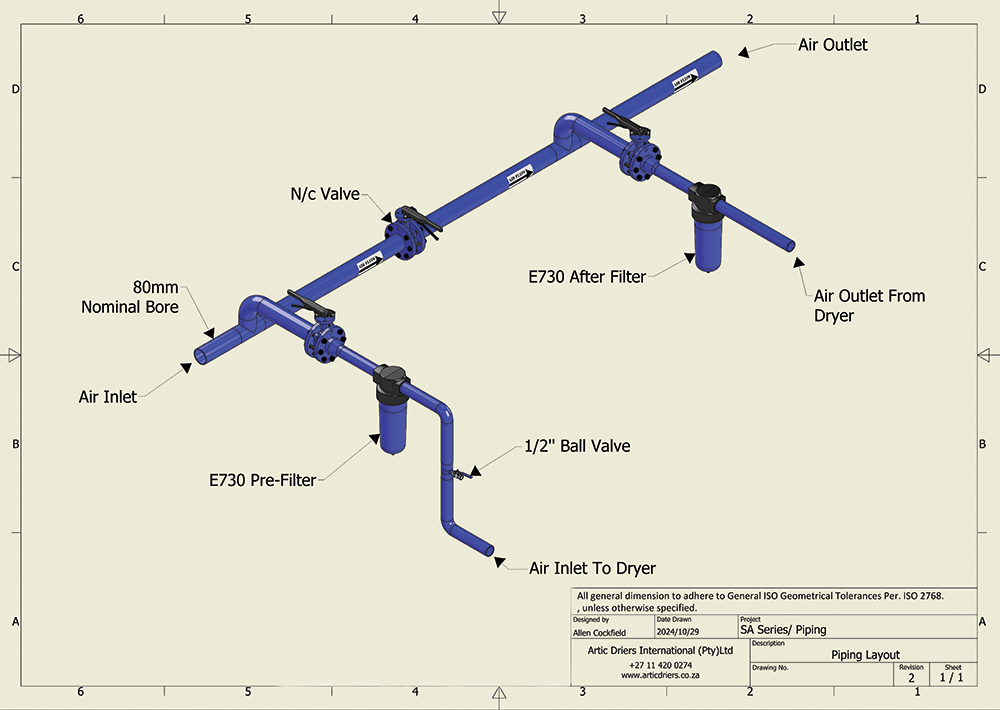
Inline air filters are not designed for bulk liquid removal; they are installed to coalesce compressor oils and trap airborne particles and debris. Poor piping installations can also add to bulk liquid contamination. The correct layout is shown below. Inlet and outlets, valves and filters should be located at the highest points.
Compressor aftercooler and filter drains must be function checked daily. The installation of a low-cost dewpoint monitor S305 from Artic’s Suto iTEC range is a good protection against compressed air system contamination. A high dewpoint alarm tells operators that a fault on a drain valve, a failure, or a trip condition of a dryer has occurred.
The same issues of bulk water contamination, aftercooler, and piping issues can also be applied to heatless twin tower chemical air dryers.
From the editor's desk: A new era Technews Publishing
Editor's Choice
After fifteen years as editor of Motion Control, the time has come for me to hand over to Andrew Seldon. It has been a privilege to be part of this publication and to witness not only the remarkable advances in motion control, fluid power and automation, but also the enormous changes in the world around us.
Read more...OMRON Robotics demos next-generation autonomous mobile robots
Editor's Choice News & events Robotics & Mechatronics
Advancing smarter material flow with the all-new LD-150 and LD-300 AMRs, OMRON Robotics demonstrated the next generation of its flagship LD series autonomous mobile robots (AMRs) at Automate 2026 in June.
Read more...The hidden heroes who shape Africa’s industrial future Bosch Rexroth Africa
Editor's Choice News & events
Behind every industrial success story, there’s a human one. Their names may never appear on a project signboard or in a headline. Yet their expertise and determination keep industries moving every day.
Read more...Bühler Southern Africa leads industry dialogue on apprenticeships
Editor's Choice News & events
Bühler Southern Africa brought together representatives from industry, government and international organisations on 30 June 2026 to explore how quality apprenticeships can help bridge the gap between high youth unemployment and industry demand for skilled technical workers.
Read more...Why lubrication fails in mining and what to do about it
Editor's Choice Electrical switching & drive systems & components
Lubrication Engineers explains the recurring failure points behind mining lubrication problems and how the right product, storage and application practices can improve equipment reliability.
Read more...Solving common automation challenges with Festo’s servo drive and servo motor solutions Festo
Editor's Choice Electrical switching & drive systems & components
Automation projects face challenges that include limited installation space, the need for precise and repeatable linear motion, rising cycle-speed demands, and seamless integration with existing control architectures. Festo’s servo portfolio directly addresses these issues with compact, modular drive and motor solutions designed for specific applications.
Read more...Inside the Giant Magellan Telescope with mechanical engineering at astronomical scale
Editor's Choice Electrical switching & drive systems & components
Construction of the Giant Magellan Telescope, set to become the world’s largest Gregorian optical infrared telescope, is well underway. While its scientific mission is to transform astronomy, its performance depends heavily on advanced mechanical, hydraulic and pneumatic engineering.
Read more...Jendamark catalyst shrinking technology leverages SEW-EURODRIVE precision SEW-EURODRIVE
Editor's Choice Electrical switching & drive systems & components
Innovative technology for shrinking catalytic converters, designed and built in South Africa by Jendamark Automation for the global market, relies on the precision of SEW-EURODRIVE’s highly dynamic servo-geared units and software.
Read more...Motion control for flight simulators Beckhoff Automation
Editor's Choice Electrical switching & drive systems & components
Turkish specialist, SANLAB is a leader in motion platforms and simulation technologies. At the heart of these platforms are application-specific servo drives, servomotors and industrial PCs for real-time control, which are supplied by Beckhoff.
Read more...PC-based control for additive machine tools Beckhoff Automation
Editor's Choice Electrical switching & drive systems & components
IRPD is a specialist in additive machine tools. Development is heavily focused on high system throughput and consistently high process quality. This goal was achieved with the help of PC- and EtherCAT-based control and drive technology from Beckhoff.
While every effort has been made to ensure the accuracy of the information contained herein, the publisher and its agents cannot be held responsible for any errors contained, or any loss incurred as a result. Articles published do not necessarily reflect the views of the publishers. The editor reserves the right to alter or cut copy. Articles submitted are deemed to have been cleared for publication. Advertisements and company contact details are published as provided by the advertiser. Technews Publishing (Pty) Ltd cannot be held responsible for the accuracy or veracity of supplied material.









 printer friendly version