

Achieving the shortest possible inspection times, even when working with different components, is paramount when it comes to series production. This is precisely what special machine builder, stoba Sondermaschinen set out to achieve with its InspectorONE optical inspection system, which is based on deep learning and features the Beckhoff XPlanar planar motor system at the conveyor system core. The system allows automotive suppliers to achieve extremely short cycle times of just three seconds when inspecting high-pressure injection valves, for example, and so inspect around six million parts per year in three-shift operation.
stoba sets itself apart through its expertise in the field of automated production. This expertise is built on extensive experience in laser material processing, requiring high level precision and the optimal combination of automation, laser technology and optical test systems. The result is the InspectorONE test system, a self-learning machine for the visual inspection of all kinds of components and products.
Modularity is also a crucial factor here. Laser technology expert, Simon Mohr explains: “Depending on the application and testing process, the system includes not only different types of stations, but also different numbers of stations, such as camera systems for surface inspection, and measurement technology for component measurement or code readers. This can be defined on a modular basis according to requirements, just as Beckhoff’s XPlanar as the central handling unit can be optimally adapted via the respective number of tiles and movers.”
Quick and error-free testing
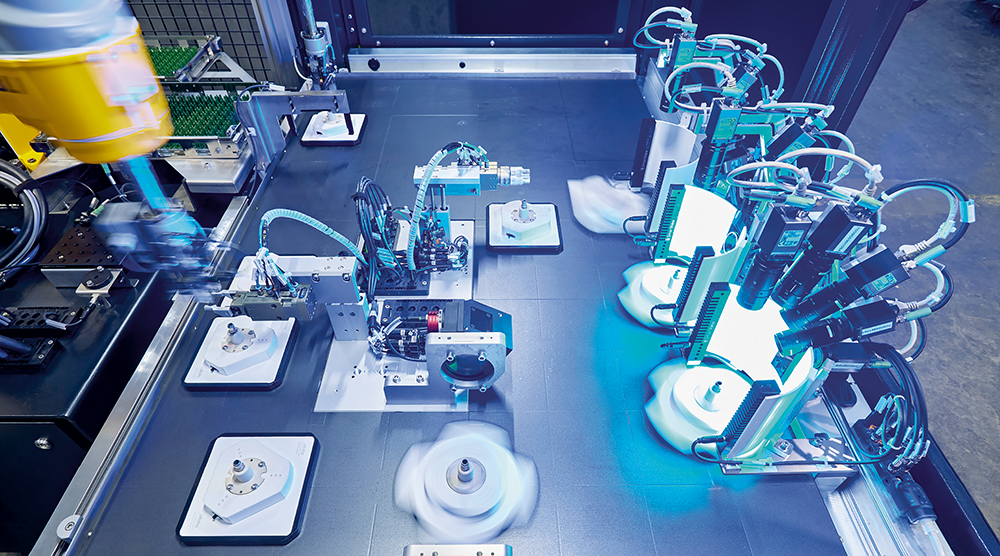
The system currently being implemented is an optical testing machine for high-pressure injection valves, which has been specially configured for an automotive supplier. It is loaded and unloaded via robots and integrated directly into the end customer’s production line. XPlanar forms the conveyor technology basis for product transport, with the floating movers moving the components to the various camera and measuring stations. This allows incredibly short inspection times to be achieved for different components.
Equipped with cameras and deep-learning software, the system operates quickly, automatically and with continuously improving capabilities such as scanning components and detecting features or anomalies. Functional examples include parts inspection with 360° rotation, simultaneous inspection of different components on one machine, and detection of surface defects, contamination, and particles in liquids or air bubbles in the material.
XPlanar for speed and flexibility
The XPlanar movers not only transport the components to the individual inspection stations, but they also optimise the process flow due to the many degrees of freedom in movement. For example, the rotation of the mover simplifies and accelerates component measurement from all sides. Mohr explains: “XPlanar enables short cycle times, which would be difficult to achieve, even with a rotary indexing machine. It is also an extremely flexible and easily customisable modular system. The floating movers represent wear- and abrasion-free conveyor technology, which makes them ideal for use in clean rooms. This would not have been feasible with linear guides or rotary indexing machines.”
According to Michael Berkner, sales expert for laser technology, alternative concepts such as a rotary indexing machines would require significantly more mechanical design, which XPlanar replaces with its high level of software functionality. Although it is also possible to measure several parts at the same time in a rotary indexing machine, it would be necessary to couple corresponding rotational axes to implement rotational inspection. This would make it impossible to achieve the required inspection time of three seconds while trying to accommodate this kind of coupling and subsequent decoupling. With XPlanar, this can be achieved simply using software functionality for 360° rotation.
Software functionality increases adaptability
Mohr also sees the high software functionality of XPlanar as a major advantage with regard to the adaptability of the test system to changing requirements. “If you consider the long service life of the system and the different product life cycles, replacing mechanics with the software functionality of XPlanar becomes decisively more important. A flexible system such as InspectorONE can be adapted to new components or changed inspection requirements over many years without much effort by simply replacing or adding the respective inspection stations. As far as the changed product transport goes, it is sufficient to perform updates via software.”
Berkner adds, “This still has great potential for the future. For example, we are looking into component-specific formulas for the motion profiles of the XPlanar movers so that we can test different components batch-by-batch without interrupting the production process. This would simply not be feasible with a mechanical conversion.”
| Tel: | +27 11 795 2898 |
| Fax: | 086 603 6868 |
| Email: | [email protected] |
| www: | www.beckhoff.com |
| Articles: | More information and articles about Beckhoff Automation |






© Technews Publishing (Pty) Ltd | All Rights Reserved

 printer friendly version