


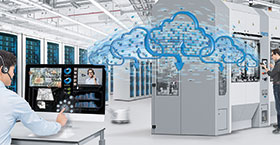
As industry changes amid the drive towards digitalisation, organisations are looking to achieve real business results from their engagement with new technologies. Marketing hype detailing theoretical benefits of an IIoT-enabled future is no longer enough, companies want to see real returns on investments in new technology. Festo, for example, not only implements IIoT functions and services into its product portfolio, but also adds training and consulting, for students as well as professionals, using the latest ideas in its Technology Factory at Scharnhausen, Germany.
Industry 4.0 products
From the mechanics to the cloud, Festo already delivers some real automation technology products for the fourth industrial revolution: integrated drive packages, modular valve terminals with open platform communications (OPC) universal architecture (UA) and IoT gateways, decentralised Codesys controllers and autonomous mechatronic subsystems with IP20 or IP65. In addition, there are IoT driven apps and services, as well as dashboards for products and subsystems.
Festo is able to provide consistent connectivity from the mechanics right up to flexible and multiple cloud concepts. The company has the advantage that it can draw on a wealth of user experience from pilot projects at the Scharnhausen plant. These include energy management and optimisation as well as innovative one-pieceflow concepts based on standardised networking, mobile maintenance with tablets or automated, flexible test systems for individual products.
Big data analytics figure out bottlenecks to reduce cycle time by 15%
The example described below refers to a significant 15% improvement in performance of an assembly line, enabled by big data analytics. It highlights how Festo’s new automation platforms with a direct link to a cloud can be a basic ingredient for success.
A large assembly line was designed for mass production, as well as lot size 1 (current customers demand lot size 200-2000). The volume each year adds up to 1,2 million at a cycle time of 13 seconds. The change of the batches is done by SAP ME/order management, but inside the machine, RFID at each work-station triggers all parameters. Technically, the basics of the assembly line are mechatronic subsystems in all machine cells, which are operated by decentralised control concepts for the electric and pneumatic drives and actuators. All stations provide the data relevant to operate and maintain the line, and are networked with all testing stations and quality systems. Data is processed locally in real-time. All data, from around about 400 IP addresses in total, is gathered, condensed and provided via OPC UA to either support motion control, or for analysis by a PC or a cloud-based solution. Such a concept generates a mass of data, which requires additional skills for the data analytics.
After two years in operation, a first big data analysis was executed and turned out to be highly valuable. Typical patterns could clearly be found and bottlenecks were identified. It was found possible to overcome these and optimise the machine’s cycle time by 15% – from 13 to 11 seconds. The changes made include modifications inside the test cells and their procedures. The work stations now trigger the test cells in advance and thereby save booting and routing time. Other bottlenecks required a more powerful CPU be installed. The value of data made such an optimisation possible without the time wasting associated with guesswork and trial and error approaches. This example shows how to transform measured value into added value with a payback period of less than one year.
Automation solutions for mechatronic subsystems in Industry 4.0 environments
To get all the relevant data out of a machine requires several ingredients. Depending on the production system, it could include integrated drive solutions, electric as well as pneumatic, plus associated sensors, quality inspection, tracking, energy monitoring, connection to logistics and order management. A possible Festo solution is the CPX system, a high-performance control platform for factory automation. It consists of individual function modules that can be used to create a modular, compact and flexible (sub)systems. Depending on the module combination, it can be used as a purely remote I/O system, or as a (centralised or decentralised) control system for factory or process automation.
Festo can thus offer a portfolio for the decentralised automation of sub-systems and small machines/installations with IP20 (CPX-E platform) and IP65 (CPX platform). All are in line with a flexible Industry 4.0 host environment, including the CPX-IOT gateway and the first customised dashboards in the clouds of Festo, Siemens MindSphere or Rockwell FactoryTalk.
For more information contact Ntando Ndokweni, Festo, +27 11 971 5535, [email protected], www.festo.co.za
| Tel: | 08600 FESTO (33786) |
| Fax: | +27 11 974 2157 |
| Email: | [email protected] |
| www: | www.festo.co.za |
| Articles: | More information and articles about Festo |






© Technews Publishing (Pty) Ltd | All Rights Reserved

 printer friendly version