


The properties of hydraulic fluids can have a major impact on the efficiency, performance and life of machines. Mechanical losses at low speed impact the design pressure and displacement requirements of hydraulic machinery. Leakage flow losses at high pressure and temperature impact productivity and cooling requirements. Manufacturers currently use standard chemical laboratory methods to develop new formulations using various polymers, but change is afoot. Now researchers at the University of California, Merced (UC) and the Milwaukee School of Engineering Fluid Power Institute are aiming to understand the interactions of hydraulic fluids at the molecular level through a combination of mechanical testing and molecular modelling. This could lead to the development of more efficient fluid power systems.
Motion Control’s editor caught up with UC Professor of Mechanical Engineering, Ashlie Martini, to find out more about the Simulation, Rheology and Efficiency of Polymer Enhanced Solutions project. “Our goal is to bridge the gap between the fundamental behaviour of polymer-enhanced hydraulic fluids and the performance of complex fluid power systems,” she says. “We aim to understand how polymer structure affects hydraulic power transmission. Specifically, we are trying to connect hydraulic power transmission efficiency to fluid rheology and then rheology to fluid molecular structure in pursuit of formulating more efficient hydraulic fluids.”
Polymer additive structure and chemistry can significantly affect hydraulic efficiency. Increased high temperature viscosity decreases internal pump flow losses under high temperature conditions; reduced traction decreases mechanical losses in pumps at high speeds; and drag reduction reduces pressure drop across valves and through hoses and tubes in the hydraulic circuit.
Two types of mechanical experiments are under way. Firstly, the researchers measure the viscosity of polymer-enhanced hydraulic fluids using a benchtop rheometer. Secondly, they use a dynamometer to measure flow losses (efficiency loss) in a hydraulic system running with these polymer-enhanced fluids. Dynamometer testing assesses the effects of fluid properties on flow and torque losses in an open-loop hydraulic system.
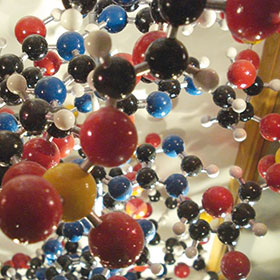
A key element of the research is the use of molecular dynamic simulation (MDS), which can provide insights into the fundamental behaviour of polymers in hydraulic fluids. This is a nanoscale modelling tool that examines the effects of polymer structure on solution viscosity and compressibility at the nano level. It is used to describe how positions, velocities and orientations of molecules change over time and it involves the numerical solution of the classical equations of motion for every atom in a material, giving the position, force and velocity as a function of time. The total force acting on an atom comes from its interaction with other atoms and external fields, and an accurate model to describe atomic interactions is critical in any MDS. It is a computational experiment where a system is defined, allowed to evolve and then observations made based on its evolution. MDS is typically applied in areas like materials science and biochemistry and Martini believes that this is the first time the technique has been used in the fluid power field.
Martini adds that this is the first time a study has attempted to combine molecular scale modelling with hydraulic efficiency measurements in an attempt to quantify the critical connection between the two. The researchers hope to develop a rational basis for the formulation of hydraulic fluids that leads to more efficient hydraulic machinery with reduced friction and leakage flow losses. “We will model the same polymer-enhanced fluids for which we are meas-uring viscosity and flow loss experimentally. However, the simulations will provide molecular scale detail into how those fluids respond to shear and increased temperature. In this way, we hope to be able to explain the experimentally observed trends in terms of the behaviour of the polymers themselves,” she explains.
“Characterising polymer solutions at multiple length scales and using several complementary techniques makes possible a better understanding of the relationship between molecular structure and the behaviour of fluids in hydraulic machines. If we can understand how a polymer additive’s structure and chemistry affect its response to shear and temperature, and then correlate this with hydraulic efficiency, this research can set the foundation for designing polymeric additives that can improve the efficiency of hydraulic components,” she concludes.






© Technews Publishing (Pty) Ltd | All Rights Reserved

 printer friendly version