



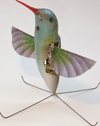
AeroVironment has developed the world’s first fully operational life-size hummingbird-like unmanned aircraft.
This is part of a contract awarded by the Pentagon’s Defense Advanced Research Projects Agency (DARPA) to design and build a prototype unmanned aircraft that flies like a hummingbird for its Nano Air Vehicle (NAV) programme.
Fly like a bird
AeroVironment already has an advanced portfolio of unmanned aircraft systems (UAS). In a technical milestone never before achieved, the Nano Hummingbird has demonstrated controlled precision hovering and fast-forward flight of a two-wing, flapping wing aircraft that carries its own energy source and uses only its flapping wings for propulsion and control. The little flying machine is built to look like a bird for potential use as a mini-spyplane, capable of manoeuvring in spy missions on the battlefield or in urban areas.
Pushing the limitations of aerodynamics, it is capable of climbing and descending vertically, flying sideways left and right, flying forward and backward, as well as rotating clockwise and counter-clockwise. All this is under remote control and carrying a video camera payload. It can also fly in and out of a building through a normal size doorway.
Currently capable of up to 11 minutes of flight, the hand-made prototype aircraft has a wingspan of 16 cm tip-to-tip and a total flying weight of 19 grams, which is less than the weight of a common AA battery. This weight includes all the systems required for flight: batteries, motors, communications systems, and video camera. It is slightly larger than the average hummingbird. The aircraft can be fitted with a removable body fairing, which is shaped to have the appearance of a real hummingbird.
Flight test milestones
The following seven technical goals were set out by DARPA as flight test milestones for the aircraft to achieve. The Nano Hummingbird met all, and exceeded many, of the milestones.
* Demonstrate hover stability in a wind gust flight which requires the aircraft to hover and tolerate a two metre per second wind gust from the side, without drifting downwind more than one metre.
* Demonstrate precision hover flight within a virtual two metre diameter sphere for one minute.
* Demonstrate a continuous hover endurance of eight minutes with no external power source.
* Fly and demonstrate controlled, transition flight from hover to 17 km/hr, fast forward flight, and back to hover flight.
* Demonstrate flying from outdoors to indoors, and back outdoors through a normal size doorway.
* Demonstrate flying indoors ‘heads-down’ where the pilot operates the aircraft only looking at the live video image stream from the aircraft, without looking at or hearing the aircraft directly.
* Fly the aircraft in hover and fast forward flight with bird-shaped body and bird-shaped wings.
Unmanned aircraft systems
UAS have proven their value in the military world. They are also utilised for monitoring borders, pipelines and utility assets or finding those who are lost and in distress. Small UAS can be launched quickly, at any time, to provide precise situational awareness whenever and wherever they are needed.
The Hummingbird is a major departure from existing drones that resemble traditional aircraft, and paves the way for a new generation of aircraft with the agility and appearance of small birds. For now it is a prototype, but 10 years down the track AeroVironment sees the NAV carrying out detailed reconnaissance missions. It has potential use in spy missions and also demonstrates the promise of fielding mini-spy planes. Industry insiders see the technology eventually being capable of flying through open windows or sitting on power lines, capturing audio and video while enemies would be none the wiser.
For more information visit http://www.avinc.com/nano






© Technews Publishing (Pty) Ltd | All Rights Reserved

 printer friendly version