


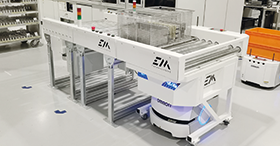
Jaqueline, Chiara and Sepp have been helping Philips Austria in Klagenfurt, Austria, with the internal transport of materials for the past two years. They are very unusual colleagues because they are autonomous mobile robots (AMRs). The migration from manual transport processes to mobile robots is part of a broad modernisation project at Philips with the primary goal of smart manufacturing.
The Philips site in Klagenfurt produces over 23 million linear cutting elements for hair and beard trimmers each year. These beard trimmers use lift-and-trim technology: the beard hair is first lifted with the help of special trimming attachments and then evenly cut off by the double-acting stainless steel blades. The transportation of these cutting elements in the Klagenfurt plant was carried out for many years by machine operators. This was a time-consuming and inefficient process that needed to be automated to free employees for more creative and demanding tasks.
When choosing the right robots, the project team decided on Omron. “The dimensions of the robot had to be small. We also wanted a system without tracks because this takes up less space. In addition, the AMR can easily be linked to SAP, which was another of our requirements. The interfaces were all there,” reports operations manager, Siegfried Seufzer. Further advantages in favour of the Omron robots included their ease-of-use, the relatively high transport speeds and their functional reliability in confined areas. If an AMR ever comes across an employee who is in its way, the robot can warn them. The Omron devices have voice functions similar to those in a navigation system.
The safety of the robots is another aspect that was considered. In an emergency the Omron AMR can drive to a place where it is out of the way of any emergency teams. Today the robots transport 500 to 1000 cutting elements per carrier. Each AMR can carry up to 10 containers; there are 10 000 elements with a total weight of 60 to 70 kg. The robots drive every half hour. A single round trip covers about 400 metres.
There are other positive effects that the project team hadn’t even considered beforehand. For instance, the quality of the transported parts has improved. The flow of material was previously disjointed and this led to product damage on the tightly packed transport trolleys. Now that the flow of material is continuous, more journeys are made, but the items are handled more gently.
Communication takes place not only between the machine and the AMR but also between the AMR and the employee. For safety reasons, departures are announced in advance and the employee is informed about the prevailing situation.Any obstacles can be recognised by the robots at lightning speed and can be avoided by using alternative routes. The coordination of several AMRs, including charging management, is also done autonomously.
In addition to the 3% improvement in the OEE values of the assembly lines, the Philips project team has noticed other positive effects. The company saves up to 500 containers due to the continuous material transport. If the work-in-progress previously took several days, it could be reduced to a few hours by automated continuous material supply.
In the next step, an AMR will be actively integrated into the production process. In addition to transport functions, the mobile robot can also take on the independent activation of systems; the completion of process steps; and the booking of orders via QR codes. Fully automatic booking in the SAP system is also planned. The AMR can communicate independently with the machine.
The AMRs are currently operating the cleaning machine at the Philips plant in Klagenfurt, which removes dirt and grinding dust from the cutting elements. In the future, a combination of the MES system and AMRs is also planned. This means, for example, that if the supply of a material is running low, this can be communicated in advance so the material supply is controlled by the systems.
Business development manager, Jürgen Holzapfel-Epstein concludes: “The use of autonomous mobile robots at Philips Austria is a prime example of how digitisation and automation can be advanced step by step, but still holistically, in the factory of the future.”
| Tel: | +27 11 579 2600 |
| Email: | [email protected] |
| www: | www.industrial.omron.co.za |
| Articles: | More information and articles about Omron Electronics |






© Technews Publishing (Pty) Ltd | All Rights Reserved

 printer friendly version