



Editor's Choice


Robot breaks world record

Second Quarter 2023 Editor's Choice Robotics & Mechatronics

An untethered robot invented at the Oregon State University (OSU) College of Engineering and manufactured by OSU spinout company, Agility Robotics, has established a Guinness World Record for the fastest 100 metres by a bipedal robot. Named Cassie, the robot set a time of 24,73 seconds at an average speed of 4 m/s, starting and finishing the sprint from a standing position, without falling. Unlike a human sprinter, Cassie has bird-type legs with knees that bend backwards. To learn how to sprint, the OSU researchers say the robot’s programming was trained in a week-long simulation that compressed a year’s worth of training experiences by computing numerous calculations simultaneously.
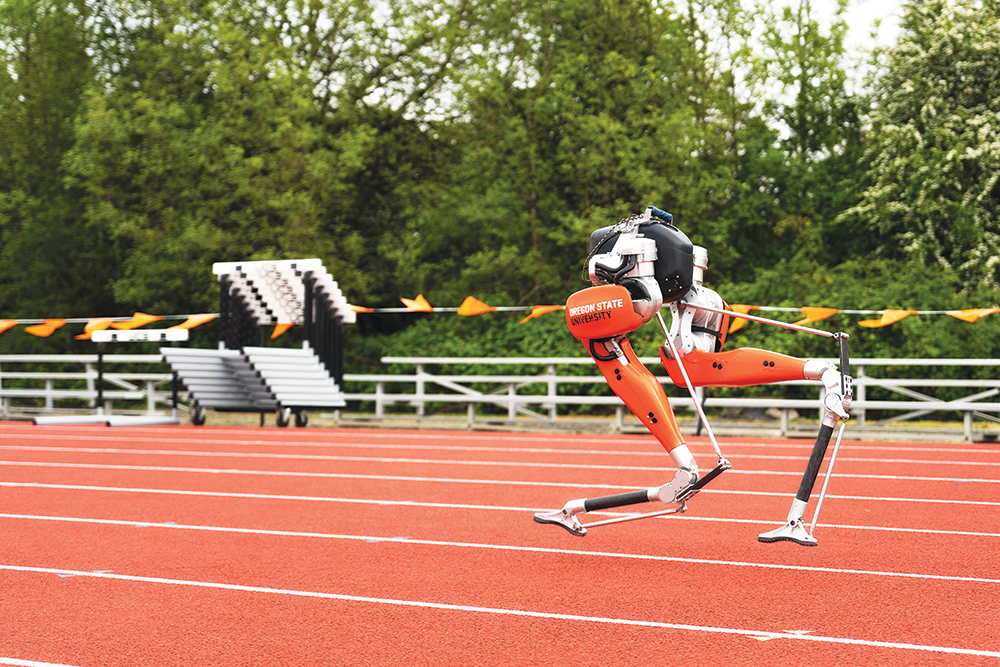
Cassie was developed as a commercial robot with a $1 million grant from DARPA, and has been used by top universities and robotics laboratories in the US as a platform for exploring machine learning. It isn’t the fastest legged robot, but the fastest bipedal. This design has particular advantages in allowing robots to traverse spaces designed for humans. Cassie’s creators say that running wasn’t the hardest part of the challenge, but getting the robot to start and stop. “Starting and stopping in a standing position are more difficult than the running part, similar to how taking off and landing are harder than actually flying a plane,” says OSU professor, Alan Fern.

The feat is especially impressive considering Cassie pulled it off blind, without an onboard camera. Instead, Cassie first learned how to run through a series of sim-to-real training sessions. OSU’s sim-to-real machine learning methods have enabled Cassie to benefit from millions of parallel-processed simulations before deployment. All that preparation ensures the robot is ready for any given task, which can include many variables, both known and unknown. Cassie has already learned how to run, hop, skip and climb stairs.

With just two legs, Cassie’s functions are limited. Agility now uses the bipedal technology developed for Cassie to power its new robot Digit, which is not only capable of walking and climbing stairs, but also has rudimentary arms for picking up and carrying small packages. This next-generation version will include a torso, arms, hands, and a head. Digit will dramatically increase functionality. It will be much more humanoid in both shape and intention.

“The key point is that sim-to-real − which teaches a system to do jobs and tasks, as opposed to traditional programming − applies much more widely than legged robotics,” Fern says. “It’s about creating a simulator where you can practice doing something. It’s a learning program, where the practice of an equivalent of years of experience can take place very fast in a computer, and then allow for the task to be safely completed.”

He explains that this represents a radical departure from the notion of trying to program a set of rules to dictate a desired action. “That’s an approach that doesn’t work, and it isn’t scalable,” he says. “The key is to program computers to learn, and then figure out how to train them. One way is through simulation, although simulation will never be a perfect reflection of the real world. So we always put in random variations to make the simulations more robust.”

As for current challenges, Agility Robotics CTO, Jonathon Hurst says that the biggest hurdle for robots is mastering the ability to navigate their environment. Although many types of robots are already deployed in industry, a human operator is often needed, and the environment is custom-fit. Such an approach won’t work in homes, which are quite different. It would be cost-prohibitive to retrofit a warehouse, let alone a single-family house, specifically for a robot. So, we need robots that can adapt, understand variables, and adjust as needed.

As for where things are headed in workforce applications, Fern envisions a future where robots train to maintain balance through physical tasks that involve variable forces beyond the robot itself, such as carrying loads or pulling carts. He can imagine a team of robots at a construction site under the command of a single operator. As costs come down, he also envisions robots in homes, performing basic tasks. One application could be performing duties to enable older adults to live more independently.

While advancements in the training of robots like Cassie, and soon Digit, have been awe-inspiring as of late, Fern and Hurst hope to see much more progress over the next five to ten years as artificial intelligence comes of age.




Share this article:
Share via emailShare via LinkedInPrint this page

Further reading:

From the editor's desk: A new era
Technews Publishing Editor's Choice
After fifteen years as editor of Motion Control, the time has come for me to hand over to Andrew Seldon. It has been a privilege to be part of this publication and to witness not only the remarkable advances in motion control, fluid power and automation, but also the enormous changes in the world around us.

Read more...
OMRON Robotics demos next-generation autonomous mobile robots
Editor's Choice News & events Robotics & Mechatronics
Advancing smarter material flow with the all-new LD-150 and LD-300 AMRs, OMRON Robotics demonstrated the next generation of its flagship LD series autonomous mobile robots (AMRs) at Automate 2026 in June.

Read more...
The hidden heroes who shape Africa’s industrial future
Bosch Rexroth Africa Editor's Choice News & events
Behind every industrial success story, there’s a human one. Their names may never appear on a project signboard or in a headline. Yet their expertise and determination keep industries moving every day.

Read more...
Bühler Southern Africa leads industry dialogue on apprenticeships
Editor's Choice News & events
Bühler Southern Africa brought together representatives from industry, government and international organisations on 30 June 2026 to explore how quality apprenticeships can help bridge the gap between high youth unemployment and industry demand for skilled technical workers.

Read more...
Why lubrication fails in mining and what to do about it
Editor's Choice Electrical switching & drive systems & components
Lubrication Engineers explains the recurring failure points behind mining lubrication problems and how the right product, storage and application practices can improve equipment reliability.

Read more...
Solving common automation challenges with Festo’s servo drive and servo motor solutions
Festo Editor's Choice Electrical switching & drive systems & components
Automation projects face challenges that include limited installation space, the need for precise and repeatable linear motion, rising cycle-speed demands, and seamless integration with existing control architectures. Festo’s servo portfolio directly addresses these issues with compact, modular drive and motor solutions designed for specific applications.

Read more...
Inside the Giant Magellan Telescope with mechanical engineering at astronomical scale
Editor's Choice Electrical switching & drive systems & components
Construction of the Giant Magellan Telescope, set to become the world’s largest Gregorian optical infrared telescope, is well underway. While its scientific mission is to transform astronomy, its performance depends heavily on advanced mechanical, hydraulic and pneumatic engineering.

Read more...
Jendamark catalyst shrinking technology leverages SEW-EURODRIVE precision
SEW-EURODRIVE Editor's Choice Electrical switching & drive systems & components
Innovative technology for shrinking catalytic converters, designed and built in South Africa by Jendamark Automation for the global market, relies on the precision of SEW-EURODRIVE’s highly dynamic servo-geared units and software.

Read more...
Motion control for flight simulators
Beckhoff Automation Editor's Choice Electrical switching & drive systems & components
Turkish specialist, SANLAB is a leader in motion platforms and simulation technologies. At the heart of these platforms are application-specific servo drives, servomotors and industrial PCs for real-time control, which are supplied by Beckhoff.

Read more...
PC-based control for additive machine tools
Beckhoff Automation Editor's Choice Electrical switching & drive systems & components
IRPD is a specialist in additive machine tools. Development is heavily focused on high system throughput and consistently high process quality. This goal was achieved with the help of PC- and EtherCAT-based control and drive technology from Beckhoff.

Read more...


While every effort has been made to ensure the accuracy of the information contained herein, the publisher and its agents cannot be held responsible for any errors contained, or any loss incurred as a result. Articles published do not necessarily reflect the views of the publishers. The editor reserves the right to alter or cut copy. Articles submitted are deemed to have been cleared for publication. Advertisements and company contact details are published as provided by the advertiser. Technews Publishing (Pty) Ltd cannot be held responsible for the accuracy or veracity of supplied material.


© Technews Publishing (Pty) Ltd | All Rights Reserved