


The world has a data storage problem. There’s an explosion in the volume of data being generated and stored, and it’s rising exponentially. Our reliance on data and, with it, digital storage has never been greater. Data is streaming onto the web from billions of devices. Every click, swipe, like and share contributes to the vast pool of digital information. New technologies like AI, NLP and deep neural networks are compounding this deluge.
All this information needs to be stored somewhere, and the demand for storage is fast exceeding the available supply. The days when a floppy disc, stiffy, CD, hard drive or SSD could store your information are long gone. Nowadays it’s the cloud. But, the cloud is in reality someone else’s computer in a data centre with a finite capacity. The data is eventually archived, mainly on magnetic tape, and this has a limited lifespan. So all the data we have already stored digitally is at risk of being lost in obsolete equipment.
Gartner warns of the ‘digital wall’ that traditional computing technologies will face as early as 2025, and predicts that by 2030 the shortfall in enterprise storage capacity could amount to nearly two thirds of demand.
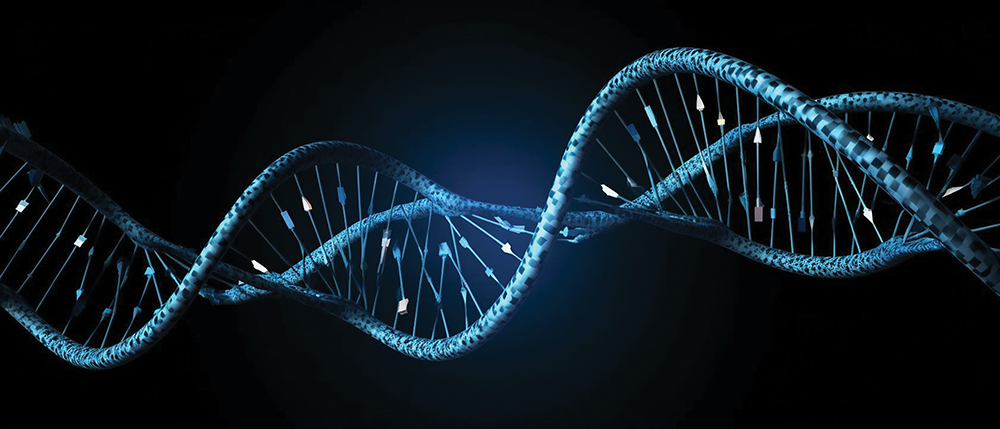
DNA, the molecule of life, encodes the genetic instructions for all living organisms. Its unique properties − compactness, longevity and information density − make it an ideal candidate for data storage. Recent advancements in biotechnology and sinking costs are driving this technology from theory to reality.
Long ago we learned to sequence and synthesise DNA, that is to read and write it. Each position in a single strand of DNA consists of one of four nucleic acids, known as bases, and represented as A, T, G, and C. In DNA storage, digital data that would be stored as 0s and 1s on a hard drive is instead encoded as a 0 or 1 on each of the four bases.
DNA is a high density, durable storage medium. It’s cheap, readily available, and stable at room temperature for millennia. One of its most notable features is its data density. A single gram of DNA is capable of storing billions of gigabytes of data. It has been calculated that all the information on the internet, which one estimate puts at about 120 zettabytes, could be stored in a volume of DNA about the size of a sugar cube (a zettabyte is 270 bytes, or a billion terrabytes).
DNA also has unequalled longevity. While traditional storage media degrade over time, DNA can remain intact for thousands of years. This makes it an ideal candidate for archiving critical information such as historical records or scientific data, ensuring that it remains accessible for future generations. It is also extremely energy-efficient compared to traditional methods. Once information is encoded into DNA molecules, it requires no power to maintain, unlike conventional data centres that consume vast amounts of electricity for cooling.
Of course, there are challenges. Storing information in DNA is easily achievable. The hard part is getting the information into and out of the molecule economically. This is already happening. In 2018, researchers from Microsoft and the University of Washington built the first prototype of a machine that could write, store and read data on DNA.
One hurdle is the cost of synthesising and sequencing DNA. The price for sequencing DNA has dropped from $25 a base in 1990 to less than a millionth of a US cent in 2024, but this is still too high for large-scale adoption. For a DNA drive to compete with today’s archival tape drives, it must be able to write about 2 gigabits per second, which at demonstrated DNA data storage densities is about 2 billion bases per second. But, humans have done this kind of scaling up before. Exponential growth in silicon-based technology is how we wound up producing so much data. Similar exponential growth can make the transition to DNA storage happen.
Looking ahead, the possibilities for DNA storage are limited only by our imagination. It has the potential to revolutionise data centres, shrinking their physical footprint, while vastly increasing storage capacity.
Imagine a world where the entirety of human knowledge fits in the palm of your hand, where information is preserved for millennia, and where data centres are powered by the building blocks of life. This is the promise of DNA storage.






© Technews Publishing (Pty) Ltd | All Rights Reserved

 printer friendly version