When designing a compressed air pipeline, remember that size matters. The internal size of the pipe, along with the pressure and air volume, determine the velocity of the compressed air in the pipeline. The higher the velocity, the higher the pressure drop in the pipe work from the compressor room to the point of use. High-pressure drops increase your energy costs and affect production rates.
What generally happens is that shop floor staff complain about low compressed air pressure. This leads to operators increasing the air compressor’s discharge pressure, which in turn means that for every 1 bar increase in pressure, you are paying an extra 7% on your power bill. The increase in pressure will also increase the discharge temperature and the wear and tear on the compressor, and may also affect the air/oil reclaimer life span.
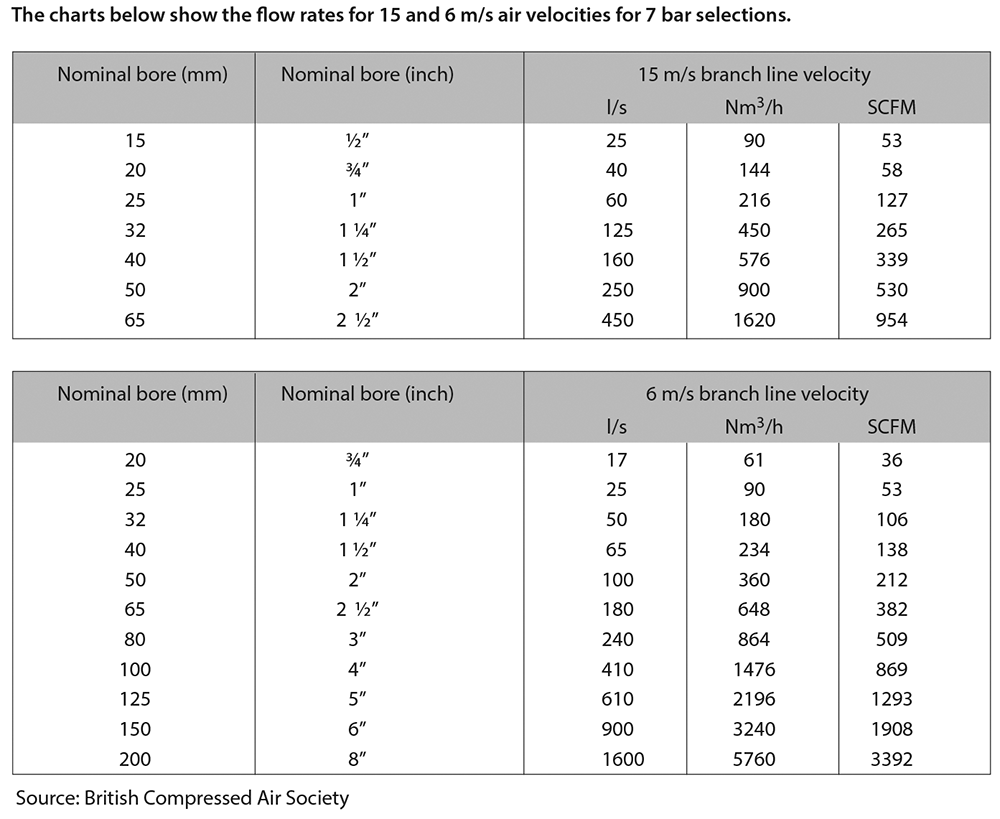
This is when bigger is better. Do not use 15 m/s as a guide for main line sizing. Use the 6 m/s selection guide. These guides are for bar applications, which will change if the pressure is lower or higher. Slower air velocities equate to lower pressure drops. This means better compressor performance and less power wasted. Use the higher speed chart for very short air take-off points only, nothing else.
The charts do not show the pressure drops for valves, bends, tee pieces or flex hoses. These charts are merely a guide – treat them cautiously. The manufacturers of compressors often set a bad example for pipe sizing. We frequently see very small undersized outlets on air compressor packages. This suits the manufacturer as the piping is cheaper and easier to fit into tightly engineered compressor packages.
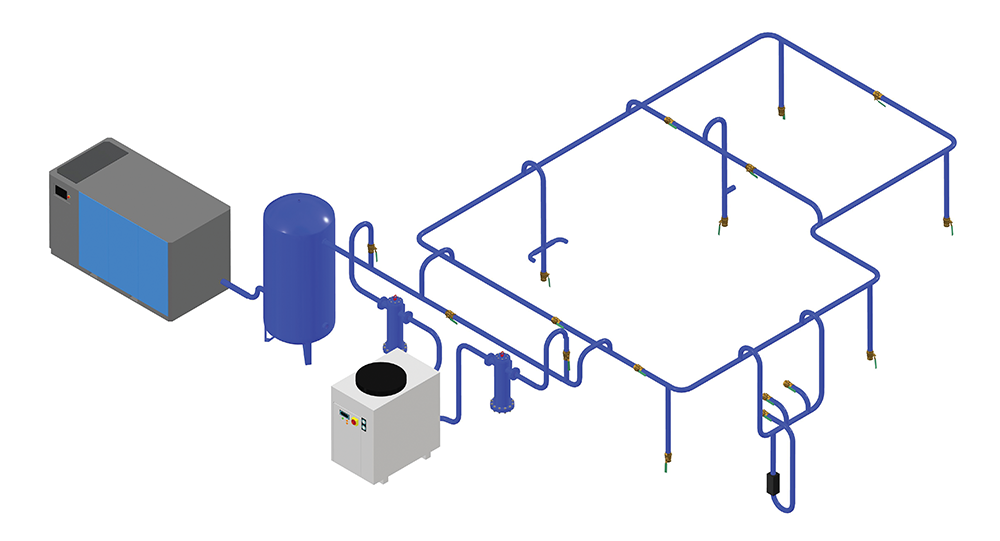
Check the charts above and oversize the piping accordingly, especially in the compressor room. Low speed equates to less back pressure. High velocities and bad pipe design lead to compressors bouncing from load to unload. This is not good for the controls, the filtration system, the air dryer or the compressor system itself.
Use a correctly sized air receiver to act as a buffer between the compressor and its ancillaries, such as dryer and filters. This will reduce your load and offload cycles and improve compressed air quality. High velocities and pressure drops in the compressor room frequently lead to the air compressor fighting for lead position or control. If possible, install a compressor controller where you determine the lead and lag air compressor as it will generally save you a small fortune on energy costs, compressor repairs and maintenance. Lower air speeds also improve compressed air filtration and reduce pressure drops across the filter bank.
Call us for a copy of ‘Compressed Air Piping Design Hints’.
From the editor's desk: A new era Technews Publishing
Editor's Choice
After fifteen years as editor of Motion Control, the time has come for me to hand over to Andrew Seldon. It has been a privilege to be part of this publication and to witness not only the remarkable advances in motion control, fluid power and automation, but also the enormous changes in the world around us.
Read more...OMRON Robotics demos next-generation autonomous mobile robots
Editor's Choice News & events Robotics & Mechatronics
Advancing smarter material flow with the all-new LD-150 and LD-300 AMRs, OMRON Robotics demonstrated the next generation of its flagship LD series autonomous mobile robots (AMRs) at Automate 2026 in June.
Read more...The hidden heroes who shape Africa’s industrial future Bosch Rexroth Africa
Editor's Choice News & events
Behind every industrial success story, there’s a human one. Their names may never appear on a project signboard or in a headline. Yet their expertise and determination keep industries moving every day.
Read more...Bühler Southern Africa leads industry dialogue on apprenticeships
Editor's Choice News & events
Bühler Southern Africa brought together representatives from industry, government and international organisations on 30 June 2026 to explore how quality apprenticeships can help bridge the gap between high youth unemployment and industry demand for skilled technical workers.
Read more...Why lubrication fails in mining and what to do about it
Editor's Choice Electrical switching & drive systems & components
Lubrication Engineers explains the recurring failure points behind mining lubrication problems and how the right product, storage and application practices can improve equipment reliability.
Read more...Solving common automation challenges with Festo’s servo drive and servo motor solutions Festo
Editor's Choice Electrical switching & drive systems & components
Automation projects face challenges that include limited installation space, the need for precise and repeatable linear motion, rising cycle-speed demands, and seamless integration with existing control architectures. Festo’s servo portfolio directly addresses these issues with compact, modular drive and motor solutions designed for specific applications.
Read more...Inside the Giant Magellan Telescope with mechanical engineering at astronomical scale
Editor's Choice Electrical switching & drive systems & components
Construction of the Giant Magellan Telescope, set to become the world’s largest Gregorian optical infrared telescope, is well underway. While its scientific mission is to transform astronomy, its performance depends heavily on advanced mechanical, hydraulic and pneumatic engineering.
Read more...Jendamark catalyst shrinking technology leverages SEW-EURODRIVE precision SEW-EURODRIVE
Editor's Choice Electrical switching & drive systems & components
Innovative technology for shrinking catalytic converters, designed and built in South Africa by Jendamark Automation for the global market, relies on the precision of SEW-EURODRIVE’s highly dynamic servo-geared units and software.
Read more...Motion control for flight simulators Beckhoff Automation
Editor's Choice Electrical switching & drive systems & components
Turkish specialist, SANLAB is a leader in motion platforms and simulation technologies. At the heart of these platforms are application-specific servo drives, servomotors and industrial PCs for real-time control, which are supplied by Beckhoff.
Read more...PC-based control for additive machine tools Beckhoff Automation
Editor's Choice Electrical switching & drive systems & components
IRPD is a specialist in additive machine tools. Development is heavily focused on high system throughput and consistently high process quality. This goal was achieved with the help of PC- and EtherCAT-based control and drive technology from Beckhoff.
While every effort has been made to ensure the accuracy of the information contained herein, the publisher and its agents cannot be held responsible for any errors contained, or any loss incurred as a result. Articles published do not necessarily reflect the views of the publishers. The editor reserves the right to alter or cut copy. Articles submitted are deemed to have been cleared for publication. Advertisements and company contact details are published as provided by the advertiser. Technews Publishing (Pty) Ltd cannot be held responsible for the accuracy or veracity of supplied material.










 printer friendly version