



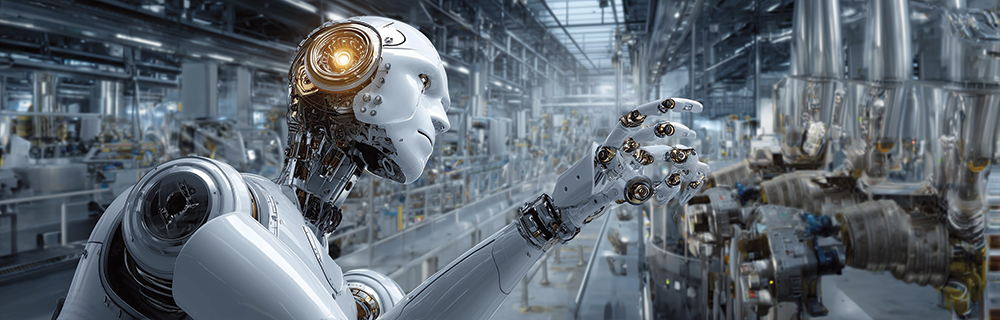
Co-habiting or working alongside robots with humanlike capabilities may no longer be a thing of science fiction. Assembling car parts or doing the weekly shop may be smart tasks for collaborative robots, while with the latest developments in vehicle autonomy, robotaxis, could have independence. IDTechEx provides trusted independent research on emerging technologies and their markets. The company’s research into robotics and autonomy uncovers some of the up-and-coming industrial uses and applications within the sector, including for automotives and logistics, as well as for personal and commercial use.
Robotic independence could be possible with LiDAR and 3D visual systems that allow humanoid robots to perceive their surroundings, and the use of cameras and sensors can allow for continuous awareness. Fitting car parts and completing work in garages can be done using industrial humanoids, which are heavier and more robust. Automating processes within large-scale production, badge labelling, material handling and inspection are all tasks for humanoid robots in manufacturing and logistics and warehousing settings.
Having a robot complete a routine health checkup could be a reality at some point in the future, with non-industrial humanoids carrying out light-duty tasks with lower force requirements. This type of robot could see an increased presence in hospital settings and medical environments to take some of the strain off healthcare systems where understaffing is an issue. IDTechEx’s report, ‘Humanoid Robots 2025-2035: Technologies, Markets and Opportunities’, explores the future market for humanoids and how increased economies of scale could push growth.
Dexterous grips and the presence of AI
The dexterous grip of human hands is starting to be passed on to robots. For example, fruit and vegetables could stay fresh and unsquashed when robot helpers go to do the weekly shop. Soft gripper technology in collaborative robots can ensure nothing delicate is at risk of being crushed, and that things are handled with the tact and sensitivity of a human worker.
Assembling car components and completing quality inspections for semiconductors and batteries will also be popular tasks for collaborative robots. Machine vision and voice recognition enabled by AI will allow them to understand commands and receive direct instruction within a warehouse setting. The use of AI and edge computing will also allow for smart control. The report, ‘Collaborative Robots 2025-2045: Technologies, Players and Markets’, covers IDTechEx’s extensive research into this sector of robotics and the revolutionary technology creating a future of change.
The use of AI in robotics could allow decision-making features, so robots could decide for themselves if the floor needs mopping or it’s time to make dinner upon receiving a cue from humans. Despite currently being somewhat unrealistic, with technologies still developing, this could be achieved in the far future. Within homes and commercial settings, service robots may be employed to reduce the strain on wait staff, or to give parents a helping hand cooking the dinner after a long day of work. IDTechEx’s portfolio of robotics and autonomy research reports explores at length the technologies that suggest a shift towards the wider domestication of different types of robots in the future.
Edge computing will allow for robots to access information about their surroundings and certain tasks. It quite literally brings data and computing abilities nearer to the devices that require services, so information is easily accessible without much latency or noticeable delay. The report ‘AI Chips for Edge Applications 2024-2034: Artificial Intelligence at the Edge’ provides information on the ways edge computing works and the many benefits of its use across a number of applications.
Robotics and AI on the road
Engaging with a built-in, personal AI assistant on the way to work could be one of the perks of software-defined vehicle (SDV) technology. Asking the car to find the nearest service station or coffee shop could be as simple as speaking to a friend as AI can demonstrate natural language capabilities and an awareness of the driver’s needs.
AI features within SDVs could allow for adaptation to individual preferences for a personalised driving experience. The detection of a specific passenger could influence the car to switch to their favourite radio station or podcast, so that cars could become on-the-move robot acquaintances. IDTechEx’s research on SDVs can be found within the latest ‘Software-Defined Vehicles, Connected Cars and AI in Cars 2026-2036: Markets, Trends and Forecasts report.
Commercial robotaxi services also demonstrate the intelligence of robotic technology as autonomy levels up within the automotive industry. Passengers will be able to benefit from journeys from point A to B while experiencing advanced driving software, partaking in what was once thought to be a futuristic experience. IDTechEx’s report, ‘Autonomous Driving Software and AI in Automotive 2026-2046: Technologies, Markets and Players’, covers the extensive use of AI in vehicles and the possibilities it is creating to streamline driving.
For more information, contact IDTechEx,






© Technews Publishing (Pty) Ltd | All Rights Reserved

 printer friendly version