


The direct drive torque motor market has been growing steadily over the last few years. Sales of torque motors are now beginning to affect sectors such as machine tools, semiconductors, flat panel and electronics assembly, all applications traditionally served by geared motor systems. This convergence raises the question: which system should engineers specify? Graham Mackrell, managing director of Harmonic Drive UK, explores the world of direct drive versus electromechanical systems.
According to a recent report by IHS technology, the world market for linear and torque motors has been growing rapidly since 2011 and now boasts revenues in excess of $1,5 billion globally, expected to reach up to $2 billion by 2019. This growth is a direct result of increased demand, particularly in China, for high precision applications including machine tools, semiconductors, flat panel and electronic assembly.
The demand for higher precision, better energy efficiency and a lower part count has seen direct drive torque motors increasingly eat into the geared motor market as engineers continue to replace old geared systems with newer direct drive motors. Despite this, many industrial applications using geared motors have been unaffected by the encroachment of direct drives. Applications that require very high levels of torque, typically over 6000 Nm, or high torque at low speeds, as well as a high gear reduction ratio to control inertia mismatching, are still better served by a geared solution.
Choose your poison
Choosing the right type of drive for your application is determined by variables including size, cost, weight and portability, as well as loading, stiffness, precision and the need to integrate with existing infrastructure like bearings, housings, encoders and couplings.
Fixed applications such as machine tools, packaging, food and beverage as well as large robotics and handling systems may tolerate heavier, less portable drives, but demand high levels of stiffness and precision. On the other hand, portable applications including medical, military, light robotics and aerospace demand lightweight, compact, zero-backlash drives that must deliver absolute precision in extreme environments, from freezing arctic plains to arid deserts and during corrosive marine missions.
Direct drive
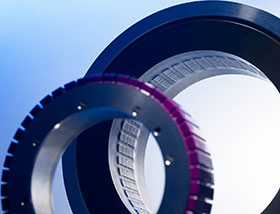
Direct drives, also called torque drives, are systems where the payload is coupled directly to the rotor without the use of a gearbox transmission, belts, pulleys or any other type of mechanical or hydraulic system. The motor itself is a brushless, rare-earth permanent magnet driven rotor with a laminated stator.
This makes the direct drive highly stiff, efficient and precise. Almost no losses are incurred through friction and there is no electrical or mechanical hysteresis – the power loss that typically occurs in a copper wound core, or the loss in accuracy typically experienced when the output shaft of a geared system reaches its torsional rigidity limit when torque is applied under heavy loading.
The low part count and dynamic response exhibited by the torque motor’s magnetic core allows the use of a high resolution encoder – a type of rotary optical sensor – for precise angular positioning of the rotor. The drive is completed with a high performance feedback controller.
So can we expect direct drive torque motors to overtake geared motors in the next five years? Not quite. Torque motors are typically 30-50% more expensive and, on average, three to four times heavier and larger for the motor kit alone, not including the housings, bearings and encoders that may be needed to complete drive installation. Power density per kilogram is still higher on mechanical actuators.
Take a robot arm as an example. An actuator with a combined encoder providing a 600 Nm output typically weighs 11,7 kg with a 180 mm diameter. The equivalent direct drive components alone weigh over 40 kg with a 392 mm diameter. While the added weight and size may not matter on a machine tool, it is critical in a moving robot arm.
Going geared
Whether you call it an electromechanical system, a servo actuator or simply a geared motor, gears have two main benefits over direct drive torque motors. Apart from the ability to move power transmission off-axis, gear motors offer torque multiplication and inertia matching. Geared systems multiply torque by using a gear reduction ratio, this means that a much smaller motor can be used to generate the same output torque as a larger torque motor.
The second major benefit of geared motors is inertia matching. In accordance with Newton's second law of motion, where F(force) = M(mass) x A(acceleration), inertia is the resistance of a moving object to its speed and direction.
Reducing the inertia mismatch between the load and the motor is vital in minimising resonance, ensuring system stability and maximising efficient power transfer. Given that the rotational force T(torque) = J(inertia) x A(acceleration), less inertia means less torque is required to accelerate the load. By reducing the motor inertia we can free up the motor torque to accelerate the load.
Although torque motors are designed to deliver maximum torque at higher speeds, typically 1500-3000 rpm for very slow speed applications, it can become difficult to deliver high torque without causing an inertia mismatch. In the equivalent mechanical solution, applying a 10:1 gear reduction ratio or less, overcomes this problem.
Best of both worlds
While it’s true that direct drive and geared systems are converging, both systems have distinct benefits. At Harmonic Drive we want to harness the functionality of both systems without the drawbacks of either. This is why we have developed two unique products in the form of TorkDrive and CanisDrive.
TorkDrive is a new multi-pole direct-drive torque motor designed for applications including rotary transfer machines, rotary tables, machining centres, roller and cylinder drives as well as positioning and handling axes. TorkDrive operates like a synchronous servo motor because the rotor is fitted with permanent magnets and the stator houses the windings. These single-pole windings are rated for 400 V AC, meaning this motor delivers maximum torque at low speeds.
Having overcome the traditional limitations of the torque drive, we turned our attention to the geared solution. CanisDrive is a lightweight, zero backlash and fully mechanical servo actuator that achieves high levels of linear torsional stiffness and minimises hysteresis. An integrated cross roller bearing further enhances the capacity for tilting loads.
Using a secondary high resolution encoder on the output shaft to calculate absolute angular position in addition to the one on the gear side, CanisDrive achieves very high levels of precision. Combined with our specially formulated grease, we have also extended the temperature range to effectively operate from -40 to 90°C.
With both of these systems we've incorporated a hollow shaft. This is essentially a bored central shaft, used to pass through cables, laser optics and other services. This is especially important on platforms in marine, defence and aerospace applications, which require 360 degrees of rotary movement. These include pan and tilt camera systems, antennas, weapon stations and radar as well as horizon levelling, azimuth and elevation devices.
The future
Going forward, it's clear to see that despite the rapid growth of direct drives, geared systems continue to provide a compelling feature set for engineers specifying high precision applications. Moreover, prices of rare-earth magnets such as neodymium are expected to rise as demand for electric motors in vehicles and transport systems increases. So, while torque motors will continue to gain market share, the humble geared motor will live to fight another day.
Harmonic Drive is represented in South Africa by Shrike Marine.
For more information contact Rhi Guthrie, Shrike Marine, +27 (0)21 447 6877, [email protected], www.shrikemarine.com






© Technews Publishing (Pty) Ltd | All Rights Reserved

 printer friendly version