



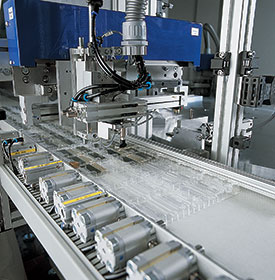
One of the most significant trends driving automation relates to machinery safety and how the integration of technologies is key to advances in this area. Festo‘s business manager, Russell Schwulst provides his viewpoint on how to make automation safer.
Machine safety is key
While the subject of machine safety is not new, it continues to play a key role in machine and plant construction. However, there are many different approaches and a great deal of uncertainty amongst machine builders in how to handle these issues. They constantly question to what degree of complexity and cost they need to go to in order to minimise risks adequately. It isn’t surprising that many machine builders and end-users seek advice and support.
In applications that are not protected by physical safety guards, but where personnel can come into direct contact with plant components, risk reduction is required. The Machinery Directive 2006/42/EC indicates that systems must provide adequate risk reduction through integrated safety functions.
In many cases, an overall safety concept requires the monitoring of a moving axis, as well as safety-related clamping or braking, depending on the expected conditions. In higher risk applications two independent channels are required. In the past, machine builders would often incorporate safety solutions into their design. These solutions took the safety switching device and wired in the Safe Torque Off (STO) function. Frequently servo motors have been replaced by a motor and brake combination in vertical applications.
Consider everything
There are several problems with this approach. They do not take into account possible failure states such as a coupling assembly breakage, or slippage, or a broken toothed belt in a parallel mounting kit that could render the brake useless. These faults could still allow the carriage and load to fall, causing damage or injury.
A fully integrated approach that monitors both the axis of a machine and allows safety-related clamping or braking is the best, safest solution. This is what Festo‘s electric axis EGC unit does. It has an optional second channel displacement encoder and one or two channel clamping unit. The mechanical system can be monitored by both a motor encoder (first channel) and a linear displacement encoder (second channel) mounted on the axis, providing two-channel monitoring.
The axis can also be specified with single- or dual-channel clamping units, called the EGC-HPN. These are suitable for holding a position, collision protection and, due to their emergency braking features, enhancing safety in any vertical axes. Typically they are used in lifting and stacking applications.
Of course legislative safety is not the only use of such features as additional encoders and mechanical braking systems. External encoders offer direct input into servo controllers to allow unsurpassed positional repeatability on mechanical axis. For instance, it is now possible to achieve 10 micron positional repeatability on a standard belt drive when configured with a simple low cost encoder option. This gives machine builders belt drive performance with ballscrew accuracy. Similarly vertical loads can be held safely for long periods on servo motors, without the need for high current usage. This can be achieved by choosing a simple mechanical clamp option.
Making automation safer is complicated
With today’s safety standards, it is a more complicated task for designers to gather together all necessary data from different manufacturers. This data is needed to calculate and document safety solutions.
Products like Festo‘s EGC axis provide a cost-effective solution for compliance to the requirements of the Machinery Directive, in a neat and self contained assembly and a single part number. Festo provides information on a wide range of electric and pneumatic safety functions through a Safety Guidelines manual. This can be downloaded from the website and distributed through the Machinery Safety Alliance seminar programme.
For more information contact Russell Schwulst, Festo, 08600 FESTO, [email protected], www.festo.com
| Tel: | 08600 FESTO (33786) |
| Fax: | +27 11 974 2157 |
| Email: | [email protected] |
| www: | www.festo.co.za |
| Articles: | More information and articles about Festo |






© Technews Publishing (Pty) Ltd | All Rights Reserved

 printer friendly version