



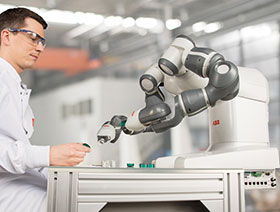
We all know what a robot is. But then it really does depend on whether you immediately think of them in sci-fi films, or paint spray booths, or welding on automotive production lines, or stacking in automated warehouses. These have been the big applications, in big automated factories, with around 240 000 robots sold last year.
The emergence of the cobot supplier
However, there is a new breed of robot now: collaborative robots, or cobots, have only really emerged as practical devices in the current decade. A cobot is a robot that is intended physically to interact with humans in a shared workspace, so the special pens and protective light curtains around the robot operating area are gone. The cobot is designed to work alongside a human operator, typically maybe lifting the heavier items involved in electronic device assembly operations: it has smooth surfaces with no sharp edges, and protected joints, so a human working alongside cannot trap their fingers, plus it stops at the slightest external touch. Additionally, the cobot is flexible, it can be trained (taught) by the assembly operator, by guiding its arms and grippers to show it what to do.
Currently the cobot market is around 5% of the total, $100 m last year. These robots are lower in cost, say $24 000 each, but are aimed at the small to medium sized companies that account for 70% of global manufacturing, where flexibility is essential. New international standards for their safe design and use are emerging, and there are many suppliers, as the market is forecast to be $1 billion by 2020.
ABB’s YuMi
One such product is the ABB YuMi (you-me) desk-top robot: a dual-arm small parts assembly robot that has flexible hands, incorporates parts feeding systems, camera-based part location and automated control: yet it has twice the reach and more strength than an operator. It can collaborate, side-by-side (or across the bench), with humans in a normal manufacturing environment, enabling companies to get the best of both humans and robots, working together. In April, the ABB YuMi was recognised for outstanding achievements in commercialising innovative robot technology with the prestigious Invention and Entrepreneurship Award at the Automatica trade fair in Munich. There followed a Golden Finger award as ‘one of the best industrial robots of 2016’ at the China International Robot Show in Shanghai. One out of every four robots sold today is sold in China, which is the world’s leading robotics growth market: 68 000 units were sold there in 2015, 17% up on 2014. YuMi was specifically designed to help consumer electronics meet the challenges produced by the need for customised personal electronics products, by enabling operators and cobots to share tasks, with easy training when the task changes. The YuMi appears to be targeted at the assembly operations common with electronic equipment, significantly in Southeast Asia.
Universal Robots – another successful startup
Universal Robots (UR) was formed in Odense, Denmark in 2005, with the goal of making robot technology accessible to small and medium-sized enterprises. They introduced their first cobot in 2008, and particularly focused on food industry applications, with 3,5 and 10 kg payload cobots. Their average payback period of 195 days for customers is claimed as the fastest in the industry. Recently their cobot arms have been awarded certification for use in clean room applications, so UR robots can now be used in areas where purity and hygiene – such as particle emission, easy-to-clean surfaces and extreme reliability – are decisive criteria for precise automation processes. This opens up more applications in the food industry, in the production of microchips and semiconductors, and in the electrical and opto-electronic industries. At the end of 2014, more than 3500 UR robots were installed worldwide: currently they claim the figure is 6000 – annual sales growing by 2,5 in just over a year.
Mercedes-Benz has replaced old robots with humans on some lines, to better manage customised products. They are moving to having production workers guiding a part-automatic robot. Scientists at MIT, working with BMW, have found that robot-human teams can be about 85% more productive than either of them, alone. Subsequently Universal Robots were rated #25 on the MIT Technology Review’s list of the world’s 50 smartest companies: Teradyne Inc then acquired UR for $285 m in 2015.
For more information contact Alok Maharaj, ABB Robotics, +27 (0)10 202 5428, [email protected], www.abb.com
| Tel: | +27 10 202 6995 |
| Email: | [email protected] |
| www: | www.abb.com |
| Articles: | More information and articles about ABB South Africa, Motion |






© Technews Publishing (Pty) Ltd | All Rights Reserved

 printer friendly version