


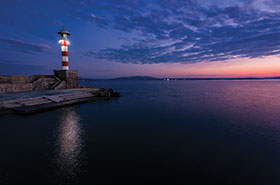
In a lighthouse the structures may appear old and dignified, but the technology inside is modern and robust. Availability, low operating costs and long maintenance intervals are the decisive criteria for the electromechanical design of the lamps. Anyone who takes a look inside a lighthouse along the French coast has a good chance of experiencing drive technology from Faulhaber.
The beam from the lamp room must be visible at least 40 km away. Particularly in areas near the coast, visual navigation signs cannot be replaced by anything else. Some 120 lighthouses with rotating lights are operated, monitored and maintained along the French coast by the government agency, Cerema.
The typical flash of the lighthouses can be achieved with three technical methods: through constant lighting with a flashing light, a constant light source with rigidly arranged lenses and a circumferential aperture, or the combination of continuous light and a circumferential lens system. Cerema makes use of LED technology, which results in a long-lasting and robust lighting system. An availability rate of 99% is achieved. “Reliability was a very important criterion for the choice of drive and led us to Faulhaber,” says Laurent Bernicot from the department for navigation and positioning systems at Cerema.
The design made use of DC-micromotors of the Faulhaber 2342 and 3257 series, as well as brushless DC-servomotors of the 3268 series – each combined with appropriately matched Faulhaber planetary gearheads. In addition to the general functionality of the drives, intensive test runs determined their behaviour in salty air.
The high demands on operation reliability are reflected in a drive unit with two motors. Two motors are connected to one gearhead and run alternately. The alternating operation harmonises the operating hours and ensures availability, as longer periods of downtime often lead to startup difficulties. Should one motor fail, the system in the lighthouse automatically switches to the second motor and reports the malfunction to the control centre. “We use remote monitoring, particularly with the large lighthouses”, explains Dirk Berger, spokesperson of the Stralsund Waterways and Shipping Office. “A two-stage escalation level is integrated in the control, prewarning in the event of impending malfunctions and failure.”
Reliable operation is monitored with a sensor that measures the time per revolution. The lighthouses must turn at the exact speed specified in their identifier. Hidden behind the identifier is a special type of flash sequence that is listed in the nautical charts and, particularly when navigating at night, allows a lighthouse to be identified unmistakeably. “Our goal is to achieve a constant rotational speed on the optical level,” continues Berger. “Thus our motors must be precise.”
The French lighthouses use a control developed by Cerema. The intelligence in the lamp room specifies how frequently and at what rate the light is to be visible within a given unit of time. A sensor measures the rotational speed of the optics and transmits the information to the control. After performing the calculation, the controller adjusts the motor speed via the analog set value directly with the motor supply voltage. The speed is constantly monitored and adjusted. Should a problem be detected, the automation solution saves the error and starts the second motor.
During the design process, Cerema employees selected three different motor types as the standard drive solution. The DC-micromotor of the DC2342 series is tailored for small optics that require only low motor power. Medium-sized optics are put into motion by the graphite-commutated motors of the Faulhaber DC3257 series. For powerful systems with high light intensity and correspondingly heavier construction, the brushless, four-pole servomotors of the 3268BX4 series are used.
During design, it is therefore important to ensure that, apart from normal operation, the motors deliver powerful peak torques in order to safely handle the high starting torques of between 5 and 8 Nm. “This was also an important factor in selecting the Faulhaber motors,p explains Bernicot. “If, however, a standstill occurs because the lighthouses are only operated at night, the optics are decoupled from the motor via a freewheel integrated in the rotary machine when the lamp is stopped.”
With respect to the high requirements on availability with long maintenance intervals, the framework conditions in a lighthouse are demanding. This is why it is so important to maintain a close project partnership. Cerema and Faulhaber have been working closely together since 2011.
For more information contact David Horne, Horne Technologies, +27 76 563 2084, [email protected], www.hornet.cc
| Fax: | 086 653 5225 |
| Email: | [email protected] |
| www: | www.hornet.cc |
| Articles: | More information and articles about Horne Technologies |






© Technews Publishing (Pty) Ltd | All Rights Reserved

 printer friendly version