


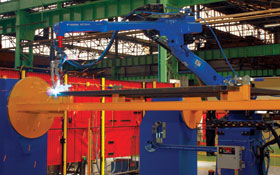
A key part of DCD Rolling Stock’s R240 million capitalisation is the implementation of Swedish-engineered Motoman robotic welding cells. These will increase production volumes in addition to utilising the skills of experienced manual welders more efficiently.
The robots are specifically grouped into four different cells to meet DCD’s requirements. The larger cells have a reach of 3,2 metres and can currently weld structures up to approximately 9 metres in length. Due to the modular design, they can be extended beyond 12 to 18 metres to ensure faster turnaround times. Manufacturing manager, Frank Ramage says, “By incorporating these robotic welding cells into the manufacturing lines on straight weld jobs, we can remove experienced welders from this standard and mundane task and redirect them to more complex projects with curves and corners that require their skills.”
The robots can weld four different fabricated bogie frames with a length of approximately 7,5 metres. There is capacity to increase by extending the rail and tracks and adding additional robots simultaneously. This substantially improves lead times for the customer compared to production of a single bogie during the previous manual process. “A higher level of work complexity positively engages the manual welders and encourages them to produce higher quality work,” continues Ramage.
The robots were supplied by Yaskawa South Africa. “We chose Yaskawa because the company is well entrenched in South Africa and has a very good track record in the manufacturing industry,” he adds.
The Motoman HP20D-6 robot arms, each with six axes and a 6 kg capacity, have a reach of 1915 mm. The large work envelope allows these cells to handle large parts and complex procedures. Each is paired with a DX100 controller which can support up to eight robots. The control system includes a Motoman DX teachbox with dead man’s switch and built-in transformer prepared for zeroing function. The DX100 reduces the need for separate PLC and HMI devices. This results in significant cost savings when integrating a robotic workcell.
Two of the cells are equipped with Motoman’s MT1-1000-S2D positioner, which has a two-axis, tilt-rotate manipulator for rotation about two axes. These also incorporate a ComArc arc welding sensor. This is a through-the-arc seam tracker that measures the arc characteristics during a weave pattern to determine variations between the robot’s taught path and the desired path. This compensates for inaccurate workpieces or work-holding fixtures.
The other two cells have single drive HSB-5000SN positioners for rotation about a single axis and are equipped with a 10 metre traverse track. Here the servo robot laser joint tracking camera system utilises Motoman’s Power-Cam laser camera.
Each cell comes complete with SKS welding equipment, a torch cleaning station, a mechanical safety system and an electrical safety system featuring a Siemens S7-300 PLC complete with HMI and programming.
DCD Rolling Stock will be expanding the range of robots still further as it grows and introduces new products. “The Motoman robotic welding cell equipment is among the most advanced in the world and staff members being trained in the application of this technology will benefit from gaining new industry insight ahead of others,” concludes Ramage.
For more information contact Frank Ramage, DCD Rolling Stock, 27 (0)11 914 1400, [email protected], www.dcd.co.za






© Technews Publishing (Pty) Ltd | All Rights Reserved

 printer friendly version