



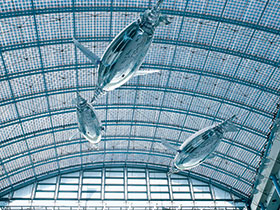
The latest innovation emerging from Festo’s Bionic Learning Network (BLN) is the AirPenguin. The BLN examines naturally occurring phenomena and develops innovative, cutting-edge bionic technology which Festo then integrates into its products.
The AirPenguin is an autonomously flying object that comes close to its natural archetype in terms of agility and manoeuvrability. It comprises a helium-filled ballonet, which has a capacity of about 1 cubic metre and thus generates 1 kg of buoyant force; at each end of the ballonet is a pyramid-shaped flexible structure of four carbon fibre rods, which are connected at joints by a series of rings spaced about 10 cm apart. The rings together with the carbon fibre rods yield a 3D Fin Ray structure that can be freely moved in any spatial direction. The Fin Ray structure was derived from the anatomy of a fish’s fin and extended here for the first time to applications in three-dimensional space.
Each pair of spatially opposed carbon fibre rods is connected via bowden wires and a double pulley, and can be extended and retracted in contrary motion by means of an actuator. This gives rise to rotation free of play both at the tip of the AirPenguin’s nose and at the end of its tail. By superimposing two perpendicular planes of rotation, any desired spatial orientation can be realised.
A strut to which the two wings are attached passes through the helium-filled ballonet. This new type of wing design can produce either forward or reverse thrust. Each wing is controlled by two actuators: a flapping actuator for the up-and-down movement of the wings, and a further unit that displaces the wing strut to alter the pressure point of the wings. There is also a central rotational actuator for the two flapping wings that directs their thrust upwards or downwards, thus making the AirPenguins rise or descend. All three actuators are proportionally controlled. This makes for continuously variable control of the flapping frequency, forward and reverse motion, and ascent and descent.
The entire wing complex comprises a strut with flat flexible wings of extruded polyurethane foam. The wing strut, which is supported at the pivot point of the torso, can be moved either towards the front or rear edge of the wing. Displacing the strut towards the front, for example, causes the wing’s pressure point to migrate forwards. The pressure of the airstream bends the cross-section of the wing in such a way as to produce a profile that generates forward thrust. If the wing strut is moved towards the rear edge of the wing, the pressure point is likewise moved to the rear, and the AirPenguin flies backwards. With this design a self-regulating, wing pressure-controlled, passively twisting adaptive wing has been realised for the first time.
Autonomous, self-regulating systems with collective behaviour
The AirPenguins are also equipped with complex navigation and communication facilities that allow them to explore their ‘sea of air’ on their own initiative, either autonomously or in accordance with fixed rules.
In the underlying project, a group of three autonomously flying Penguins hovers freely through a defined air space that is monitored by invisible ultrasound transmitting stations. The Penguins can move freely within this space; a microcontroller gives them free will in order to explore it. The microcontroller also controls a total of nine digital actuators for the wings and for the head and tail sections. By means of XBee, based on ZigBee, large volumes of data can be transmitted between the Penguins and the transmitting stations by 2,4-GHz band radio. The Penguins recognise each other on the basis of their distances to the transmitting stations. The rapid, precise control allows the AirPenguins to fly in a group without colliding, while also mastering height control and positional stability. As an alternative, they can act synchronously as a group.
A comprehensive central surveillance system provides security in case of sensor failure and reports low energy supply. Whenever necessary, it prompts the Penguins to return to the charging station.
Technology-bearers for the automation technology of tomorrow
Autonomous, versatile, adaptive self-regulating processes will acquire increasing significance in future for automation in production. The animal kingdom can provide insights here which, when implemented by resourceful engineers, lead to astounding new applications.
The ongoing development of sensor and control technology is thus also being promoted along the road to decentralised, autonomously self-controlling and self-organising systems thanks to inspiration from nature. The transfer to automation technology is also to be found by analogy in regulating technology from Festo, for example in the new VPPM and VPWP proportional-pressure regulators for servo-pneumatics.
For more information contact Kershia Beharie, Festo, +27 (0)11 971 5509, [email protected], www.festo.co.za
| Tel: | 08600 FESTO (33786) |
| Fax: | +27 11 974 2157 |
| Email: | [email protected] |
| www: | www.festo.co.za |
| Articles: | More information and articles about Festo |






© Technews Publishing (Pty) Ltd | All Rights Reserved

 printer friendly version