



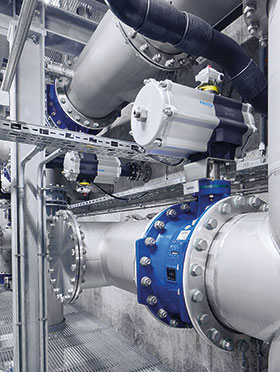
When planning municipal water management systems, it is worthwhile to consider the service life costs. In addition to the purchase price, follow-up costs such as operation, energy consumption, maintenance and repair can become real cost drivers.
Not so with pneumatic automation technology. It is robust, cost-effective and reliable because the compressed air is easy to transport, store and regulate. A comparison of pneumatic and electric actuator technology reveals surprising results in favour of pneumatics. A classic example of a filtration system for a municipal water treatment plant with seven multi-layer filters, seven activated carbon filters and 84 automated process valves revealed that the acquisition costs of a pneumatic system are 28% more advantageous.
So why do pneumatic systems offer such cost benefits? Pneumatic actuators only require electricity for regulating and generating compressed air; the movement itself is triggered by the compressed air. By contrast, electric actuators continuously need energy for the electronics, the heating and movement.
Overload-proof
In water technology plants, process valves are often actuated only infrequently or not at all for long periods of time. This can lead to the formation of deposits and caking and thus to increased breakaway torques or forces. Pneumatic actuators can overcome this problem simply by increasing the air pressure. They cope well with loads without getting damaged and are not affected by differences in temperature, contamination and humidity. Pneumatic actuators only require electricity for regulating and generating compressed air and act directly on the shut-off valves.
Since pneumatic actuators are overload-proof and a higher actuation force can be achieved very simply by increasing the pressure, it is often possible to use smaller sizes with a lower weight than would be the case for electric actuators. Provided the tubing has zero leakage and the units are precisely dimensioned, the resulting solutions are energy-efficient. Pneumatic systems from Festo are able to deliver high forces of up to 75 000 N and torques of up to 10 000 Nm.
Digitalisation for even greater energy efficiency
The brand-new Festo Motion Terminal VTEM catapults pneumatics into the age of Industry 4.0 with apps that can replace over 50 individual components. Just as the smartphone turned the mobile communication market on its head a decade ago, so too is the Festo Motion Terminal set to revolutionise automation technology. The new type of function integration, combined with software apps, simplifies the entire value chain, since only one piece of hardware is now required.
With the Motion Terminal, for example, different pressure levels can be used for opening and closing process valves. This can drastically decrease compressed air consumption. In addition, a diagnostic function can be activated after a freely selectable number of switching operations. This function detects any leaks on an actuator-specific basis and sends specific maintenance messages or shuts down that section of the plant. This makes laborious manual leakage detection in extensive compressed air networks unnecessary.
Energy efficiency perspectives
The energy efficiency module MSE6-E2M, makes saving energy easy. The integrated flow rate and pressure sensors monitor and automatically reduce the air consumption in systems. The module detects the operating status when no compressed air is consumed, and automatically shuts off the supply.
Once the supply is shut off, it checks for any leaks in the system. If there is too much of a drop, the controller is notified. This automatic leakage detection system enables specific maintenance to be carried out, and the continuous monitoring of consumption increases process reliability.
Simple and uncomplicated
Pneumatics is an uncomplicated technology, and is easy to install. Apart from end-position sensing and monitoring the compressed air supply, it doesn’t need to be monitored and checked. It follows the ‘fit and forget’ principle.
Pneumatic actuators have proven to be resistant to vibration and are durable. They are made from a small number of components and are thus less likely to break down. Pneumatic actuators are also resistant to continuous loads and remain maintenance-free over their entire service life.
Unbreakable
With up to 1 million switching cycles, the average service life of pneumatic actuators is rather impressive. This is true even in harsh environments with high temperature differences, contamination and humidity. Extreme heat or cold and humidity cannot harm corrosion-resistant pneumatic components. They are temperature-insensitive between -20 and +80°C, with special low temperature designs being insensitive down to -40°C and high temperature designs up to 120°C. Components made entirely of stainless steel supplement the product portfolio.
For more information contact Kershia Beharie, Festo, +27 (0)11 971 5509, [email protected], www.festo.co.za
| Tel: | 08600 FESTO (33786) |
| Fax: | +27 11 974 2157 |
| Email: | [email protected] |
| www: | www.festo.co.za |
| Articles: | More information and articles about Festo |






© Technews Publishing (Pty) Ltd | All Rights Reserved

 printer friendly version