


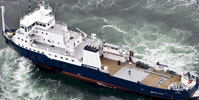
VLT High Power frequency converters from Danfoss strengthen the tunnel thrusters on a cable-laying vessel, while Advanced Active harmonic filters provide high voltage quality for the generator.
CT Offshore specialises in installing and maintaining offshore cables for the many new wind turbine farms being developed in Denmark. The company converted an outdated ferry, the MV SIA, into a cutting edge cable laying vessel with all the latest equipment for installing and maintaining cables between offshore wind turbines and the onshore electricity network.
Full refurbishment
To hold the SIA in position with a precision of 200 mm, the Dutch Thruster Group supplied seven GME e-motor driven 200 kW tunnel thrusters in the bow and stern. Together with an existing thruster of 400 kW, the combined power of 1,8 MW, in full integration with a Navis dynamic positioning system, navigated the vessel along a pre-programmed route – even under the difficult weather conditions and strong currents that often plague the North Sea.
3,2 MW power plant
To provide power to the thrusters and other equipment, the Dutch Thruster Group also supplied a power plant of 3,2 MW, consisting of four Mitsubishi diesel generators and two 190A VLT Advanced Active filters from Danfoss..
Frequency converters cut down on wear
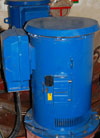
The Dutch Thruster Group decided to speed-regulate the thrusters using Danfoss frequency converters instead of a traditional solution with fixed speed e-motor and variable pitch propeller, or an hydraulic driven system.
“We chose a frequency converter driven system because it is economically attractive, fuel efficient and maintenance free. With additional moving parts for pitch control or an hydraulic system, more maintenance would be involved,” explains Martin Franken, sales and marketing manager of the Dutch Thruster Group. “For a vessel operating around the clock under dynamic positioning, a controllable pitch system with the e-motors running at full speed over a longer period of time at low load would waste a lot of energy.”
20% power is saved
“A frequency converter can adjust exactly to the power needed without compromising the efficiency. Compared to hydraulic thruster systems, a staggering 20% power is saved on system losses,” adds general manager and project leader, Edy Vos.
The ship is classified under Lloyd’s Register of Shipping for dynamic positioning in accordance with DP2 classification. This means that there is a redundancy on all active systems, preventing simple errors from leading to hazardous situations which can result in loss of positioning power.
Active harmonic filters provide high voltage quality
The generator unit can be divided into two independent systems of 1,6 MW when SIA operates in DP2 mode. The two active harmonic filters on the starboard and port sides ensure that harmonic voltage distortion is lower than 8% THvD, in accordance with Lloyd’s Register of Shipping’s rules, even when all systems are running simultaneously at full power.
If the electrical supply had been installed without active filters, the generators would have to have been much larger to meet Lloyd’s requirements for voltage quality. This would have been a very expensive solution, and there was no room for larger generators in the existing engine room.
Plenty of excess power
The vessel proved to be completely stable during its seaworthiness testing – even when it turned around quickly with the thrusters running at full power.
Source: inMotion, the VLT Newsletter, September 2010
For more information contact Donald Fowkes, Danfoss, +27 (0)11 803 8390, [email protected], http://www.danfoss.co.za






© Technews Publishing (Pty) Ltd | All Rights Reserved

 printer friendly version