



Founded in 1992 by aeronautical engineer Alfredo Schulz and his father, and later joined by electrical engineer Danie Kuys, Simuflight started out in a garage. Danie and Alfredo could not afford industry standard equipment but with intensive research and development they developed their own PLC and software core, which grew with them. Their flight simulators are in essence an electronic version of a wind tunnel and Simuflight has been building them for 15 years. Every aircraft has different characteristics so each simulator is unique. To date the company has sold 19.
Virtual flying
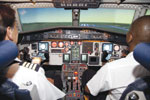
Simuflight’s software modules simulate the complete flying experience. The pilot sits in an authentic cockpit, modelled according to the specific aircraft type. All the switches, dials, throttles, control column, seats and onboard equipment are the real thing. Scenery is provided through projection onto a life size screen and the experience is incredibly realistic. The software that shows the external view from the cockpit creates visual effects so real that some people experience motion sickness.
The software allows trainees to experience realistic malfunctions of virtually any nature – from hydraulic leaks to engine fires to fuel pump booster malfunction – and the pilot can practice how to handle them. “A three hour training session is about as much as even an experienced pilot can take,” says Kuys.
Beckhoff technology
Simuflight’s latest project was commissioned by SA Airlink and was based on the Jetstream 41. For the first time Simuflight used a commercial PLC. Beckhoff was chosen as the technology supplier because of its ability to apply the power of the PC to a demanding control application. The company offered an industry standard with a reliable PLC system and good Ethernet-based communication between PLC and PC. Previously SA Airlink spent around R8 million a year flying crew overseas for training. This J41 simulator cost them R7 million and the amount will be recovered in less than a year.
“It was originally thought that SA Airlink would have to scrap one of their aircraft so they could cut off the cockpit and use it for the simulator,” says Kuys. “Then someone playing around on eBay discovered that a farmer in Spain had a fully equipped Jetstream cockpit up for auction. They ended up paying only $50 000 and Airlink was able to salvage avionics equipment worth R2 million that was not needed for the project.”
Kilometres of wiring
Simulators often run 20 hours a day and a large amount of information has to be processed very quickly. Key elements of a simulator are the flight deck hardware, motion controllers, control software, and an acquisition device to collect and process the data and return a response. Anything the pilot puts his hands on must be monitored and the complete cockpit situation has to be assessed in 50 milliseconds by the PLC. The signal resulting from the pilot’s response is processed at 60 times a second in the software core and the results fed back to lights on the panel, indicators, gauges or other instrumentation. The instruments are virtual – they are just LCD screens covered with suitable bezels and knobs.
There are hundreds of switches in the on/off position, circuit breakers and force sensors. Altogether there are over 800 digital I/O points. Input/output management of the event driven data is crucial and Simuflight is planning to develop proprietary I/O modules with a specially designed I/O card that can clip onto the EtherCAT bus between the Beckhoff controller and I/O card. Data acquisition is centralised and all wiring goes to a central point. A typical flight simulator has 5 to 8 kilometres of wiring.
In addition PCI driven data acquisition cards take care of the 60 analogue input and output signals. These monitor the position of the foot and hand controls and results from the control loading force sensors. They measure primary controls such as roll, pitch, yaw and power. The control loading system comprises servo motors which apply forces to the controls in the cockpit, giving them varying levels of ‘stiffness’.
Beckhoff Automation MD, Conrad Muller sums up: “We invested our time, design experience and resources into this project and we look forward to offering Simuflight even more as a technology partner for the next generation of simulators.”
For more information contact Kenneth McPherson, Beckhoff Automation, +27 (0)11 795 2898, [email protected] , www.beckhoff.co.za
| Tel: | +27 11 795 2898 |
| Fax: | 086 603 6868 |
| Email: | [email protected] |
| www: | www.beckhoff.com |
| Articles: | More information and articles about Beckhoff Automation |






© Technews Publishing (Pty) Ltd | All Rights Reserved

 printer friendly version