


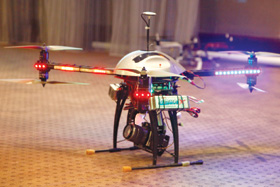
Drawing on 30 years’ background in radio controlled aircraft, local entrepreneurs Neville Pienaar and Gary McDonogh are actively involved in the rapidly changing technology of unmanned aerial vehicles (UAVs). Aerial Robotic Media uses the latest radio controlled robotic technology to carry out HD aerial imaging using flying robots, and has developed a range of aerial surveillance products for commercial aerial photography applications such as monitoring of traffic; patrolling perimeters of residential estates; wildlife cameras and poacher tracking; coastal monitoring; and crowd control. Aerial Robotic Media has now set its sights on providing autonomous drones for use in the security industry.
This new technology has many advantages, being able to deliver a bird’s eye view at a reduced cost. It is silent and stealthy, has an autopilot ability (which makes it a drone), has low altitude ability and can operate in confined spaces or inaccessible areas. It also has multisensory capability and allows real-time video transmission to the ground.
The correct name for these machines is multi-rotors since they have between three and eight propellors. The main frame is constructed from machined aluminium and carbon fibre, making it lightweight yet rigid. A variety of frame designs exist, for example quad, hex, octo or H-frame. The frame rests on skids, very much like helicopter skids.
Brushless motors are very powerful for their size and thus are the best motors to use on a multi-rotor. Each motor has a maximum rpm ability, normally rated as Kv or rpm/volt. Motors are generally rated at 380-710 Kv, with a 14,8–22,2 battery voltage. This means the maximum rpm at each motor is between 8400 and 10 500 rpm. Each motor is capable of lifting about 1,5 kg.
The electronic speed controls (ESC) control the speed of each motor. Each is in turn controlled by the flight stabiliser. Each motor has its own speed control and draws between 15 and 45 A. The size of the propellers is determined by the size of the motors. Special efficient propellers are available for multi-rotors, which deliver high thrust yet low flying speed. They are typically 30 cm in diameter with a pitch of 15 cm up to 38 cm. The bigger the propeller the higher the current draw will be and thus the lower the flying time.
High discharge capacity LiPo batteries are used, which can deliver over 220 A of current without damaging the battery. Without LiPo battery technology, the machines would not be able to fly efficiently. The receiver (Rx) receives instructions from the transmitter (Tx) to effect control over the machine. The operator moves the controls on the Tx, the Rx receives the signal, and the machine moves accordingly. The Tx should have at least eight channels so that eight separate commands can be sent to the Rx.
A video transmitter sends images to a ground monitor so that the operator can see what the camera sees. The gimbal holds the camera or sensor. It is gyro stabilised so the image always stays still on the screen, even if the machine is being bumped and moved by wind currents. On the ground the operator has a video monitor and computer to pass on instructions to the machine to follow certain routes.
The flight stabilising system is a critical part of the machine. Without it, the multi-rotor would not be able to fly. It controls the ESCs using three gyros and three accelerometers. These microchips are managed by advanced algorithms programmed into the firmware. The rate at which the machine corrects its attitude is managed by the software. The flight stabiliser also holds the gyro which controls the camera gimbal.
The auto-pilot system allows for pre-programming of missions where the machine flies autonomously. This allows the system to take off and land automatically at the push of a button. The GPS and compass work together with the auto-pilot system, telling the machine where it is. A fail-safe system is built in which prevents the machine from getting lost. If there is a signal loss from the transmitter or an abort command, then the machine will automatically return to its pre-set home location and land safely.
With these features, the multi-rotor platforms can be harnessed to do a number of aerial photography duties, limited only by the type of camera or sensor that is installed. There are always limits with new technology and some of the challenges include the battery life, operating in the rain, and training of operators, as well as the legal implications and privacy criteria. Neville and Gary add that legislation is battling to keep up with the technology and the Civil Aviation Authority (CAA) and Commercial Aviation SA (CASA) are only now developing a legal framework covering the equipment that can be used. “Commercial UAVs will be here in South Africa in the near future and they will have many applications, but there is a need for collaboration and investment in technology,” concludes Neville.
For more information contact Neville Pienaar, Aerial Robotic Media, +27 (0)71 745 5292, [email protected]






© Technews Publishing (Pty) Ltd | All Rights Reserved

 printer friendly version