



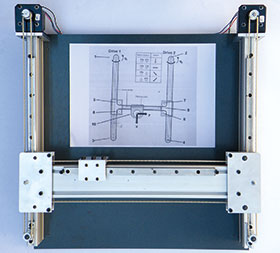
We are not aware of the design origins of the H Robot, but our experience with gantry machines indicated that a number of shortcomings with conventional machines had been addressed. We decided to build one for evaluation.
The robot is constructed on the standard gantry principle with a moving bridge carrying a moving carriage. It is belt driven.
Conventional practice would drive the bridge by means of a belt and motor on one side. The carriage would be driven in the horizontal direction with another motor and belt travelling on the bridge. This construction has a number of disadvantages:
• The moving motor has to be cabled via an energy chain.
• Only dragging on one side of the bridge allows the other edge to pull skew.
• The bridge becomes heavier and more difficult to accelerate fast.
• Proximity of the bridge motor to interference emitters such as welders or plasma cutters creates electrical problems.
• Increased motor protection is needed due to proximity to smoke and cutting fluids.
The H Robot has both drive motors stationary on the back of the machine. The bridge has two idler pulleys on each side and opposite the drive motors are the tail idler pulleys. The belt ends meet on the carriage. Both ends of the bridge are restrained from pulling skew by the belt tension, resulting in improved machine rigidity.
The figure shows a top view of the machine. The drive motors are 44 mm stepper motors driven by Techlyn 3 Amp motor drives. The drive commands come from a Galil motion controller programmed by a PC. The program resides on the controller, and further PC intervention is not needed while the program is executing.
Motion kinematics
Straight line motion parallel to the X and Y axes requires both motors to rotate simultaneously. Rotation of a single motor produces motion 45° to the ordinates. The kinematics are therefore not trivial, but still orders of magnitude removed from those of a delta robot for instance. An additional problem is that the axis homing moves also require the two motors to move simultaneously. The required absolute positions of the two motors are given by two simple equations:
θA=(Y-X)X20
θB=-(Y+X)X20
θA and θB are the absolute motor positions with respect to zero position. In this case the motor resolution using quarter steps is 800 steps per revolution.
X and Y are the target positions in millimetres measured from the home (zero) position.
The 20 in the equations is the distance each belt moves per motor revolution. In this case the motor pulley has 16 teeth and the belt pitch is 2,5 mm. Therefore, one motor revolution translates into 2,5 X 16 = 40 mm/rev.
The resolution in motor steps per revolution is 800/40 = 20 motor steps per mm.
Control method
A motion controller from Galil Motion Control was connected to supply step and direction signals to the two drives. The controller was programmed to produce a 100 mm square robot move. As the carriage was not required to stop at the corners, the controller operated in the vector mode. The program is listed below.
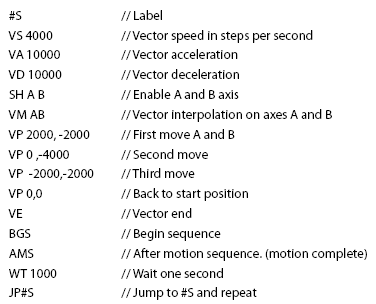
Running the code resulted in smooth motion averaging 8,5 metre/minute. Possible applications would be pick and place machines, profile cutters, drilling machines, inspection machines, welding machines, assembly machines and wiring harness manufacture.
For more information contact Glyn Craig, Techlyn, +27 (0)11 835 1174, [email protected], www.techlyn.co.za






© Technews Publishing (Pty) Ltd | All Rights Reserved

 printer friendly version