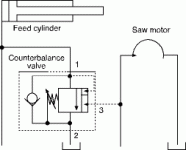
The cutting device may be a trenching chain, a drill, a grade trimming wheel or a saw. The feed could be a cylinder, a motor or a tractive drive. Typically, an operator will adjust the feed rate so that the cutting device does not stall. The problem with this solution is that when the cutting is easy, productivity is lost. This simple circuit shown below may be a better solution.
How it works
A counterbalance valve is a direct-acting, pilot-assisted relief valve. Pilot assist at port 3 lowers the effective setting of the relief valve at a rate determined by the pilot ratio. Port 3 of the counterbalance senses the pressure at the cutting device or saw. Port 1 connects to the feed circuit and port 2 goes to tank.
When the pressure required to drive the saw starts to climb too high, the effective setting of the counterbalance is lowered. Feed force will be modulated by relieving the feed circuit to tank, thus preventing the cutting device from stalling.
Note:
This circuit is all about pressure control as opposed to flow control. Pressure control allows large changes in flow with small changes in pressure. The determining factor in this circuit is the pressure at the cutting device. Do not get too caught up in numbers. There are at least three performance curves involved and trying to predict exactly what will happen is difficult, if not impossible.
In order to serve this purpose, the counterbalance valve has to have enough capacity to handle the flow of the feed circuit. The counterbalance valve will probably need a low pilot ratio and a high setting. Please note that this circuit is presented as one example of how to apply Sun Hydraulics' cartridge valves. It is not a guarantee that such a saw will never stall again.
Drone flies in and swaps its own battery in 25 seconds
Editor's Choice News & Events Infrastructure Products & Solutions
Local enterprise-class drone consultants can now supply SA organisations that need remote aerial operations with in-house drone and dock solutions that enable 25-second automated battery swapping.
Read more...Finding footing with footage Axis Communications SA
Surveillance Infrastructure
Storage is a strategic consideration for critical infrastructure security, and operators must consider how to meet their storage requirements without getting stuck in a quagmire of constantly having to buy more capacity.
Read more...Connecting security operations from gate to control room
Integrated Solutions Infrastructure
Most private security companies already have plenty of technology in place. The problem is that those systems often produce separate records, making it harder to piece together what happened across a shift or incident.
Read more...Supply chain attacks have become an industry of their own
Information Security Integrated Solutions Logistics (Industry)
Organisations face a fundamental change in supply chain risk. Opportunistic attacks are becoming increasingly systematic, with threat actors deliberately targeting trusted technologies and relationships that can give them access to multiple organisations at once.
Read more...One picture of the estate
Editor's Choice Integrated Solutions Security Services & Risk Management Residential Estate (Industry)
Bringing patrol, incident, and H&S reporting onto a single platform: a security operation should be able to show what happened, when it happened, and how personnel responded.
Read more...Connecting access control, logistics and asset tracking SA Technologies
Access Control & Identity Management Integrated Solutions Residential Estate (Industry) Logistics (Industry)
Physical barriers matter, but a site is not secure just because the gate is strong or the container is locked. True security requires verifying every movement, tracing handovers, making exceptions visible, and allowing intervention before minor issues become major losses.
Read more...Enabling smarter and safer residential estates Impro Technologies
Access Control & Identity Management Infrastructure Residential Estate (Industry)
Modern estates must manage residents, visitors, contractors, domestic workers, delivery personnel, security staff, and service providers, often across multiple access points and facilities. Traditional systems are increasingly unable to provide the visibility, accountability, and operational efficiency required.
Read more...Security works better when it starts with the building
Facilities & Building Management Infrastructure
If the project team has already determined where services will run, how people will move through the building, and where access points will sit, the security specialist is working within decisions that have already been made.
Read more...Optimising access control and the right to privacy neaMetrics Suprema IDEMIA Technews Publishing SMART Security Solutions
Editor's Choice Access Control & Identity Management Integrated Solutions Residential Estate (Industry)
How can access be controlled more efficiently without disrupting the estate or creating endless queues in the visitor lane(s), while also adhering to the draft Code of Conduct?
Read more...Integrating the industry
News & Events Infrastructure
With private security, neighbourhood watches, CCTV, drones, control rooms and community safety networks expanding across the country, the next frontier may not be more technology, but connecting what already exists.
While every effort has been made to ensure the accuracy of the information contained herein, the publisher and its agents cannot be held responsible for any errors contained, or any loss incurred as a result. Articles published do not necessarily reflect the views of the publishers. The editor reserves the right to alter or cut copy. Articles submitted are deemed to have been cleared for publication. Advertisements and company contact details are published as provided by the advertiser. Technews Publishing (Pty) Ltd cannot be held responsible for the accuracy or veracity of supplied material.










 printer friendly version