Rotor Flux Control (RFC) is seen as a major advantage in applications where a combination of dynamic performance, stability and speed accuracy are required without encoder feedback and where low audible noise is important. The advanced method of open-loop speed control devised at Control Techniques (CT) is a standard feature on its flagship range of AC drives, Unidrive SP.
“Rotor Flux Control provides a simulated speed feedback that gives excellent speed accuracy without actually having the cost of direct feedback from an encoder,” says CT product manager, Richard Smith.
Vast amounts have been spent by the drives industry trying to develop the perfect control algorithm to achieve accurate and dynamic control of a standard AC induction motor without measuring its speed – yet, to date, closed-loop control, with its extra costs of wiring and a costly encoder, has been the only choice for some applications.
Several methods of open loop control exist: variable frequency (VF) is the simplest and lowest cost to implement; however the speed of the motor changes significantly with load and temperature so that good speed holding and low speed operation is not possible.
Open-loop vector control, which models some aspects of the motor, is better, giving good speed holding, but only moderate dynamic performance. Direct torque control (DTC) offers improved dynamic performance, but does not allow the user to modify the switching frequency resulting in significant audible noise from the motor plus additional motor losses.
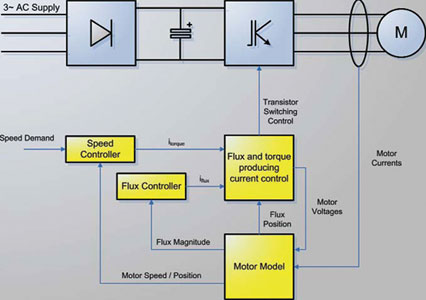
RFC addresses all of these drawbacks, using a simple, yet accurate, mathematical motor model to calculate a simulated speed and position feedback, allowing the loop to be closed without the need to physically mount and wire an encoder.
The simplicity of the algorithm allows the calculations to be performed synchronously with the speed and current loops within the drive, resulting in a characteristic performance that is dynamic, with excellent speed accuracy and a stable operation even with troublesome light loads.
Control Techniques claims that RFC control delivers full torque in less than 0,5 ms, (compared with four times this for DTC) significantly increasing the dynamic performance of the drive and motor and greatly extending the bandwidth of the system.
An important feature of DTC is that the switching frequency is selectable, making the drive suitable for applications where low audible drive noise is important such as lifts and other building system drives.
CT acknowledges that RFC is not a solution to every application. Systems where accurate speed and torque control are required down to zero speed will still require feedback devices. It does, however, allow open loop drives to be used in more applications where, in the past, only a closed loop drive would be able to perform.
Magma X100 delivers AMB systems for wide range of industrial machinery
Electrical switching & drive systems & components
SpinDrive launches Magma X100 controller, bringing active magnetic bearing technology to a new generation of industrial applications. The Magma X100 expands SpinDrive’s oil-free, frictionless AMB technology to applications below 150 kW, unlocking new addressable markets.
Read more...Why lubrication fails in mining and what to do about it
Editor's Choice Electrical switching & drive systems & components
Lubrication Engineers explains the recurring failure points behind mining lubrication problems and how the right product, storage and application practices can improve equipment reliability.
Read more...Echain protects cables in cleanrooms igus
Electrical switching & drive systems & components
Advanced polymer manufacturer igus has developed a new cleanroom energy chain with an innovative guide system that allows for abrasion-resistant travel over distances of up to 30 metres.
Read more...PowerFlex drives cut energy use by up to 30% amid rising costs
Electrical switching & drive systems & components
Rockwell Automation’s PowerFlex 755TS variable frequency drives are delivering energy reductions of 10 to 30% in Africa’s industrial operations, with adaptive control and predictive maintenance features that cut downtime by up to 50%.
Read more...Next-generation oil-free motor systems with active magnetic bearings
Electrical switching & drive systems & components
WEG and SpinDrive are collaborating to integrate SpinDrive’s AMBs and built-in IoT condition monitoring into WEG’s market-leading electric motor offering, creating an oil-free, maintenance-free drive solution.
Read more...Direct drive with integrated control Vepac Electronics
Electrical switching & drive systems & components
The PSD 40 direct drive is a mechatronic system with integrated control, bus interface and absolute measuring system, with no battery required.
Read more...AI-powered on-premises analytics for industrial drives Siemens South Africa
Electrical switching & drive systems & components
Siemens is introducing a new on-premises analytics solution for industrial drive systems. The software enables users to evaluate drive data entirely within their own infrastructure and meet stringent data-sovereignty requirements.
Read more...Hydrostatic machine base for ultra-precision grinding centre
Electrical switching & drive systems & components
Hyprostatik Schönfeld has developed a high-precision hydrostatic machine base for a new ultra-precision grinding centre for Optotech. The machine platform enables a previously unattainable combination of dimensional accuracy, dynamics and surface quality in the ultra-precision grinding of optical surfaces.
While every effort has been made to ensure the accuracy of the information contained herein, the publisher and its agents cannot be held responsible for any errors contained, or any loss incurred as a result. Articles published do not necessarily reflect the views of the publishers. The editor reserves the right to alter or cut copy. Articles submitted are deemed to have been cleared for publication. Advertisements and company contact details are published as provided by the advertiser. Technews Publishing (Pty) Ltd cannot be held responsible for the accuracy or veracity of supplied material.










 printer friendly version