



Engineers face a PLC expansion dilemma as new demands are made on existing automation systems. Often the processing requirements associated with more sophisticated I/O processing are significant. Connections to third-party devices, such as RFID and barcode readers, and PID (proportional-integral-derivative) control loops place heavy, non-traditional demands on PLCs.
EtherNet/IP
Allen-Bradley introduced EtherNet/IP in 2001. While the name sounds much like Internet Protocol over Ethernet, EtherNet/IP (note the capital ‘N’) was actually a proprietary ‘Industrial Protocol’ running over Ethernet. If plugged into a standard Ethernet network, hardware using EtherNet/IP is not compatible with normal network traffic.
EtherNet/IP was later made an open protocol, however, and is now supervised by ODVA (Open DeviceNet Vendors Association). EtherNet/IP incorporates CIP (Common Industrial Protocol), which is also supervised by ODVA and supported by many vendors.
Because SNAP I/O supports EtherNet/IP natively, engineers currently using Allen-Bradley PLCs can supplement their control networks and expand capabilities without concerns about communication and compatibility, without extra programming, and with little effect on PLC performance.
PLC performance
PLCs usually scan remote I/O directly through a bus-coupler, which simply provides communication, not local intelligence. Adding more I/O normally requires PLC resources both for scanning and for myriad functions such as counting, latching, thermocouple linearisation, ramping, PID loop control, and so on. The addition of one or more PID loops can significantly impact system performance.
Opto 22’s SNAP I/O, however, allows users to distribute this processing to a local I/O processor, the brain, which runs them independently of the PLC. This intelligent processor at the I/O rack offers communication to the host PLC and also performs extensive local processing such as PID loop control, signal linearisation and engineering unit conversion that are more easily and logically handled on the brain than the PLC.
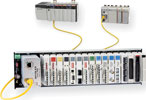
With these functions independently handled at the I/O level, I/O point count can be increased without significant impact on the PLC’s performance.
Configuration
The list of functions that the SNAP I/O processor executes at the I/O level without additional programming is extensive and includes:
* PID loop control (up to 96 loops).
* Serial device control (RS-232/485).
* High-speed counting (up to 20 kHz, depending on the module and brain).
* Quadrature counting.
* Analog scaling.
* Digital and analog totalising.
* Watchdog timeout.
* Time-proportional output (TPO).
* Input latching.
* Pulse generation and measurement.
* Frequency and period measurement.
A free I/O configuration utility is included with the brain. Once the new I/O is configured, the brain scans its local I/O, performs the required functions, and waits for the PLC to pick up the data.
Communication and compatibility
If communication with the PLC is lost, the brain continues to run PID loops and other locally configured functions, so a communication failure does not necessarily cause local processes to stop. If a process needs to be brought to a safe condition in the event of communication failure – for example, valves or pumps turned off – the watchdog timeout can be enabled to monitor communications, and the brain will set outputs to a predetermined level.
For more information contact Mike Harrison, Opto Controls, +27 (0)11 792 5232, [email protected], www.opto.co.za






© Technews Publishing (Pty) Ltd | All Rights Reserved

 printer friendly version