Smooth, precise linear motion
1st Quarter 2012
Electrical switching & drive systems & components
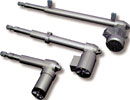
These loads can be moved at speeds up to 90 mm/s as standard with higher speeds available on request.
The two main segments of the actuator are the actuation unit and the drive unit. The drive unit is based around a precision Spiroid gear set, which is a right angled/offset drive consisting of a gear and pinion. The pinion is positioned in a different plane to the gear, which allows each shaft to be supported by bearings on both ends. The pinion has a parallel screw form and has fewer teeth than the gear, which has a face type similar to a hypoid-offset spiral bevel. This arrangement offers a greater number of continuously meshing teeth than for a worm gear of similar size.
The high contact ratio provides higher strength, smoothness and quiet action from a compact design. This provides high quality rotary motion from the drive unit, which is transferred into linear motion by the actuation unit. As standard, the motors available for mounting on the gearbox are 3 phase AC, 1 phase AC or DC motors, with or without a brake. In order to maintain the compact envelope of the unit the motors have special drive shaft and face mounts, which are common for all motor sizes irrespective of frame size.
The actuation unit is based around a lead screw assembly, which converts the rotary motion into linear movement. As the screw rotates, the nut extends and retracts the ram, which is attached to the load. Two types of lead screw are used: a precision cut trapezoidal screw and nut for low duty applications, and a high quality ball screw and nut for low to medium duty applications. The lead screw assembly is packaged inside a ram arrangement with guides and seals to provide a sturdy enclosure.
The actuator housing is designed to be compact, light and corrosion resistant. The ram has an aluminium outer tube and plated steel inner tube. The gearbox has a cast aluminium casing which closely follows the gear set profile for minimal envelope. Extra corrosion protection can be provided by special paint finishes or materials. The mounting options for the units include the classic double clevis and trunnion to clevis arrangements.
As the level of motion control varies with application the EMA actuators can have a wide array of devices fitted. These include overload clutch, limit switches and encoders. The overload clutch is a device, which is mounted on the actuators ram, which will slip when the torque to drive the load exceeds the limit set. If the load is axially locked, or if a torque greater than the clutch setting is required to move the load, the clutch will disengage the load from the ram and prevent the motor from overloading the actuator components.
Within the range there are three defined sizes I, C and H, standing for intermittent, continuous and high speed respectively. The I and C units both use the same gearbox type but with different lead screws: a trapezoidal screw in the I unit and a ball screw in the C unit. The H type uses a different gearbox, which employs a higher gear ratio to achieve the higher speeds. The gearbox housing itself has an increased surface area and mass for improved thermal duty rating. The H unit also uses a ball screw actuation unit.
For more information contact Kevin Hoy, Yale Engineering Products, +27 (0)11 794 2910, [email protected], www.yalejhb.co.za
Further reading:
Magma X100 delivers AMB systems for wide range of industrial machinery
Electrical switching & drive systems & components
SpinDrive launches Magma X100 controller, bringing active magnetic bearing technology to a new generation of industrial applications. The Magma X100 expands SpinDrive’s oil-free, frictionless AMB technology to applications below 150 kW, unlocking new addressable markets.
Read more...
Mammoet completes major bridge replacement at Amsterdam Centraal Station
Electrical switching & drive systems & components
Mammoet completes the second of five major bridge replacements at Amsterdam Centraal Station, transporting steel deck sections by water to keep the station open throughout the works.
Read more...
Compressorless hydrogen turbine generates electricity using detonation waves
Electrical switching & drive systems & components
Researchers at the Karlsruhe Institute of Technology (KIT) have demonstrated a hydrogen gas turbine that generates electricity without a mechanical compressor.
Read more...
Why lubrication fails in mining and what to do about it
Editor's Choice Electrical switching & drive systems & components
Lubrication Engineers explains the recurring failure points behind mining lubrication problems and how the right product, storage and application practices can improve equipment reliability.
Read more...
Echain protects cables in cleanrooms
igus
Electrical switching & drive systems & components
Advanced polymer manufacturer igus has developed a new cleanroom energy chain with an innovative guide system that allows for abrasion-resistant travel over distances of up to 30 metres.
Read more...
PowerFlex drives cut energy use by up to 30% amid rising costs
Electrical switching & drive systems & components
Rockwell Automation’s PowerFlex 755TS variable frequency drives are delivering energy reductions of 10 to 30% in Africa’s industrial operations, with adaptive control and predictive maintenance features that cut downtime by up to 50%.
Read more...
Next-generation oil-free motor systems with active magnetic bearings
Electrical switching & drive systems & components
WEG and SpinDrive are collaborating to integrate SpinDrive’s AMBs and built-in IoT condition monitoring into WEG’s market-leading electric motor offering, creating an oil-free, maintenance-free drive solution.
Read more...
Direct drive with integrated control
Vepac Electronics
Electrical switching & drive systems & components
The PSD 40 direct drive is a mechatronic system with integrated control, bus interface and absolute measuring system, with no battery required.
Read more...
AI-powered on-premises analytics for industrial drives
Siemens South Africa
Electrical switching & drive systems & components
Siemens is introducing a new on-premises analytics solution for industrial drive systems. The software enables users to evaluate drive data entirely within their own infrastructure and meet stringent data-sovereignty requirements.
Read more...
Hydrostatic machine base for ultra-precision grinding centre
Electrical switching & drive systems & components
Hyprostatik Schönfeld has developed a high-precision hydrostatic machine base for a new ultra-precision grinding centre for Optotech. The machine platform enables a previously unattainable combination of dimensional accuracy, dynamics and surface quality in the ultra-precision grinding of optical surfaces.
Read more...









 printer friendly version