

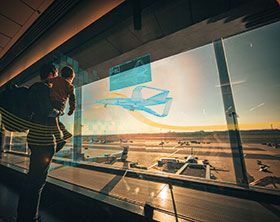
The Brazilian Aeronautics Institute of Technology (ITA) is involved in training, research and technological development in the field of aeronautics. The ITA attaches particular importance to fostering links between research and industry and works in close cooperation with the Brazilian Government to ensure that research aligns as closely as possible to the needs of industry. Issues currently in the spotlight are brake system performance and anti-skid technology in normal and failure modes.
To play through possible scenarios, the ITA relies on the use of simulation software from the Siemens PLM Software Simcenter portfolio. This allows students at the ITA to gather experience with the latest features of the advanced simulation setup during their course training. Quite apart from this benefit, ITA has also been able to speed up the evaluation of brake system performance under failure conditions, helping to strengthen Brazil’s position in the highly competitive aeronautical industry.
Aircraft brake systems are not only highly complex but also crucial to aircraft safety. The blocking of brakes during braking manoeuvres, for instance, must be avoided at all costs. Traditionally, brake system performance has always been tested by executing multiple load rig tests and test flights. This is time consuming and also a costly process, which explains why the research team at the ITA set about looking for a new method that would ensure a safe landing every time the Aeronautics Research Institute studies aircraft braking operations using simulation software from Siemens.
Applications & Technology News involve simulation of the aircraft’s hydraulic brake system. A study carried out by the ITA demonstrated the usefulness of system simulation to design and validate the model of a hydraulic brake system in order to assess functionality in both normal operation and in the event of a failure. The experts at the ITA used the LMS Imagine.Lab Amesim from Siemens PLM Software to model the hydraulic system. Computational parameterised model the researchers at ITA decided to base their study on a braking system supplied with power by the aircraft’s own hydraulic power generation system. This system is later duplicated to independently provide hydraulic power to each brake. The model generated in LMS Amesim is composed of three elements: the valve assembly, the brake assemblies and the input blocks. “LMS Amesim is a great tool for quickly creating system models, mainly due to its facility for dealing with the physical blocks found in its software libraries,” says Mario Maia Neto, a PhD candidate at ITA. As he explained, this enabled the creation of complex models without the need to write entire mathematical formulas for each subsystem. Using LMS Amesim helped ITA develop a computational, parameterised model for the aircraft hydraulic brake system to assess the behaviour of its relevant variables in normal operational conditions, as well as when typical failures are simulated. Subsequently the results were compared in order to find a way of compensating for the loss of performance in the ‘failure mode’. The last step of this computational method was to devise a strategy or actions such as the definition of specific maintenance tasks to maintain the required system level. Neto envisages enormous potential for the new methodology. “In the current context, modelling and simulation has the potential to improve the execution of several design development activities, such as system architecture study, requirements validation, performance analysis and optimisation, safety and assessment, fault detection and diagnosis,” he concludes. Using LMS Imagine, Lab Amesim from Siemens PLM Software, the experts at the ITA are able to quickly and simply generate a virtual model of a hydraulic aircraft brake system. The model – composed of the valve assembly, brake assemblies and input blocks – is used to analyse brake system performance and anti-skid technology in the normal and failure modes. The brake’s normal torque response can then be directly compared to braking behaviour in the simulated failure mode.
For more information contact Jennifer Naidoo, Siemens Digital Factory and Process Industries and Drives, +27 11 652 2795, [email protected], www.siemens.co.za
| Tel: | +27 11 652 2000 |
| Fax: | 086 506 6149 |
| Email: | [email protected] |
| www: | www.siemens.co.za |
| Articles: | More information and articles about Siemens South Africa |






© Technews Publishing (Pty) Ltd | All Rights Reserved

 printer friendly version