



Editor's Choice


Thousands of robots swarm together

Second Quarter 2020 Editor's Choice Robotics & Mechatronics

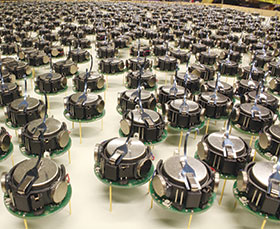
Each low-cost, three-legged robot moves around with the help of two motors that vibrate at different frequencies, causing it to move across a surface on its rigid legs.

It communicates with its neighbours, measuring their proximity through infrared transmitters and receivers. After being programmed to form a set shape such as the letter K or a starfish, each one in turn navigates its way to a final position using primitive behaviours – following the edge of a group, tracking a distance from the origin or maintaining a sense of relative location. If a traffic jam forms, nearby robots sense it and cooperate to fix the problem.

“Each robot is identical and is controlled by exactly the same program,” explains Dr Michael Rubenstein from the Harvard University School of Engineering and Applied Sciences. “The only thing they have to go on to make decisions is what their neighbours are doing.” The robots are much simpler than many conventional robots, for example individuals may have trouble moving in a straight line; but at full scale the smart algorithm controlling them overcomes individual limitations and the robots can complete a human-specified task – like assembling into a particular shape.

Infrared control

Although the Kilobots can communicate with their neighbours, they have no sense of a broader environment. Four robots mark out the origin of a coordinate system while the remaining robots receive a 2D image of the shape. The initial set of instructions is beamed to the robots via infrared, after which they work autonomously, requiring no further human intervention. Starting with a random selection, if they are in a position to move they motor slowly around, flashing their infrared lights to broadcast information to other Kilobots nearby. They then assemble into the specified shape.

Inspiration from nature

The self-organising behaviour was inspired by the cooperative activities of insects like army ants. The Harvard team aims to provide a physical model for advancing the understanding of collective behaviour, creating artificial swarms with the capabilities of natural ones. The Kilobot demonstrates how simple machines performing simple behaviours can create complexity in a group and that robots can be programmed to perform useful functions by coordinating interactions among many individuals. “The beauty of biological systems is that they are elegantly simple yet in large numbers accomplish the seemingly impossible. At some level you no longer even see the individuals, you just see the collective as an entity in itself,” says research leader Radhika Nagpal, professor of computer science at the Harvard School of Engineering and Applied Sciences.

Practical testing of advanced algorithms

Although there is a large amount of research on algorithms and control methods for groups of decentralised, cooperating robots, they are generally validated by simulation only. The Kilobot goes well beyond the state-of-the-art in robotics by allowing the practical testing of advanced algorithms on a large scale through the use of cheap materials and simple programming. “Performing complex behaviours with as little hardware as possible to keep costs down encompasses the spirit of Kilobots,” says Rubenstein.

An important milestone

The technology is being heralded as an important milestone in the development of collective artificial intelligence. “Increasingly we’re going to see large numbers of robots working together to solve problems,” adds Nagpal. The researchers believe that robot swarms might one day tunnel through rubble to find survivors, remove contaminants from the environment, assist dwindling bee populations in pollinating crops and self-assemble to form support structures in collapsed buildings. Success in getting so many robots to self-organise could be a significant milestone in the development of nanotechnology and a collective artificial intelligence, according to the researchers. The next stage is to refine the intelligence and develop smaller robots capable of the same tasks, eventually aiming for the nano scale.




Share this article:
Share via emailShare via LinkedInPrint this page

Further reading:

PC-based control for additive machine tools
Beckhoff Automation Editor's Choice Electrical switching & drive systems & components
IRPD is a specialist in additive machine tools. Development is heavily focused on high system throughput and consistently high process quality. This goal was achieved with the help of PC- and EtherCAT-based control and drive technology from Beckhoff.

Read more...
A guide to common hydraulic system contaminants
CT Hydraulics (Nqoba) Editor's Choice Hydraulic systems & components
Every engineer, machine designer and maintenance professional understands that the heart of any reliable hydraulic system is its fluid. But the moment that fluid is compromised, your system’s life expectancy and your peace of mind drop dramatically.

Read more...
Compressed air piping design
Artic Driers International Editor's Choice Pneumatic systems & components
When designing a compressed air pipeline, remember that size matters. The internal size of the pipe, along with the pressure and air volume, determine the velocity of the compressed air in the pipeline.

Read more...
Top questions about pressure gauges
SA Gauge Editor's Choice Pneumatic systems & components
Some questions never go out of date, and in our industry, a few have been asked for decades. At SA Gauge, we hear them every week. Here are the ten questions we hear most often, and the practical answers that can save time, money and frustration.

Read more...
A technological leap with the proportional valve terminal
Festo South Africa Editor's Choice
Festo continually makes bold technological leaps to keep pace with global advancements. Controlled Pneumatics is redefining the boundaries of compressed air technology to meet the demands of today’s most advanced applications.

Read more...
PC-based control optimises robotic parts handling on plastics machinery
Beckhoff Automation Editor's Choice
NEO is a cartesian robot developed by INAUTOM Robótica in Portugal for parts removal on plastics machinery. Its aim is to increase system productivity. NAUTOM Robótica has entered into a strategic partnership with Bresimar Automação to increase the working speed of the cartesian robots using advanced control and motion solutions from Beckhoff. The result is a comprehensive, future-proof automation solution for its entire family of cartesian robots.

Read more...
Heavy impact, smart control
Axiom Hydraulics Editor's Choice Hydraulic systems & components
Every now and then a project lands on your desk that’s equal parts heavy machinery and fine control - a tantalising mix for any engineer. A client approached Axiom Hydraulics with a project exactly like this.

Read more...
Driving fluid power forward
Editor's Choice
The National Fluid Power Association is developing its latest Industrial Technology Roadmap for 2025, showing how hydraulics and pneumatics are changing to meet new industrial demands.

Read more...
World’s hottest engine
Editor's Choice Electrical switching & drive systems & components
Scientists have built the world’s smallest engine. It’s also the world’s hottest. It could provide an unparalleled understanding of the laws of thermodynamics on a small scale, and provide the foundation for a new, efficient way to compute how proteins fold.

Read more...
Reinventing the wheel
Editor's Choice Electrical switching & drive systems & components
Once a curiosity in the early automotive age, in-wheel motors are now re-emerging with real promise. From electric cars to commercial vehicles and even aircraft, they are on the verge of transforming transportation engineering.

Read more...


While every effort has been made to ensure the accuracy of the information contained herein, the publisher and its agents cannot be held responsible for any errors contained, or any loss incurred as a result. Articles published do not necessarily reflect the views of the publishers. The editor reserves the right to alter or cut copy. Articles submitted are deemed to have been cleared for publication. Advertisements and company contact details are published as provided by the advertiser. Technews Publishing (Pty) Ltd cannot be held responsible for the accuracy or veracity of supplied material.


© Technews Publishing (Pty) Ltd | All Rights Reserved