Insect-sized flying robots with flapping wings
First Quarter 2022
Editor's Choice
Robotics & Mechatronics
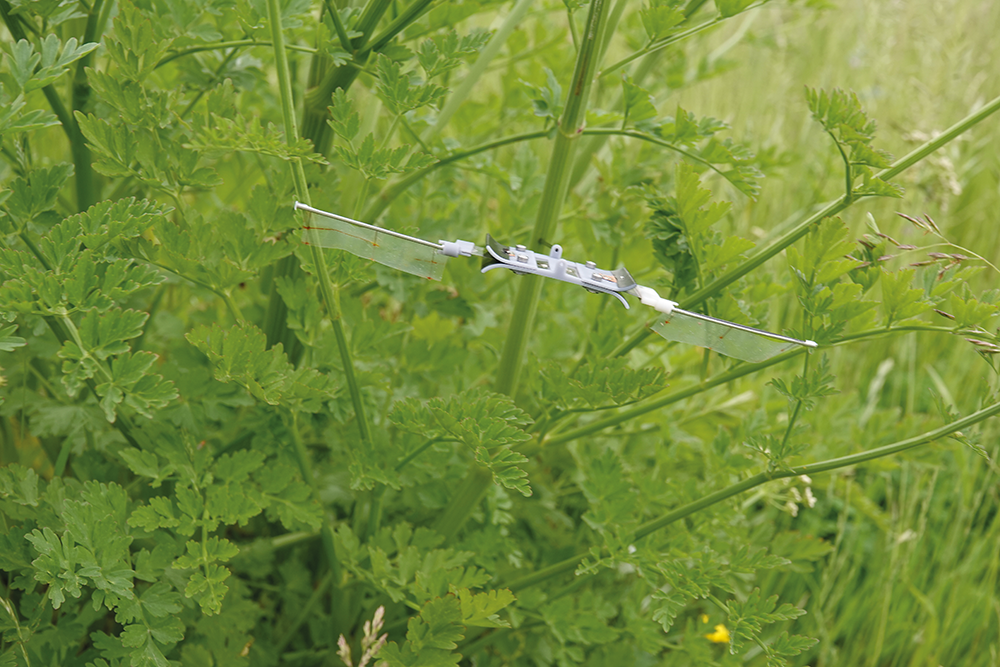
A new drive system for flapping wing autonomous robots has been developed by a University of Bristol team, using a new method of electromechanical zipping that does away with the need for conventional motors and gears.
This new advance published in the journal Science Robotics* could pave the way for smaller, lighter and more effective micro flying robots for environmental monitoring, search and rescue and deployment in hazardous environments. Until now, typical micro flying robots have used motors, gears and other complex transmission systems to achieve the up-and-down motion of the wings. This has added complexity, weight and undesired dynamic effects.
Taking inspiration from bees and other flying insects, researchers from Bristol’s Faculty of Engineering, led by professor of Robotics Jonathan Rossiter, have successfully demonstrated a direct-drive artificial muscle system, called the liquid-amplified zipping actuator (LAZA), that achieves wing motion using no rotating parts or gears.
The LAZA system greatly simplifies the flapping mechanism, enabling future miniaturisation of flapping robots down to the size of insects.
In the paper, the team shows how a pair of LAZA-powered flapping wings can provide more power compared with insect muscle of the same weight, enough to fly a robot across a room at 18*nbsp;body lengths per second.
They also demonstrated how the LAZA can deliver consistent flapping over more than one million cycles, important for making flapping robots that can undertake long-haul flights.
The team expects the LAZA to be adopted as a fundamental building block for a range of autonomous insect-like flying robots.
Dr Tim Helps, lead author and developer of the LAZA system said: “With the LAZA, we apply electrostatic forces directly on the wing, rather than through a complex, inefficient transmission system. This leads to better performance and simpler design and will unlock a new class of low-cost, lightweight flapping micro-air vehicles for future applications, like autonomous inspection of off-shore wind turbines.”
Professor Rossiter added: “Making smaller and better performing flapping wing micro robots is a huge challenge. LAZA is an important step toward autonomous flying robots that could be as small as insects and perform environmentally-critical tasks such as plant pollination and exciting emerging roles such as finding people in collapsed buildings.”
*Paper: ‘Liquid-amplified zipping actuators for micro-air vehicles with transmission-free flapping’ by T. Helps, C. Romero, M. Taghavi, A. Conn and J. Rossiter in Science Robotics.
Further reading:
From the editor's desk: A new era
Technews Publishing
Editor's Choice
After fifteen years as editor of Motion Control, the time has come for me to hand over to Andrew Seldon. It has been a privilege to be part of this publication and to witness not only the remarkable advances in motion control, fluid power and automation, but also the enormous changes in the world around us.
Read more...
OMRON Robotics demos next-generation autonomous mobile robots
Editor's Choice News & events Robotics & Mechatronics
Advancing smarter material flow with the all-new LD-150 and LD-300 AMRs, OMRON Robotics demonstrated the next generation of its flagship LD series autonomous mobile robots (AMRs) at Automate 2026 in June.
Read more...
The hidden heroes who shape Africa’s industrial future
Bosch Rexroth Africa
Editor's Choice News & events
Behind every industrial success story, there’s a human one. Their names may never appear on a project signboard or in a headline. Yet their expertise and determination keep industries moving every day.
Read more...
Bühler Southern Africa leads industry dialogue on apprenticeships
Editor's Choice News & events
Bühler Southern Africa brought together representatives from industry, government and international organisations on
30 June 2026 to explore how quality apprenticeships can help bridge the gap between high youth unemployment and industry demand for skilled technical workers.
Read more...
Why lubrication fails in mining and what to do about it
Editor's Choice Electrical switching & drive systems & components
Lubrication Engineers explains the recurring failure points behind mining lubrication problems and how the right product, storage and application practices can improve equipment reliability.
Read more...
Solving common automation challenges with Festo’s servo drive and servo motor solutions
Festo
Editor's Choice Electrical switching & drive systems & components
Automation projects face challenges that include limited installation space, the need for precise and repeatable linear motion, rising cycle-speed demands, and seamless integration with existing control architectures. Festo’s servo portfolio directly addresses these issues with compact, modular drive and motor solutions designed for specific applications.
Read more...
Inside the Giant Magellan Telescope with mechanical engineering at astronomical scale
Editor's Choice Electrical switching & drive systems & components
Construction of the Giant Magellan Telescope, set to become the world’s largest Gregorian optical infrared telescope, is well underway. While its scientific mission is to transform astronomy, its performance depends heavily on advanced mechanical, hydraulic and pneumatic engineering.
Read more...
Jendamark catalyst shrinking technology leverages SEW-EURODRIVE precision
SEW-EURODRIVE
Editor's Choice Electrical switching & drive systems & components
Innovative technology for shrinking catalytic converters, designed and built in South Africa by Jendamark Automation for the global market, relies on the precision of SEW-EURODRIVE’s highly dynamic servo-geared units and software.
Read more...
Motion control for flight simulators
Beckhoff Automation
Editor's Choice Electrical switching & drive systems & components
Turkish specialist, SANLAB is a leader in motion platforms and simulation technologies. At the heart of these platforms are application-specific servo drives, servomotors and industrial PCs for real-time control, which are supplied by Beckhoff.
Read more...
PC-based control for additive machine tools
Beckhoff Automation
Editor's Choice Electrical switching & drive systems & components
IRPD is a specialist in additive machine tools. Development is heavily focused on high system throughput and consistently high process quality. This goal was achieved with the help of PC- and EtherCAT-based control and drive technology from Beckhoff.
Read more...










 printer friendly version