


During a vehicle electrification project, it is important to collaborate with a credible electrification partner on key system information, specifications and the system’s desired results. Factors to consider include the type of vehicle, its drivetrain architecture, battery technology and voltage, new or existing gears, performance, life and efficiency targets. One of the most important components in your electric system is the motor.
Cooling options
How an electric motor is cooled is a top consideration since there is a direct correlation between the motor’s ability to dissipate heat and its power. The cooler the motor, the more power it delivers. To actively cool an electric motor and extend the performance, oil or water ethylene glycol are recommended.
Spray oil cooling is a ‘wet’ rotor design and is very effective at cooling an electric motor. In addition, if it is integrated into a drivetrain component like a transmission or gearbox, the same oil can be circulated and used for the motor. For example, this oil can also be used to lubricate bearings. Using spray oil on the motor’s rotor can also remove heat from the centre of the motor.
If the spray oil cooling is not integrated into a drivetrain or transmission, there are implications, including the addition of a stand-alone oil cooling circuit and larger circulation pumps, resulting in more system complexity and an increase in cost. Using different oils can also vary the system’s thermal capacitance. Finally, the motor’s angle of operation or scavenging must be considered to ensure the oil does not enter the air gap between the rotor and stator, resulting in shear and an excess hot spot.
A liquid cooled electric motor, or an external cooled motor using a secondary jacket, is another effective method to cool an electric motor and boost its performance. Liquid cooled electric motors utilise water ethylene glycol, which offers better thermal capacity than oil. If the electric system has advanced batteries and higher power electronics, water ethylene glycol is typically used as well to cool the vehicle inverters and the battery.
However liquid cooling can hinder a system’s high speed and continuous power requirements due to the additional size and weight of the double wall housing or secondary jacket. Convection cooling is ideal for smaller vehicles with a low tractive duty cycle where a motor coolant may not be justified due to its cost and complexity. Instead of a flooded jacket cooling design, which would increase the size and weight of the motor, Parker developed an embedded serpentine coolant tube circuit. This innovative design provides a smaller and lighter motor. Additional design benefits include the elimination of a thermal interface to the heat source and maximising its turbulent flow effectiveness.
Speed range
Since the amount of magnetic material also affects an electric motor’s size, Parker works with customers to optimise their gear reduction systems in order to produce the required power at a high speed. The company recommends taking advantage of motor speed and accompanying efficiency to reduce costs. For example, when replacing a 50 kW diesel engine producing 400 Nm of torque at 2000 rpm, it would be advantageous to combine a motor producing 200 Nm at 4000 rpm or 100 Nm at 8000 rpm with a 2:1 or 4:1 gear reduction respectively to achieve equivalent performance at a lower cost.
Form factor
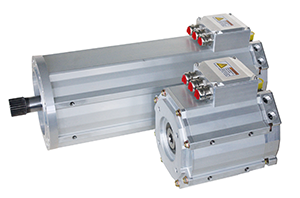
One electric motor size does not fit all. When selecting the correct electric motor, it is important to choose the right diameter. Parker’s GVM Series Permanent Magnet AC (PMAC) motor is available in three diameters with multiple lengths, to scale for a system’s torque and power requirements.
Efficiency
When electrifying a vehicle, fractions of efficiency matter to overall performance. In other words, not all permanent magnet motor designs have the same efficiency characteristics. What is important, especially in propulsion applications, is the motor’s efficiency over its range of operation. Parker’s GVM magnetic design exhibits very high efficiency across a broad operating range of performance. This can yield a 2% increase in a vehicle’s range, or an increase in time before the next charge.
Reliability and durability
Finally, select an electric motor specific to your application. If the electric motor is going to be used in a rough environment, consider a motor like the GVM that meets test standard SAE J1455 for crash, shock, vibration, dust, sand/gravel, bombardment, humidity, sea spray and immersion, along with operating temperatures from -40 to 120°C.
| Tel: | +27 11 961 0700 |
| Fax: | +27 11 392 7213 |
| Email: | [email protected] |
| www: | www.parker.com/za |
| Articles: | More information and articles about Parker Hannifin - Sales Company South Africa |





© Technews Publishing (Pty) Ltd | All Rights Reserved

 printer friendly version