


The world’s largest and most powerful magnet is the Central Solenoid magnet in the ITER fusion reactor in France. Built by General Atomics, it is the result of over five years of research and development, and the statistics are mind-blowing. This giant pulsed superconducting electromagnet is 18 metres tall, 4,2 metres wide, and weighs around 90 700 tons. Its strength is 13 teslas at its core, which is about 280 000 times the strength of the earth’s magnetic field. It will play a critical role in the new ITER fusion reactor, which is a collaborative project among 35 nations.
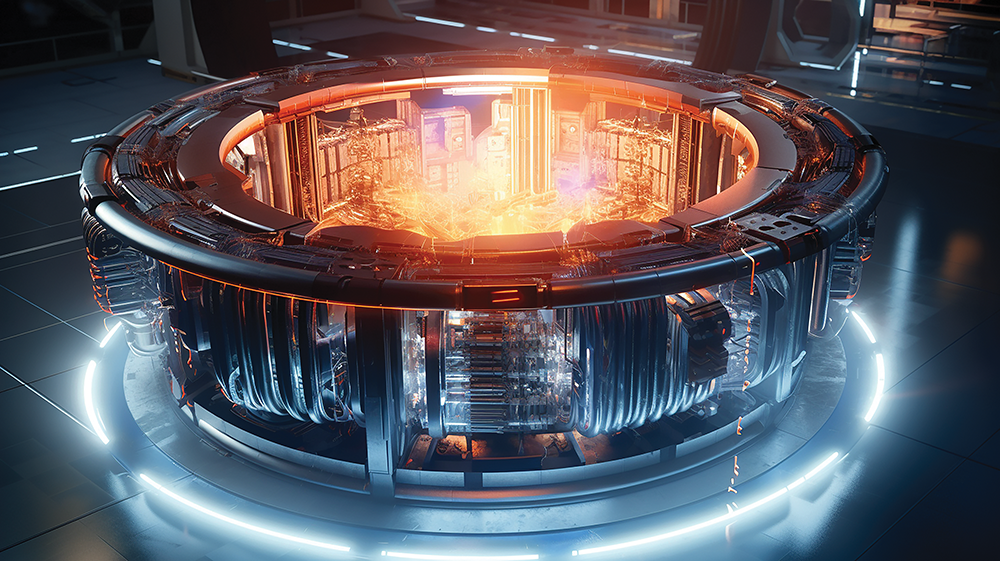
The project aims to achieve sustained nuclear fusion to replicate the process of energy production in the centre of the sun. If successful, the fusion reactor will be a major breakthrough in providing large-scale clean electricity and combating global climate change. General Atomics says that Central Solenoid is strong enough to lift the 101 600 ton USS Gerald R Ford, the world’s biggest aircraft carrier, two metres into the air. It is so strong, a structure has been built to house it which needs to be able to withstand forces twice that of a space shuttle taking off.
The promise of fusion
In nuclear fusion a small amount of vapourised deuterium and tritium is released into a large, doughnut-shaped vacuum chamber known as a tokamak. The tokamak superheats these isotopes, stripping away the electrons and converting the gas into plasma. This superhot plasma reaches 150 million °C, or ten times hotter than the core of the sun. At this temperature, the atoms undergo fusion, giving off large amounts of energy, which can be used to create electricity by heating water, and creating steam to turn turbines.
One of the biggest hurdles to sustained fusion is containing and manipulating the searing plasma inside the reactors. This is where the Central Solenoid comes into play. The powerful magnetic field it creates will pin the plasma in place inside the tokamak, and maintain the reaction.
How its made
The Central Solenoid is made up of six individual modules stacked inside the centre of the ITER reactor. Each individual module is essentially a big coil containing around 5,6 kilometres of steel-jacketed niobium-tin superconducting cable. The module is then heat treated in a large furnace for several weeks to further increase its conductivity, after which the cables are insulated and the coil is wrapped into its final shape.
After insulation, the module is enclosed in a mould, and 3800 litres of epoxy resin are injected under vacuum to saturate the insulation materials and prevent bubbles or voids. When hardened at 650°C, the epoxy fuses the entire module into a single structural unit.
The finished module is subjected to a series of demanding tests, placing it in the extreme conditions it will experience during operation, including near complete vacuum, and a cryogenic temperature of -270°C required for the magnet to become superconducting.
The mission
The Central Solenoid will play a critical role in ITER’s mission to prove that energy from hydrogen fusion can be created and controlled on an industrial scale, and to establish fusion energy as a practical, safe and inexhaustible source of clean, abundant and carbon-free electricity. The materials to power hydrogen fusion for millions of years are readily abundant, and the only by-product is helium. Like a gas, coal, or nuclear fission plant, a fusion plant will provide highly concentrated, baseload energy around the clock. Yet fusion produces no greenhouse gas emissions or long-lived radioactive waste. The risk of accidents with a fusion plant is very limited – if containment is lost, the fusion reaction simply stops.
Conclusion
Although ITER will not generate electricity, it will be a critical testbed for the technologies necessary for the commercial production of fusion-based electricity. The lessons learned at ITER will be used to design the first&bsp;generation of commercial fusion power plants.
Central Solenoid is currently around 75% complete. The construction remains on track to finish by 2025, but full-scale fusion reactions won’t take place until 2035 at the earliest. “This project ranks among the largest, most complex and demanding magnet programmes ever undertaken,” says John Smith, General Atomics’ director of engineering and projects. “The ITER project is the most complex scientific collaboration in history,” says Dr. Bernard Bigot, director-general of ITER. “Without this global participation, ITER would not have been possible; but as a combined effort, each team leverages its investment by what it learns from the others.”






© Technews Publishing (Pty) Ltd | All Rights Reserved

 printer friendly version