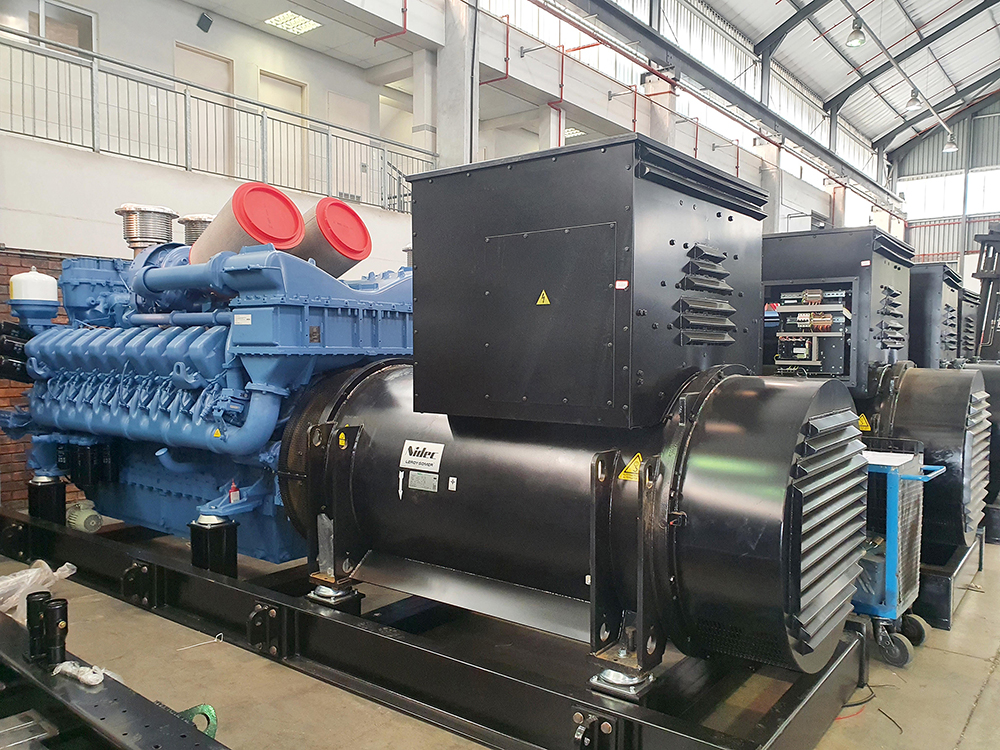
The increasing reliance of South African businesses on generator sets (gensets) to mitigate power disruptions highlights a crucial need for proper selection based on specific operational demands. Despite their growing usage, there is still widespread confusion about how to choose the appropriate genset, often leading to inefficient and costly decisions.
Understanding the differences between standby, prime and continuous applications is essential to optimise genset performance and longevity. Craig Bouwer, senior manager Gensets at WEG Africa, explains that many customers mistakenly select gensets based solely on nameplate rating. “Understanding the specific application of the genset is crucial for the right selection, and the first step is knowing that genset applications are broadly categorised into standby, prime and continuous, each with distinct operational requirements,” he says.
Standby gensets are seldom used, and are typically kept for emergency situations. These units have a limit on operational hours per year and a specific load factor. Due to loadshedding, few gensets are used solely for standby purposes in South Africa,
Prime and continuous applications are more common in the country. Prime gensets can run unlimited hours annually with variable loads, maintaining an average load factor below their maximum rating. Continuous gensets also operate unlimited hours, but with a constant and predetermined load.
Engineering manager, Damian Schutte explains that understanding the difference between prime and continuous ratings is also critical. The load factor is a key differentiator, not the unlimited time requirement, with prime applications having variable loads and continuous ones having fixed loads.
Schutte uses a vehicle analogy to illustrate the differences: a continuous genset is like a car on cruise control operating at a steady speed within its capacity on a long-distance trip, while a prime genset is akin to a vehicle driving in the city. Standby can be perceived as racing between traffic lights.
The choice of genset rating impacts its expected lifespan and maintenance needs. For example, continuous power may be required in mines during loadshedding to supplement limited grid power, while industrial applications like workshops with variable loads would need a prime-rated genset. Bouwer notes that standby power remains vital in essential service sectors for health and safety reasons, especially in environments like mines, hospitals and data centres.
As an OEM, WEG Africa uses these categories to guide customers in their genset choices, aiming to match their specific needs and expected service life. “We caution against oversimplifying the selection process by just matching the total load with a genset's nameplate rating, as this can lead to premature failure and additional costs. To ensure the correct choice, we work closely with customers – assessing their load requirements, usage frequency and operational conditions – and through this process we can ensure optimal genset selection,” Bouwer concludes.
Magma X100 delivers AMB systems for wide range of industrial machinery
Electrical switching & drive systems & components
SpinDrive launches Magma X100 controller, bringing active magnetic bearing technology to a new generation of industrial applications. The Magma X100 expands SpinDrive’s oil-free, frictionless AMB technology to applications below 150 kW, unlocking new addressable markets.
Read more...Why lubrication fails in mining and what to do about it
Editor's Choice Electrical switching & drive systems & components
Lubrication Engineers explains the recurring failure points behind mining lubrication problems and how the right product, storage and application practices can improve equipment reliability.
Read more...Echain protects cables in cleanrooms igus
Electrical switching & drive systems & components
Advanced polymer manufacturer igus has developed a new cleanroom energy chain with an innovative guide system that allows for abrasion-resistant travel over distances of up to 30 metres.
Read more...PowerFlex drives cut energy use by up to 30% amid rising costs
Electrical switching & drive systems & components
Rockwell Automation’s PowerFlex 755TS variable frequency drives are delivering energy reductions of 10 to 30% in Africa’s industrial operations, with adaptive control and predictive maintenance features that cut downtime by up to 50%.
Read more...Next-generation oil-free motor systems with active magnetic bearings
Electrical switching & drive systems & components
WEG and SpinDrive are collaborating to integrate SpinDrive’s AMBs and built-in IoT condition monitoring into WEG’s market-leading electric motor offering, creating an oil-free, maintenance-free drive solution.
Read more...Direct drive with integrated control Vepac Electronics
Electrical switching & drive systems & components
The PSD 40 direct drive is a mechatronic system with integrated control, bus interface and absolute measuring system, with no battery required.
Read more...AI-powered on-premises analytics for industrial drives Siemens South Africa
Electrical switching & drive systems & components
Siemens is introducing a new on-premises analytics solution for industrial drive systems. The software enables users to evaluate drive data entirely within their own infrastructure and meet stringent data-sovereignty requirements.
Read more...Hydrostatic machine base for ultra-precision grinding centre
Electrical switching & drive systems & components
Hyprostatik Schönfeld has developed a high-precision hydrostatic machine base for a new ultra-precision grinding centre for Optotech. The machine platform enables a previously unattainable combination of dimensional accuracy, dynamics and surface quality in the ultra-precision grinding of optical surfaces.
While every effort has been made to ensure the accuracy of the information contained herein, the publisher and its agents cannot be held responsible for any errors contained, or any loss incurred as a result. Articles published do not necessarily reflect the views of the publishers. The editor reserves the right to alter or cut copy. Articles submitted are deemed to have been cleared for publication. Advertisements and company contact details are published as provided by the advertiser. Technews Publishing (Pty) Ltd cannot be held responsible for the accuracy or veracity of supplied material.










 printer friendly version