




Compressed air dryers are common in various industries for a good reason. Clean and dry compressed air is essential in today’s modern operating environment. Even a mid-range air compressor can collect hundreds of litres of water and oil in a day. Without an air dryer and filter bank in line the downtime created by condensate can be substantial. However, there are issues about air dryer selection and the impact of geographic location that need careful consideration prior to placing an order.
What’s inside the box
A dryer consists of thermally matched parts. There is the fan-cooled freon gas condenser which is cooled by atmospheric air or cooling water. This is followed by the compressed air heat exchanger/evaporator. This cools the warm, wet saturated compressed air to 3°C, and this cooling effect turns the water vapour in the compressed air into a liquid condensate that can be trapped and ejected via an automatic drain- to-waste.
Most commonly, a fully hermetic freon compressor is the source of compressed freon gas that ejects hot freon (HP circuit) and accepts back low temperature freon (LP circuit) for recompression. All these items are thermally matched to the compressed air load (air volume) entering the dryer.
The designers of dryers work on ‘standard conditions’, which in Europe it is:
• 25°C ambient.
• 35°C compressed air inlet to dryer.
• 7 bar air inlet pressure.
• A dewpoint of 3°C.
• A specific volume of compressed air – we will assume this is 10m3/min.
If one or more of these temperatures is higher than designed for (with a given compressed air flow rate) or the pressure is lower, the gas system will start to take strain. It cannot handle thermal overloading. If this happens, the gas pressure will rise and a HP gas pressure trip will occur. In this event the compressed air dew point will rise and the compressed air becomes wet. Wet compressed air is not what you paid for. It should be noted that HP trip switches require manual resetting.
High gas temperatures may also cause the freon compressor’s internal thermostatic protection relays to open. These thermal relays protect the freon motor windings. The opening of this set of relays will shut down the gas compressor, and wet compressed air results. Then when the gas compressor cools down, the relays reset and energise the compressor again. If these relays are subjected to repeated opening and closing, eventually they will burn out. This leads to compressor failure and repair bills, dryer downtime, and wet compressed air creating havoc downstream.
Dryer re-rating
We will make the following assumptions to select a dryer:
• Inlet air flow is 10 m3/min.
• Inlet air pressure is 7 bar G.
• Ambient summer temperature in the dryer area is 35°C.
• Inlet air temp from the air compressor in summer is 45°C.
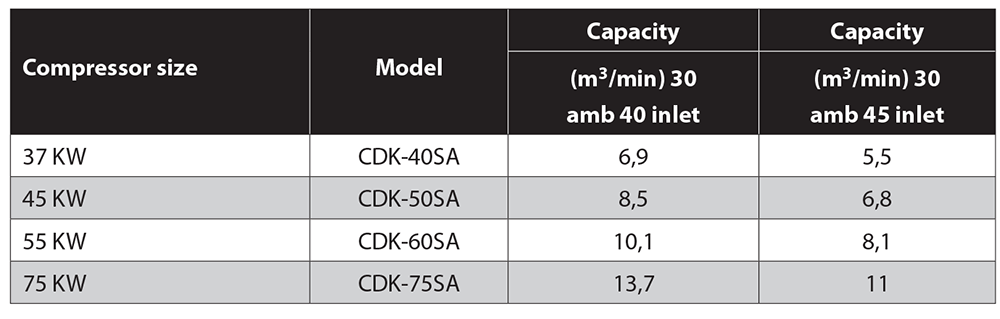
Referring to the chart below, a Model CDK 75SA is the one to select. It’s capacity is 11 m3/min using the above assumptions, and that’s fine for most summer operational areas in South Africa. In winter, with cooler temperatures, the dryer will have an easier time and will provide the dew point required.
Euro specs
If the dryer was operating in a summer temperature of ambient 25°C, inlet 35°C and bar 3° dew point, it could handle ±17 m3/min; but beware of buying equipment based on this European specification.
By re-rating a dryer we match the thermal load to the mechanical capacity of the freon compressor and its associated equipment to the temperatures in the dryer area.
Or stated another way: high ambient and inlet temperatures easily overload the refrigeration circuit, and the fan-cooled condenser cannot dissipate the heat of the freon gas to obtain dew point or achieve the correct suction temperatures. By selecting a bigger air dryer, we automatically have more thermal capacity within the dryer and the ability to accept and reject higher heat loads imposed by the dryer’s location.
A dryer that is purchased based on the European flow rate conditions and installed in South Africa will be severely undersized when summer arrives.
With worldwide temperatures rising almost year by year, the correct selection of an air dryer is critical. In times gone by, a
30°C ambient and 40°C inlet selection was normal, but now,
If the supplier chain does not publish the correction tables in sales leaflets or online, or reselect the dryer to suit site conditions, it’s time to move on. Buying an undersized air dryer is wasting your time and your hard-won budget allocation.
Artic Driers also has practical guides to compressor room design, which can be found at the following link:
https://articdriers.co.za/wp-content/uploads/2025/05/COMPRESSOR-HOUSE-Design-Hints-FAQs-2025.pdf. The dryers in the table represent a fraction of Artic’s large range, and the models are shown for illustration purposes only.
| Tel: | +27 11 420 0274 |
| Email: | [email protected] |
| www: | www.articdriers.co.za |
| Articles: | More information and articles about Artic Driers International |






© Technews Publishing (Pty) Ltd | All Rights Reserved

 printer friendly version