


Editor's Choice


Robots in South Africa

Second Quarter 2020 Editor's Choice Robotics & Mechatronics

Manufacturers In South Africa experience significant challenges and there are many obstacles that prevent industries from pushing forward into a new era of automation and robotic solutions. Due to the effects of COVID-19, many businesses might not have a choice but to rapidly adopt these technologies – especially if they wish to survive in this new contactless society. Automation is no longer a sub-point in a five year roadmap, but an item of critical importance.

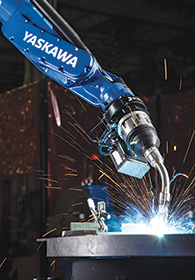
Stringent health and safety measures have always been a massive concern for manufacturers, but many organisations will need to double their efforts to meet the new requirements in the post-COVID-19 world. Yaskawa Southern Africa chairman, Terry Rosenberg, says robotics in South Africa is already operating to international standards.

“Since our products come from an international source, they already adhere to the strictest health, safety and quality guidelines,” he explains. “As a result, we insist on the same standards in our operations. When a client purchases equipment from us, we recommend they take the mechanical and electrical safety facilities we offer as part of the robotic solution, to ensure safe and responsible machine usage. Further to this, we offer prescribed training for the safe, functional use of the equipment once in the production environment.”

At the same time, Yaskawa is educating and preparing its clients to operate robots to the required global standards. “We have a special academy designed for end-user training,” Rosenberg explains. “This school provides modules on the basics of robotics, as well as the specific training for the application. Not only will the end-users learn how to use and program the equipment, but they’ll also be taught how to operate it in a safe environment. Furthermore, we provide ongoing training for new employees and other applications that might be introduced at a later stage.”

Globally, the automotive industry accounts for a significant portion of every robot produced. According to Statista, the automotive robotics market is the second largest industrial robotics market. It is no different in South Africa, where the sector is one of the largest users of robotics solutions. That being said, Rosenberg has seen the adoption of robotics in another key industry.

“We’ve seen growth in the food manufacturing industry, particularly in the material handling aspect of the production line, where robots are used for the packing and palletising of large volumes of products,” he continues. “When there are mass quantities and heavy lifting, robots are capable of performing the functions that might be too dangerous or impossible for humans to execute.”

He adds that the food manufacturing industry is also cognisant of the impact of the 2017 listeriosis outbreak and now COVID-19. There is a need to increase the cleanliness of operations and remove human contact. This can be achieved through the use of robotic solutions.

One of the most common misconceptions about robotics is that it is strictly aimed at large enterprises. Rosenberg stresses that this is not the case. In fact, he has seen a substantial interest and increase in the usage of robots in the SMME sector in recent times.

“For some smaller companies, the only way they can produce the required quantity of products is through the use of robotics,” he explains. “As an example, we encountered a small company that operates its dispenser business from a farm. Due to the current pandemic, the demand for its automatic dispensers drastically increased. In order to meet the demand, the solution was to implement a robot that is able to work around the clock.”

While increasing its production, this business has also had to expand its labour force by 50%, thereby creating more jobs. “There’s a fallacy that robots replace human workers,” Rosenberg says. “That isn’t the case at all, because we’ve seen robotic powered industries turn into global giants that employ more people over the years. These organisations have been able to grow and add to their ranks thanks to technology. There will always be a need for people to complete challenging tasks that require human reasoning.”




Share this article:
Share via emailShare via LinkedInPrint this page

Further reading:

PC-based control for additive machine tools
Beckhoff Automation Editor's Choice Electrical switching & drive systems & components
IRPD is a specialist in additive machine tools. Development is heavily focused on high system throughput and consistently high process quality. This goal was achieved with the help of PC- and EtherCAT-based control and drive technology from Beckhoff.

Read more...
A guide to common hydraulic system contaminants
CT Hydraulics (Nqoba) Editor's Choice Hydraulic systems & components
Every engineer, machine designer and maintenance professional understands that the heart of any reliable hydraulic system is its fluid. But the moment that fluid is compromised, your system’s life expectancy and your peace of mind drop dramatically.

Read more...
Compressed air piping design
Artic Driers International Editor's Choice Pneumatic systems & components
When designing a compressed air pipeline, remember that size matters. The internal size of the pipe, along with the pressure and air volume, determine the velocity of the compressed air in the pipeline.

Read more...
Top questions about pressure gauges
SA Gauge Editor's Choice Pneumatic systems & components
Some questions never go out of date, and in our industry, a few have been asked for decades. At SA Gauge, we hear them every week. Here are the ten questions we hear most often, and the practical answers that can save time, money and frustration.

Read more...
A technological leap with the proportional valve terminal
Festo South Africa Editor's Choice
Festo continually makes bold technological leaps to keep pace with global advancements. Controlled Pneumatics is redefining the boundaries of compressed air technology to meet the demands of today’s most advanced applications.

Read more...
PC-based control optimises robotic parts handling on plastics machinery
Beckhoff Automation Editor's Choice
NEO is a cartesian robot developed by INAUTOM Robótica in Portugal for parts removal on plastics machinery. Its aim is to increase system productivity. NAUTOM Robótica has entered into a strategic partnership with Bresimar Automação to increase the working speed of the cartesian robots using advanced control and motion solutions from Beckhoff. The result is a comprehensive, future-proof automation solution for its entire family of cartesian robots.

Read more...
Heavy impact, smart control
Axiom Hydraulics Editor's Choice Hydraulic systems & components
Every now and then a project lands on your desk that’s equal parts heavy machinery and fine control - a tantalising mix for any engineer. A client approached Axiom Hydraulics with a project exactly like this.

Read more...
Driving fluid power forward
Editor's Choice
The National Fluid Power Association is developing its latest Industrial Technology Roadmap for 2025, showing how hydraulics and pneumatics are changing to meet new industrial demands.

Read more...
World’s hottest engine
Editor's Choice Electrical switching & drive systems & components
Scientists have built the world’s smallest engine. It’s also the world’s hottest. It could provide an unparalleled understanding of the laws of thermodynamics on a small scale, and provide the foundation for a new, efficient way to compute how proteins fold.

Read more...
Reinventing the wheel
Editor's Choice Electrical switching & drive systems & components
Once a curiosity in the early automotive age, in-wheel motors are now re-emerging with real promise. From electric cars to commercial vehicles and even aircraft, they are on the verge of transforming transportation engineering.

Read more...


While every effort has been made to ensure the accuracy of the information contained herein, the publisher and its agents cannot be held responsible for any errors contained, or any loss incurred as a result. Articles published do not necessarily reflect the views of the publishers. The editor reserves the right to alter or cut copy. Articles submitted are deemed to have been cleared for publication. Advertisements and company contact details are published as provided by the advertiser. Technews Publishing (Pty) Ltd cannot be held responsible for the accuracy or veracity of supplied material.


© Technews Publishing (Pty) Ltd | All Rights Reserved