Mobile robots for quiet locations
1 August 2020
Editor's Choice
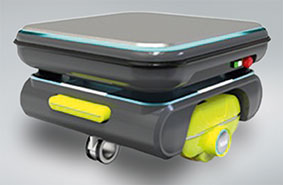
NSK has developed an innovative direct-drive wheel unit aimed at OEMs looking to add mobility to their autonomous or collaborative robots. Specifically designed for use in quiet environments such as hospitals, hotels, offices and libraries, robots fitted with the new wheel unit can efficiently carry and move loads up to 100 kg without disturbing people.
The major obstacle with systems like conventional autonomous guided vehicles used in factories and warehouses is the noise they make. In contrast, the NSK direct-drive wheel unit is much quieter, facilitating use in public spaces and non-manufacturing environments. Settings such as service sector businesses and public facilities require robots that operate quietly to avoid impeding conversations and disturbing people from their tasks.
The quiet nature of NSK’s wheel unit is attributed to its gearless structure (direct-drive motor), which leverages the technology behind the company’s Megatorque Motor to eliminate the operating noise generated by typical gearboxes. Using the Megatorque Motor as a wheel was a new concept and NSK had to invent ways of employing the system’s parts to create the optimal specification at a reasonable cost.
As well as low noise output, the wheel unit is designed for safe operation around people and is ideal for use in service robots, power-assist push carts and other collaborative robot (cobot) applications. A key feature of the design is its ‘back-driveability’, which makes for easy reversion to push/pull manual operations in the event of an issue.
In use, a newly developed dedicated drive controls two wheel units simultaneously via simple signals. The drive is equipped with sensors measuring wheel rotation, acceleration, tilt and other useful parameters. Signals from the sensors can be output for use by an on-board PC in autonomous robot applications.
The development process has been intensive to ensure the delivery of a high quality, technically competent and functionally robust solution. A broad range of existing technologies was leveraged, including mechatronics, controls and software, with NSK’s team of experts tasked with engineering a system that could fulfil a new robotics market. A key part of this work was obtaining the opinions of people who worked in places like hospitals and libraries, to find out what kind of robot would provide the optimum solution for such environments. After all, alongside the desire to drive a new frontier in robotics, NSK also has the ambition of bringing useful robots closer to daily life.
Further reading:
From the editor's desk: A new era
Technews Publishing
Editor's Choice
After fifteen years as editor of Motion Control, the time has come for me to hand over to Andrew Seldon. It has been a privilege to be part of this publication and to witness not only the remarkable advances in motion control, fluid power and automation, but also the enormous changes in the world around us.
Read more...
OMRON Robotics demos next-generation autonomous mobile robots
Editor's Choice News & events Robotics & Mechatronics
Advancing smarter material flow with the all-new LD-150 and LD-300 AMRs, OMRON Robotics demonstrated the next generation of its flagship LD series autonomous mobile robots (AMRs) at Automate 2026 in June.
Read more...
The hidden heroes who shape Africa’s industrial future
Bosch Rexroth Africa
Editor's Choice News & events
Behind every industrial success story, there’s a human one. Their names may never appear on a project signboard or in a headline. Yet their expertise and determination keep industries moving every day.
Read more...
Bühler Southern Africa leads industry dialogue on apprenticeships
Editor's Choice News & events
Bühler Southern Africa brought together representatives from industry, government and international organisations on
30 June 2026 to explore how quality apprenticeships can help bridge the gap between high youth unemployment and industry demand for skilled technical workers.
Read more...
Why lubrication fails in mining and what to do about it
Editor's Choice Electrical switching & drive systems & components
Lubrication Engineers explains the recurring failure points behind mining lubrication problems and how the right product, storage and application practices can improve equipment reliability.
Read more...
Solving common automation challenges with Festo’s servo drive and servo motor solutions
Festo
Editor's Choice Electrical switching & drive systems & components
Automation projects face challenges that include limited installation space, the need for precise and repeatable linear motion, rising cycle-speed demands, and seamless integration with existing control architectures. Festo’s servo portfolio directly addresses these issues with compact, modular drive and motor solutions designed for specific applications.
Read more...
Inside the Giant Magellan Telescope with mechanical engineering at astronomical scale
Editor's Choice Electrical switching & drive systems & components
Construction of the Giant Magellan Telescope, set to become the world’s largest Gregorian optical infrared telescope, is well underway. While its scientific mission is to transform astronomy, its performance depends heavily on advanced mechanical, hydraulic and pneumatic engineering.
Read more...
Jendamark catalyst shrinking technology leverages SEW-EURODRIVE precision
SEW-EURODRIVE
Editor's Choice Electrical switching & drive systems & components
Innovative technology for shrinking catalytic converters, designed and built in South Africa by Jendamark Automation for the global market, relies on the precision of SEW-EURODRIVE’s highly dynamic servo-geared units and software.
Read more...
Motion control for flight simulators
Beckhoff Automation
Editor's Choice Electrical switching & drive systems & components
Turkish specialist, SANLAB is a leader in motion platforms and simulation technologies. At the heart of these platforms are application-specific servo drives, servomotors and industrial PCs for real-time control, which are supplied by Beckhoff.
Read more...
PC-based control for additive machine tools
Beckhoff Automation
Editor's Choice Electrical switching & drive systems & components
IRPD is a specialist in additive machine tools. Development is heavily focused on high system throughput and consistently high process quality. This goal was achieved with the help of PC- and EtherCAT-based control and drive technology from Beckhoff.
Read more...









 printer friendly version