


Editor's Choice


Energy from the power of the moon

Third Quarter 2021 Editor's Choice Shaft power components

The development of tidal power is supported by the global drive to transition from fossil fuels to more sustainable alternatives.

It is intended to help reduce climate-damaging CO2 emissions, slow down global warming and thus build a more sustainable future for generations to come.

With the help of modern technology from SKF, another source of power from nature besides sun and wind will be tapped there from now on: that of the moon. This can be felt on earth in the tidal currents of the sea created by its gravitational pull. Strong currents arise where the ebb and flow of tide squeeze between islands. These are particularly powerful off the Orkney Islands, which is why experiments with tidal current power plants have been carried out here for several years and specifically at the European Marine Energy Centre (EMEC).

Today EMEC is Europe’s leading test site for tidal and wave energy projects. Orbital Marine Power, the Scottish-based developer of the world’s leading floating tidal turbine technology, has now launched its first commercial 2 MW unit, the Orbital O2. This will soon be installed at EMEC, where it will become the world’s most powerful operational tidal turbine.
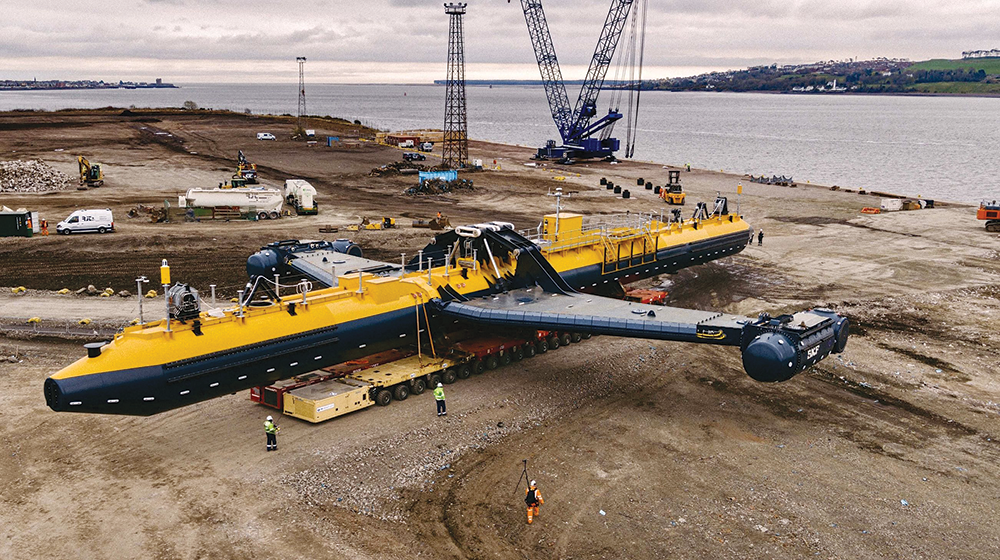
About 15 metres below the O2’s 72 metre long superstructure, two fully integrated power trains from SKF are attached on two wing-like legs. Here the twin-bladed rotors rotate, each with a diameter of 21 metres, the largest ever on a single generating platform to date, driven by the tidal current. The electricity generated in the generators is conducted ashore via a subsea cable, where it can be fed directly into the grid, stored or processed into ‘green hydrogen’.

SKF as an holistic system integrator

SKF delivered the fully integrated holistic power trains as plug-and-play modules to Scotland. The 1 MW power trains, as used in the Scottish Orbital project, complement the generation of electricity from solar and wind power. The tides are reliable, the flow of electricity is predictable and the energy density due to the working medium seawater is very high.

Within the Orbital O2 power trains, SKF core competence is not only found in the main bearings, gearbox bearings and in the slewing bearings for pitching the rotor blades, but also in the seawater seals of the main shafts between the rotor hub and the nacelle housing; and SKF also provides the CoMo condition monitoring for the entire system and various lubrication systems.

Ocean energy: tremendous potential

Experts see ocean energy devices that generate energy from wave or tidal power as an important pillar of the renewable energy transition. In its current offshore strategy, the EU Commission is aiming for 40 gigawatts of ocean energy by 2050 − generated from ocean energy devices, floating photovoltaic systems and by using algae to produce biofuels.

The O2 project has also received funding from the European Union’s Horizon 2020 research and innovation programme under the FloTEC project, as well as the European Regional Development Fund through the Interreg North West Europe programme under the ITEG project.

SKF offers solutions that reduce friction and CO2 emissions, whilst at the same time increasing machine uptime and performance. The company’s products and services around the rotating shaft include bearings, seals, lubrication management, artificial intelligence and wireless condition monitoring. SKF is represented in more than 130 countries and has around 17 000 distributor locations worldwide. Annual sales in 2020 were R125 billion.


Credit(s)


Share this article:
Share via emailShare via LinkedInPrint this page

Further reading:

A technological leap with the proportional valve terminal
Festo South Africa Editor's Choice
Festo continually makes bold technological leaps to keep pace with global advancements. Controlled Pneumatics is redefining the boundaries of compressed air technology to meet the demands of today’s most advanced applications.

Read more...
PC-based control optimises robotic parts handling on plastics machinery
Beckhoff Automation Editor's Choice
NEO is a cartesian robot developed by INAUTOM Robótica in Portugal for parts removal on plastics machinery. Its aim is to increase system productivity. NAUTOM Robótica has entered into a strategic partnership with Bresimar Automação to increase the working speed of the cartesian robots using advanced control and motion solutions from Beckhoff. The result is a comprehensive, future-proof automation solution for its entire family of cartesian robots.

Read more...
Heavy impact, smart control
Axiom Hydraulics Editor's Choice Hydraulic systems & components
Every now and then a project lands on your desk that’s equal parts heavy machinery and fine control - a tantalising mix for any engineer. A client approached Axiom Hydraulics with a project exactly like this.

Read more...
SKF and Sieb & Meyer announce strategic partnership for magnetic bearings
SKF South Africa News & events
SKF has announced a strategic partnership with Sieb & Meyer, a renowned expert in variable frequency drives and control electronics.

Read more...
Driving fluid power forward
Editor's Choice
The National Fluid Power Association is developing its latest Industrial Technology Roadmap for 2025, showing how hydraulics and pneumatics are changing to meet new industrial demands.

Read more...
World’s hottest engine
Editor's Choice Electrical switching & drive systems & components
Scientists have built the world’s smallest engine. It’s also the world’s hottest. It could provide an unparalleled understanding of the laws of thermodynamics on a small scale, and provide the foundation for a new, efficient way to compute how proteins fold.

Read more...
It’s full steam ahead for SKF’s sustainable leak detection solution
SKF South Africa Pneumatic systems & components
One of SKF’s key customers based in Cape Town, which depends on steam systems for its production processes, was facing costly challenges related to high energy consumption and excessive maintenance hours. SKF recommended the TKSU 10 ultrasonic leak detector as a more streamlined, user-friendly alternative.

Read more...
Reinventing the wheel
Editor's Choice Electrical switching & drive systems & components
Once a curiosity in the early automotive age, in-wheel motors are now re-emerging with real promise. From electric cars to commercial vehicles and even aircraft, they are on the verge of transforming transportation engineering.

Read more...
Redefining motion control with Festo’s vision for seamless and intelligent automation
Festo Editor's Choice Electrical switching & drive systems & components
The quest for precision, flexibility and efficiency continues to shape the future of industrial automation, and Festo, as a long-standing leader in automation technology, stands firmly at the forefront of this movement, driving innovation and setting the benchmark for excellence.

Read more...
The opportunity and impact of MEPS electric motor regulations
WEG Africa Editor's Choice Electrical switching & drive systems & components
South African companies are gearing up for the new Minimum Energy Performance Standards, part of a global trend towards energy-efficient electric motors.

Read more...


While every effort has been made to ensure the accuracy of the information contained herein, the publisher and its agents cannot be held responsible for any errors contained, or any loss incurred as a result. Articles published do not necessarily reflect the views of the publishers. The editor reserves the right to alter or cut copy. Articles submitted are deemed to have been cleared for publication. Advertisements and company contact details are published as provided by the advertiser. Technews Publishing (Pty) Ltd cannot be held responsible for the accuracy or veracity of supplied material.


© Technews Publishing (Pty) Ltd | All Rights Reserved