


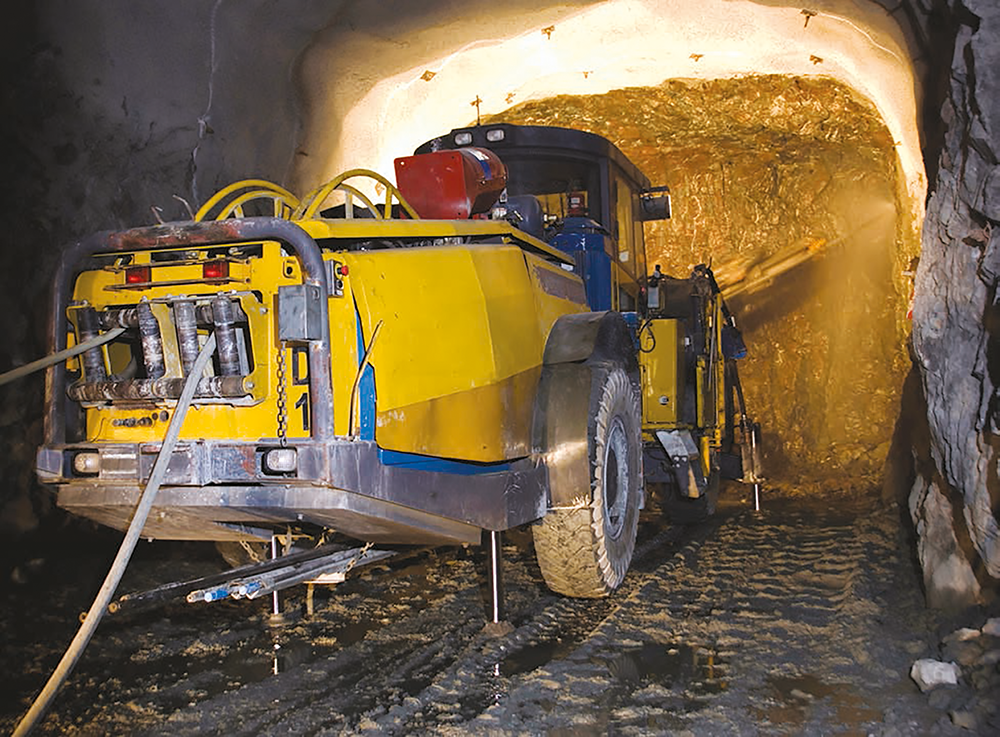
Various technologies, ideas and approaches are being reviewed by mine operators. In today’s mining industry there are many challenges that have never been seen before, and it seems that suppliers, academics and big mining companies are increasingly working together to rethink innovative business models and technologies. Mining operations must identify creative ways to handle the increased demand for minerals and resources as global economies become even more reliant on mineral sales. As a result, mine operators must dig deeper into the earth to accommodate the growing demand. Not only must productivity and output be increased, but also environmental standards must be met. This requires smarter interaction between humans and machines, with increased connectivity. Today’s mines must be agile and have the vision to maintain sustainability, safety and reliability at profitable levels.
“Harnessing the complex data from a connected mine’s equipment is key to maximising uptime. Parker’s Mobile IoT makes it easy to identify usage trends and field-based problems with unparalleled intellectual design and operational insight,” said Kyle Cambridge, sales leader – Motion Systems Group, Parker Hannifin South Africa.
Increasing automation and electrification in mining is driven by green initiatives for reduced emissions as well as a desire for increased safety and productivity. Mining types tend to require different motivations. Underground mining, for example, has continued to electrify as a result of health regulations and cost savings in ventilation systems. In contrast, the surface mining sector is influenced more by corporate carbon neutral programmes. Whatever the motivation, many industry experts believe that automation and digital solutions will work alongside electrification to monitor energy usage and help miners reach their sustainability targets while also improving the quality of the working environment.
Many mines have digitised their operations, effectively embracing digital transformation by adding equipment sensors and adopting unified networks to transmit data, but it seems the industry still has progress to make. According to BCG’s Digital Acceleration Index (DAI), the metals and mining industry is roughly 30-40% less digitally mature than comparable industries such as automotive or chemicals. Mining companies can increase productivity, adapt to a challenging labour market, manage assets more effectively and minimise their environmental footprint by accelerating digital transformation.
Many mines are already engaged in the electrification journey. This is particularly the case for underground mines, where tethered or battery-powered load-haul-dump (LHD) vehicles are common. They significantly reduce ventilation costs while also reducing greenhouse gases. Other benefits include reduced maintenance costs, with battery vehicles having 25% or so fewer parts compared with diesel propulsion systems, and less noise, vibration and heat. In surface mining, the use of electric-powered mining trucks has historically focused on the use of trolley-assist trucks, which are diesel-electric drive haul trucks that receive the power to run the wheel motors from catenary/overhead electric wire lines constructed on specified routes. Converting to electric drives on these vehicles is the most promising option.
In a poll conducted by Mining-Technology.com, between March and May 2021, 30% of the 496 respondents felt that the use of battery-powered vehicles would have the greatest impact on reducing emissions from mining operations over the next five years. This compared with 16% expecting the greatest impact to come from hydrogen-powered vehicles and 21% from use of on-site renewable energy.
Miners typically face risks ranging from flying debris, to a full mine collapse to vehicular incidents. Oversized equipment and lack of visibility could cause bodily harm to miners. Plus, there are ongoing air movement/ventilation issues. In underground mining, methane is one of the biggest safety concerns, as even a small spark could cause a catastrophic explosion.
Advances in technology and the introduction of strict safety regulations by MSHA have resulted in a reduction of workplace incidents in recent years. Maintaining adequate inventory is critical for any product-intensive industry. In the context of mining, ease of ordering, and advance stock arrangements are crucial considering the high-risk environment. Yet, predicting the need for safety stock is the biggest challenge that mining operations face today. The onus then falls on the procurement teams to deep dive into identifying the future requirements of commonly used materials and also analysing the historical stock consumption trend to maintain adequate stock levels and manage advance orders accordingly. If supply chain predictions are not accurate, products need to be obtained locally in an efficient manner.
Parker developed the Parker Tracking System (PTS) in response to market concerns over product availability. PTS offers a better asset management approach by speeding up the product ordering and replacement process.
| Tel: | +27 11 961 0700 |
| Fax: | +27 11 392 7213 |
| Email: | [email protected] |
| www: | www.parker.com/za |
| Articles: | More information and articles about Parker Hannifin - Sales Company South Africa |






© Technews Publishing (Pty) Ltd | All Rights Reserved

 printer friendly version