



Several leading academic institutes in Germany are collaborating on the future of hybrid electric flying. The partners are researching an entirely new propulsion system for medium-range aircraft with up to 35 passengers. They include the Fraunhofer Institutes and the Brandenburg Technical University, under the leadership of Rolls-Royce Germany.
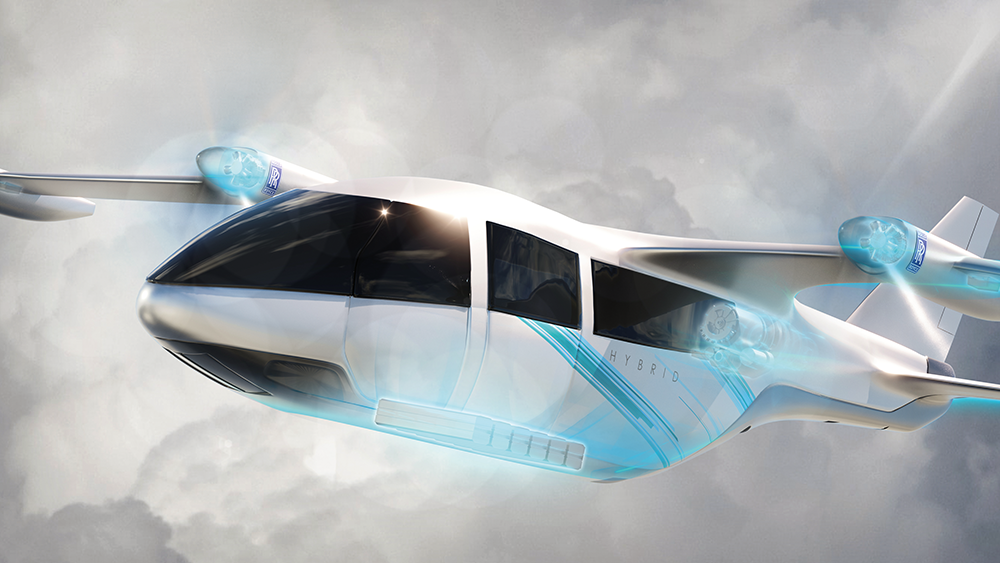
The Clean Sky programmes of the European Union serve as important guidelines for the aviation industry to achieve a significant reduction in nitrogen oxide and noise emissions caused by aviation. A promising technology for this purpose is hybrid electric flying. This is how the partners envision a future hybrid-electric aircraft: a gas turbine generates electrical energy, which charges intermediate battery storage; the aircraft draws its electrical energy from this storage for propulsion.
This technology banks on larger, slower rotating rotors that produce less noise on the ground, creating a significantly smaller noise footprint than conventional propulsion aircraft. The modular structure of the proposed concept also allows for the future use of alternative fuels or entirely new power sources.
By mid-2026, the partners aim to develop manufacturing technologies for hybrid electric propulsion components, qualify existing technologies, and produce prototype components. The focus is on accelerating the development and delivery of prototypes in a sector characterised by high competition. An example is the project’s goal to shorten the lead times significantly from the finished design of a functional prototype to handing it over to the client, reducing them from several months to a few weeks. Other projects involve creating highly flexible production concepts essential for efficient mass production.
Each of the participating Fraunhofer Institutes contributes its specific expertise to provide solutions for the aircraft manufacturer’s later serial development. The planned production technologies, such as additive manufacturing, have not been applied in aircraft construction before. Qualifying them for this industry, with its particularly stringent requirements for quality, reliability and durability, is a challenge that they are now addressing. The high interdisciplinarity of the research projects requires utilising the competencies of multiple institutes, and discussing technical issues synergistically.
One key component involving multiple institutes in its development is the combustion chamber of the gas turbine. In hybrid-electric flying, a gas turbine generates electrical energy, which charges an intermediate battery storage system. The aircraft draws its electrical power from this storage for propulsion.
The Fraunhofer Institute for Machine Tools and Forming Technology has built a reputation for developing cutting-edge manufacturing processes and production systems. It takes on the coordination role among the research partners. Relying on its expertise in forming technology and high-performance machining, it is involved in production processes for the combustion chamber housing via bulk-forming and flexible component machining. Another focus is the arrangement or geometry of the coils in electric drives that enables more efficient operation and higher torque. Fraunhofer specifically supports continuous digital representation in all sections of the development cycle through to serial production.
The Fraunhofer Institute for Material and Beam Technology focuses on laser-based additive manufacturing. In direct energy deposition, metal is melted and subsequently welded where needed. This technology allows components of up to ten metres in length to be printed in any shape or size.
The Fraunhofer Institute for Manufacturing Technology and Advanced Materials further develops a specifically innovative metallic 3D printing process established by the Israeli company, Tritone Technologies. MoldJet combines two manufacturing processes that work alternately for layer-wise component manufacturing. In the first layer, the form is produced as a negative to the component geometry from a wax-like polymer using inkjet print heads. This printed layer of form material is then filled with metal powder paste through a slot nozzle and a squeegee. Due to the layer-wise construction, it is possible to manufacture complex components with undercuts or internal channels, without support structures.
No gas turbine is complete without cast components such as turbine blades or housings. ACCESS is responsible for the development of these cast components. ACCESS refines the latest additive processes to accelerate the complex precision casting route. The goal is to develop tool-free precision casting parts in a shorter time, at lower costs, but with greater design freedom.
Rolls-Royce develops and delivers complex energy and propulsion solutions for safety-critical applications in the air, on water and on land. Rolls-Royce Germany is very active in the aviation industry. It is the only German aircraft engine manufacturer authorised for the development, production and maintenance of modern civil and military turbine engines.






© Technews Publishing (Pty) Ltd | All Rights Reserved

 printer friendly version