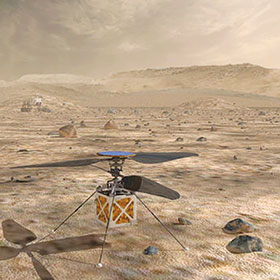
The US space agency NASA has announced that its Jet Propulsion Laboratory (JPL) will be sending a helicopter to the Red Planet on the upcoming Mars 2020 rover mission. The rotors will be controlled by robust DC motors from maxon motor in Switzerland. It will land on Mars in February 2021 while attached to the bottom of the rover. During the first 30 days of the mission it will undertake several autonomous flights, each lasting up to 90 seconds. It will send inflight images of Mars back to Earth for the first time. The Mars helicopter technology will lay the way for many future scientific and exploratory missions to Mars. Similar robots could serve as flying eyes for future rovers, exploring the surroundings and finding the best route for the rover.
For the small helicopter to fly, it takes an enormous engineering effort. The thin air on Mars is comparable to the conditions prevailing on Earth at an altitude of 30 kilometres. Even accounting for the reduced Martian gravity, the helicopter must therefore be particularly light (1,8 kilograms) and can only carry small batteries. This requires that the components used are extremely energy-efficient, a characteristic of maxon’s DC motors. The drives from Switzerland have proven themselves in many previous Mars missions and will also be used in JPL’s helicopter. Six DCX precision micro motors with a diameter of 10 mm are responsible for moving the swashplate and hence adjusting the inclination of the rotor blades i.e. for controlling the vehicle.
The helicopter propulsion system is designed and built by AeroVironment under contract from JPL. maxon engineers have been working closely with the specialists at AeroVironment who are world experts in building micro air vehicles. After a year of development work, NASA’s approval for the inclusion of the helicopter project in the Mars2020 mission is an additional motivation for the Swiss drive specialists. “Being part of another Mars pioneering project makes us incredibly proud and happy,” says Eugen Elmiger, CEO of maxon motor.
The Mars helicopter is just one of several other Mars projects that maxon is currently involved in. For example, in the European Space Agency’s ExoMars rover more than 50 drives are located in the wheels, drill head, analysis unit and camera mast. This mission is also scheduled for launch in 2020. In November 2018, NASA’s InSight lander studied the Red Planet’s seismic activity and planet core temperature. A powerful and robust DC motor from maxon drove a pile driver type mechanism that burrowed almost five metres deep into the Martian soil.
From the editor's desk: A new era Technews Publishing
Editor's Choice
After fifteen years as editor of Motion Control, the time has come for me to hand over to Andrew Seldon. It has been a privilege to be part of this publication and to witness not only the remarkable advances in motion control, fluid power and automation, but also the enormous changes in the world around us.
Read more...OMRON Robotics demos next-generation autonomous mobile robots
Editor's Choice News & events Robotics & Mechatronics
Advancing smarter material flow with the all-new LD-150 and LD-300 AMRs, OMRON Robotics demonstrated the next generation of its flagship LD series autonomous mobile robots (AMRs) at Automate 2026 in June.
Read more...The hidden heroes who shape Africa’s industrial future Bosch Rexroth Africa
Editor's Choice News & events
Behind every industrial success story, there’s a human one. Their names may never appear on a project signboard or in a headline. Yet their expertise and determination keep industries moving every day.
Read more...Bühler Southern Africa leads industry dialogue on apprenticeships
Editor's Choice News & events
Bühler Southern Africa brought together representatives from industry, government and international organisations on 30 June 2026 to explore how quality apprenticeships can help bridge the gap between high youth unemployment and industry demand for skilled technical workers.
Read more...Why lubrication fails in mining and what to do about it
Editor's Choice Electrical switching & drive systems & components
Lubrication Engineers explains the recurring failure points behind mining lubrication problems and how the right product, storage and application practices can improve equipment reliability.
Read more...Solving common automation challenges with Festo’s servo drive and servo motor solutions Festo
Editor's Choice Electrical switching & drive systems & components
Automation projects face challenges that include limited installation space, the need for precise and repeatable linear motion, rising cycle-speed demands, and seamless integration with existing control architectures. Festo’s servo portfolio directly addresses these issues with compact, modular drive and motor solutions designed for specific applications.
Read more...Inside the Giant Magellan Telescope with mechanical engineering at astronomical scale
Editor's Choice Electrical switching & drive systems & components
Construction of the Giant Magellan Telescope, set to become the world’s largest Gregorian optical infrared telescope, is well underway. While its scientific mission is to transform astronomy, its performance depends heavily on advanced mechanical, hydraulic and pneumatic engineering.
Read more...Jendamark catalyst shrinking technology leverages SEW-EURODRIVE precision SEW-EURODRIVE
Editor's Choice Electrical switching & drive systems & components
Innovative technology for shrinking catalytic converters, designed and built in South Africa by Jendamark Automation for the global market, relies on the precision of SEW-EURODRIVE’s highly dynamic servo-geared units and software.
Read more...Motion control for flight simulators Beckhoff Automation
Editor's Choice Electrical switching & drive systems & components
Turkish specialist, SANLAB is a leader in motion platforms and simulation technologies. At the heart of these platforms are application-specific servo drives, servomotors and industrial PCs for real-time control, which are supplied by Beckhoff.
Read more...PC-based control for additive machine tools Beckhoff Automation
Editor's Choice Electrical switching & drive systems & components
IRPD is a specialist in additive machine tools. Development is heavily focused on high system throughput and consistently high process quality. This goal was achieved with the help of PC- and EtherCAT-based control and drive technology from Beckhoff.
While every effort has been made to ensure the accuracy of the information contained herein, the publisher and its agents cannot be held responsible for any errors contained, or any loss incurred as a result. Articles published do not necessarily reflect the views of the publishers. The editor reserves the right to alter or cut copy. Articles submitted are deemed to have been cleared for publication. Advertisements and company contact details are published as provided by the advertiser. Technews Publishing (Pty) Ltd cannot be held responsible for the accuracy or veracity of supplied material.










 printer friendly version