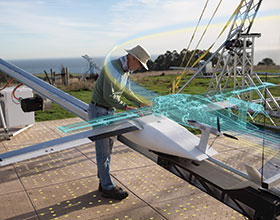
Zipline International designs and builds autonomous flying drones that transport medical supplies in hard to reach regions. The company uses design solutions from Siemens PLM Software. This enables the easy and cost-effective manufacture of the drones, which can travel at around 100 kilometres per hour, and brings together the individual disciplines involved in the process, such as electrical engineering, mechanical engineering and aero engineering. Simulations enable virtual test flights, making it easy to identify and remove faults and to optimise the drones.
The flying drones are designed with the CAD software NX from Siemens PLM Software to deliver lifesaving products to rural areas faster and more reliably than ever before. In many countries around the world, for example Tanzania or Rwanda in Africa, the supply of medical products is a major challenge – particularly in an emergency. Areas are often remote and hard to reach. Above all, a lack of blood supplies frequently leads to fatalities. In 2016 CEO of Zipline, Keller Rinaudo and his team developed a new delivery system for medical supplies. “Our first-generation aircraft and logistics system allowed us to create the first drone-only delivery service in the world”, says Rinaudo. “And it is helping to save lives in Rwanda every day.” Since the first drone took off, Zipline has completed over 7000 flights and delivered 13 000 units of blood. This success is due in no small part to the careful design of the drones, where Zipline relies on NX software from Siemens PLM Software.
Quick and easy data handling
The drones have a service radius of 80 kilometres and can carry up to 1,75 kilograms of cargo per flight. It is also important that they can work in all weather conditions and deal with any unforeseen problems. The design software used in the company’s early years quickly reached its limits. “I really pushed hard to move the company to NX”, recalls Scott Parker, mechanical engineer at Zipline. “Something that you want to do with an aircraft like this is check that your part fits with the rest of the plane. In the previous CAD package, that would be a multi-hour ordeal. With NX, you just load it up. Everything is fast, and you don’t make mistakes.” In addition, using NX Journal enables Zipline to quickly and easily create a bottom-up bill of materials that gives a detailed mass buildup, which helps the firm optimise the aircraft in terms of weight.
Virtual tests for real-life rescue missions
In addition to maximum weight reduction – each kilogram saved increases the range of the drone by five percent – test flights also play a key role. With virtual test flights, Zipline can simulate the heat characteristics of the battery or the thermal performance of the drone cost-effectively and without physical prototypes. Jeremy Schwartz, roboticist at Zipline, sums up what this work means to the team: “When one of our drones takes off in Rwanda, it’s delivering blood to somebody who needs blood. It’s saving somebody’s life, and just thinking about that is an incredible thing.”
AI-powered on-premises analytics for industrial drives Siemens South Africa
Electrical switching & drive systems & components
Siemens is introducing a new on-premises analytics solution for industrial drive systems. The software enables users to evaluate drive data entirely within their own infrastructure and meet stringent data-sovereignty requirements.
Read more...Solving common automation challenges with Festo’s servo drive and servo motor solutions Festo
Editor's Choice Electrical switching & drive systems & components
Automation projects face challenges that include limited installation space, the need for precise and repeatable linear motion, rising cycle-speed demands, and seamless integration with existing control architectures. Festo’s servo portfolio directly addresses these issues with compact, modular drive and motor solutions designed for specific applications.
Read more...Inside the Giant Magellan Telescope with mechanical engineering at astronomical scale
Editor's Choice Electrical switching & drive systems & components
Construction of the Giant Magellan Telescope, set to become the world’s largest Gregorian optical infrared telescope, is well underway. While its scientific mission is to transform astronomy, its performance depends heavily on advanced mechanical, hydraulic and pneumatic engineering.
Read more...Jendamark catalyst shrinking technology leverages SEW-EURODRIVE precision SEW-EURODRIVE
Editor's Choice Electrical switching & drive systems & components
Innovative technology for shrinking catalytic converters, designed and built in South Africa by Jendamark Automation for the global market, relies on the precision of SEW-EURODRIVE’s highly dynamic servo-geared units and software.
Read more...Motion control for flight simulators Beckhoff Automation
Editor's Choice Electrical switching & drive systems & components
Turkish specialist, SANLAB is a leader in motion platforms and simulation technologies. At the heart of these platforms are application-specific servo drives, servomotors and industrial PCs for real-time control, which are supplied by Beckhoff.
Read more...PC-based control for additive machine tools Beckhoff Automation
Editor's Choice Electrical switching & drive systems & components
IRPD is a specialist in additive machine tools. Development is heavily focused on high system throughput and consistently high process quality. This goal was achieved with the help of PC- and EtherCAT-based control and drive technology from Beckhoff.
Read more...A guide to common hydraulic system contaminants CT Hydraulics (Nqoba)
Editor's Choice Hydraulic systems & components
Every engineer, machine designer and maintenance professional understands that the heart of any reliable hydraulic system is its fluid. But the moment that fluid is compromised, your system’s life expectancy and your peace of mind drop dramatically.
Read more...Compressed air piping design Artic Driers International
Editor's Choice Pneumatic systems & components
When designing a compressed air pipeline, remember that size matters. The internal size of the pipe, along with the pressure and air volume, determine the velocity of the compressed air in the pipeline.
Read more...Top questions about pressure gauges SA Gauge
Editor's Choice Pneumatic systems & components
Some questions never go out of date, and in our industry, a few have been asked for decades. At SA Gauge, we hear them every week. Here are the ten questions we hear most often, and the practical answers that can save time, money and frustration.
Read more...Next-generation condition monitoring Siemens South Africa
Electrical switching & drive systems & components
The next generation Sitrans MS200 multisensor from Siemens is setting new standards in condition monitoring.
While every effort has been made to ensure the accuracy of the information contained herein, the publisher and its agents cannot be held responsible for any errors contained, or any loss incurred as a result. Articles published do not necessarily reflect the views of the publishers. The editor reserves the right to alter or cut copy. Articles submitted are deemed to have been cleared for publication. Advertisements and company contact details are published as provided by the advertiser. Technews Publishing (Pty) Ltd cannot be held responsible for the accuracy or veracity of supplied material.










 printer friendly version