



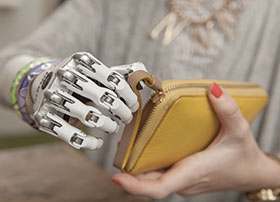
Tie shoelaces, fold bed linen, tear open a bag of crisps – the list of things that are difficult to do with one hand goes on and on. People who have lost a hand are confronted with such obstacles every day.
To make daily life easier, the British company Steeper has developed the bebionic myoelectric hand prosthesis. This is controlled by myoelectric signals generated from muscle contractions in the arm, and can perform multiple different grip patterns selected by the user. Faulhaber high power density motors ensure that the prosthesis can grip smoothly, quickly and firmly and retain the grip force without relaxing.
The bebionic myoelectric prosthesis weighs between 400 and 600 grams and is about as heavy as a natural hand. It is controlled using the tiny electric signals in the body. These are generated when a muscle contracts and can be detected with electrodes on the skin – the same way as an ECG in heart diagnostics. Two electrodes are integrated into the prosthesis socket, which detect the myoelectric signal and forward it to the control electronics. These signals are amplified and used to activate the five small electric motors, one for each digit, which move the fingers and thumb, causing the hand to open and close. The strength of the muscle contraction controls the speed and the gripping force: a weak signal generates a slow movement, a strong signal generates a quick movement.
Additional motors for more control
To control the individual fingers, each finger on the bebionic hand is equipped with its own electric motor. The four motors for the fingers are located in the palm of the hand, the fifth located in the thumb itself. Encoders are integrated into the motors, which precisely detect the position of the finger at any time. Thanks to individual control, the fingers can be arranged into a total of 14 different grip patterns.
To change between the individual grip patterns, the bebionic wearer also uses the arm muscles. Different grip patterns are available, depending on which thumb position is chosen. The hand owner can therefore decide which of the 14 possible grip types to use, and in which order, and using software, can program the prosthesis individually.
Increased self-esteem
The bionic hand makes many everyday activities easier. “It leads to a clearly improved quality of life,” explains Ted Varley, technical director at Steeper.
“Furthermore, the artificial hand also has a big psychological effect. Many users report that their feeling of self-esteem is increased with the use of a bebionic hand.” In this context, the attractive design of the prosthesis also plays an important role, and the exterior design has been adapted as closely as possible to the natural appearance.
Top marks for performance
The new DC-micromotor of series 1024 SR is genuinely best-in-class and the most powerful for its size on the market. With a diameter of 10 mm and a length of 24 mm, it delivers a stall torque rating of 4,6 mNm. Furthermore, it offers consistently high torque across the entire speed range resulting from the flat speed/torque curve. The strong performance is made possible by the development of a new coil design which contains 60% more copper than its predecessor and has been combined with a powerful rare earth magnet. In order to make the movement as quiet as possible, the artificial hand uses planetary gearheads based on series 10/1 in customised versions which do not contain any plastic.
“A significant challenge was the development of the linear drive system, which had to be integrated into the thumb,” says Tiziano Bordonzotti, sales manager at Faulhaber Minimotor. Thanks to high precision four-point contact bearings from Faulhaber’s subsidiary, Micro Precision Systems, it was possible to make the drive system significantly shorter compared to the competition. The unique characteristics of the four-point contact bearing allow the hand to withstand the required high axial load, even with a smaller dimension than alternative bearing systems.
Ted Varley is excited. “The small bebionic hand is the most lifelike myoelectric hand prosthesis on the market and it would not have been possible to realise this project without the close co-operation of the Faulhaber project team,” he concludes.
For more information contact David Horne, Horne Technologies, +27 (0)76 563 2084, [email protected], www.hornet.cc
| Fax: | 086 653 5225 |
| Email: | [email protected] |
| www: | www.hornet.cc |
| Articles: | More information and articles about Horne Technologies |






© Technews Publishing (Pty) Ltd | All Rights Reserved

 printer friendly version