


Predictive maintenance has become a buzzword in recent decades as factories drive down the total cost of ownership of capital equipment by preventing failures and downtime in a ‘just-in-time’ way. According to an IndustryWeek report, unplanned downtime costs industrial manufacturers an estimated $50 billion annually. Equipment failure is behind 42% of this unplanned downtime. It will be hard to challenge the need for an effective maintenance regime. It is often assumed that implementing a predictive maintenance strategy entails a complete overhaul of operations. In reality a few small steps can make a huge difference to machine uptime and overall equipment effectiveness.
There are three main types of maintenance: reactive, preventative and predictive. But how do you make sense of these terms? Human health can provide an analogy to machine health. Take diabetes, for example. Reactive maintenance would be implemented after a doctor has confirmed a patient’s diabetes. The patient focuses on measures to keep the disease under control. In contrast, preventative maintenance would treat the disease before any symptoms, through a healthy lifestyle and eating plan. Predictive maintenance would come into play when someone is pre-diabetic, but still within a safe limit. Regular monitoring of blood glucose would reveal whether the situation is stable or deteriorating and help identify whether more interventions are required.
Production engineers want to increase machine reliability by minimising the possibility of costly and disruptive downtime. There are many factors to consider, not least the cost of implementation and management in comparison with the number of downtime events. The key word is data. Implementing a predictive maintenance programme requires three basic things: data, time and analysis. Data − the modern version of a crystal ball − is an ally to increase machine reliability. Extensive knowledge is required as to why an asset is beginning to fail; and partnering with a reputable automation specialist can pay significant dividends.
Over the last year alone, SMC has performed 25 energy audits at large food and packaging and motor manufacturer sites. These audits carefully analyse the air wasted through leaks that have directly forced customers to run compressors harder or at higher pressures, costing them more in valuable electricity. The volume of air required per machine or line cycle is also analysed to determine if localised high pressure boosters could provide the same solution. This has allowed several of these factories to drop the nominal target pressure from their main line compressors. The audits provide simple suggested solutions whether they be reactive, remedial repairs or preparing the site with truly predictive data feedback devices.
A case in point is a pneumatic cylinder, the workhorse of many industrial machines. Among the common failure modes for pneumatic actuators is a leaking piston seal. These faults can be difficult to detect and lead to a loss of pressure. An operating pressure loss of just 0,1 MPa can negatively affect the theoretical force output of a cylinder with a 32 mm diameter piston by 17%. A further side-effect of this is an increase in air consumption in order to compensate for the leak.
Adopting a predictive maintenance strategy entails little more than fitting a pressure sensor at key areas and monitoring pressure against time. SMC’s high precision ISE20 digital pressure switch with easy setting modes and IO-Link offers a solution here. Any component changes soon become apparent due to abnormal performance curves in comparison with those ‘learned’ for normal operation. With machine learning and real-time analysis, it is possible to implement timely predictive maintenance before incurring any major performance losses or downtime.
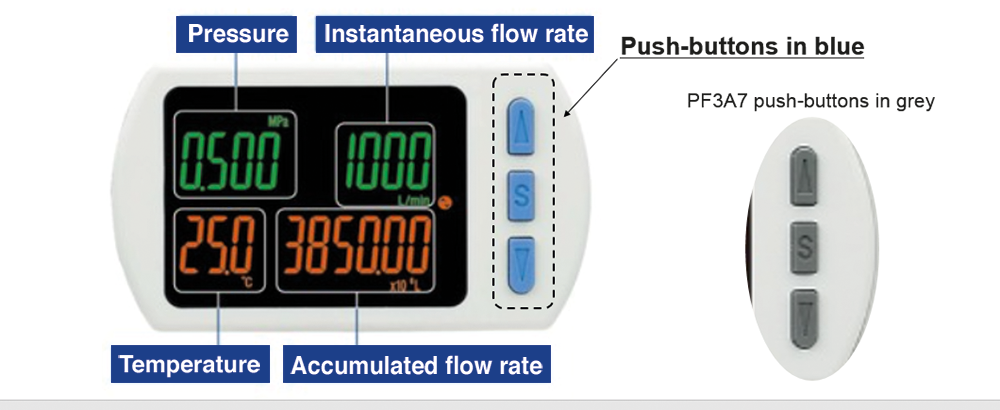
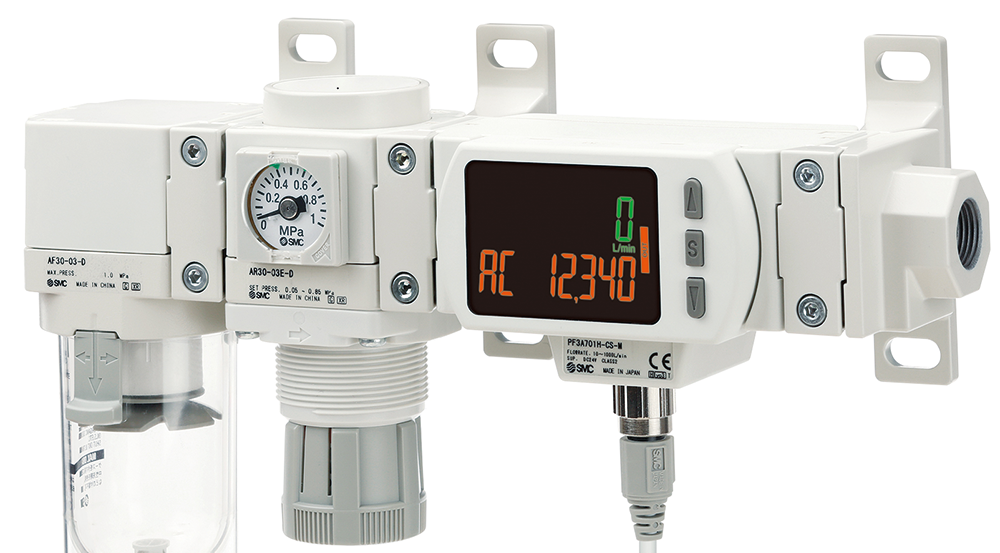
Installing a network of flow sensors to continuously track the usage of compressed air and thereby any leaks or possible malfunctions over the pneumatic circuit is good practice. You can smartly automate your monitoring process with SMC’s PF3A*H digital flow switch, an all-in-one solution for large flow that detects leaks and keeps air consumption in check. Another option is the ALDS Series (Automatic Leak Detection System), which allows you to determine machine leakages with exact leak location and value.
As well as pressure and sensors, proximity sensors can be used to calculate cylinder speed and help detect other possible mechanical issues. Machines can learn, predict and prevent, but they still require human input to define suitable variables to monitor and set acceptable/unacceptable limits. In addition, humans must select which machine components to fit with sensors, as not all will be critical to uptime and productivity. Budgets, time and staff availability also come into the equation.
Another potential factor here involves reliability-based maintenance. Designing from origin means identifying reductions in unnecessary maintenance costs based on failure mode effects analysis. In essence, this approach focuses on the different failures that could occur and their potential consequences. SMC makes this task easy by hosting configurator tools on its website for pneumatic airlines, valve manifolds and cylinders, helping to optimise product selection and performance for the application in hand.
With these thoughts in mind, partnering with a proven technology specialist is a prudent strategy. For instance, pooling SMC’s knowledge of automation components with the individual machine knowledge of a customer makes for a powerful and resourceful combination.
| Tel: | +27 11 100 5866 |
| Email: | [email protected] |
| www: | www.smcza.co.za |
| Articles: | More information and articles about SMC Corporation South Africa |






© Technews Publishing (Pty) Ltd | All Rights Reserved

 printer friendly version