



In a task of galactic proportions, the Sloan Digital Sky Survey (SDSS) aims to observe and analyse four million stars and 300 000 black holes over the next five years. The SDSS will also reconstruct cosmic evolution stories and verify the physical models of the genesis of the galaxy.
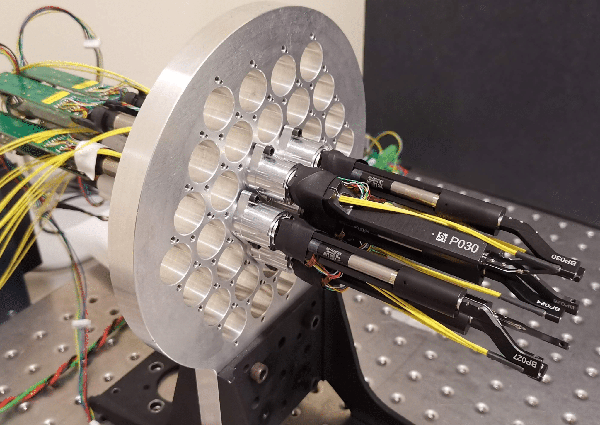
SDSS is a cooperative alliance of astrophysicists from around the world. They have already presented the largest 3D map of the universe, a milestone in astronomical research. Equipped with numerous telescopes, the project will make possible “the first spectroscopic observation of the entire sky in various astronomical dimensions of time in the optical and infrared light spectrum”. In total, more than six million objects will be targeted. In each of the large telescopes, 500 small robots align the optical units with great precision, using motors and gearheads from Faulhaber.
How planets are formed
Among the objectives of this endeavour is the reconstruction of the history of the Milky Way. Researchers plan to retrace the formation of the chemical elements, decrypt the inner workings of stars, examine the formation of planets, and answer many open questions regarding black holes. Another goal is the mapping of the interstellar gas masses of the Milky Way – a thousand times more precisely than previously – to describe “the self-regulating mechanisms of galactic ecosystems”. The data will be collected by two large-scale telescopes: Apache Point in New Mexico and Las Campanas in Chile.
Spotting supernova
Placed in the telescopes are optical fibres that are targeted at specific objects in the universe. Individual stars or the luminous accretion discs of black holes can be precisely observed and analysed. With the new technology developed specifically for SDSS, the rearrangement of the fibres will take no more than a minute instead of weeks. This is because the fibres are now adjusted by means of 500 small motorised robots – referred to by the astronomers as astrobots – in each of the two telescopes.
They are mounted on the telescopic plate and precisely align the optical fibres on the front extension with the individual objects to be observed. This also allows the researchers to respond immediately to unpredicted cosmic events.
Micrometre precision
Each of the astrobots consists of two slim cylinders arranged lengthwise with a curved extension at the front end. The rear, thicker cylinder is secured in the plate of the telescope. It forms the alpha unit and turns the central axis of the robot. Mounted eccentrically to the front of this is the beta unit. It likewise moves the fibre tips in the curved end in a circular path.
Through the combination of the two axial movements, the fibre tips can be freely positioned within a circular area. Three optical fibres are arranged in each astrobot. One is designed for light in the visible spectrum and one for the infrared spectrum. The third is used for calibration. With its help, the fibre tips are moved into position in three steps with an accuracy of just a few micrometres.
Researching faster
“Because we save an enormous amount of time with the automatic alignment, we can observe many more objects and perform a larger number of measurements,” explains Jean-Paul Kneib, professor of astrophysics at Ecole Polytechnique Fédérale in Switzerland. “This effect is raised to an even higher power through the high precision.”
The technical prerequisites for this extreme accuracy are provided by motors and gearheads from Faulhaber. The two robot axes are driven by brushless DC-servomotors. Their force is transferred to the robot mechanics by means of suitable planetary gearheads. Integrated encoders report the rotary position of the motors to the controller.
Backlash-free precision
To achieve the required precision, engineers had to eliminate the backlash in the system. They accomplished this by replacing the conventional coupling between the gearhead shafts and the mechanical axes of the robot with clamp connections, and by installing a compression spring to make the gearhead backlash-free.
The search for the right partner for this technical development did not take Kneib’s team much time. “There are not even a handful of manufacturers in the world who can produce micromotors with the required quality and durability,” he says. “Faulhaber was already on the short list of companies from whom we requested a quotation. In addition to the outstanding quality and the good mutual experiences, a decisive argument was that Faulhaber can supply everything from a single source.”
For more information contact David Horne, Horne Technologies, +27 76 563 2084, [email protected], www.hornet.cc
| Fax: | 086 653 5225 |
| Email: | [email protected] |
| www: | www.hornet.cc |
| Articles: | More information and articles about Horne Technologies |






© Technews Publishing (Pty) Ltd | All Rights Reserved

 printer friendly version