

The global drive towards net zero and sustainable energy sources is accelerating the shift from fossil fuel to electric-driven machines. Some European companies are already setting conditions for electric-driven equipment on their tender requirements. Large machines are more complex to convert because of the high power demand. Nevertheless, as electric technology develops, the ground engineering sector is making progress in transitioning the industry to electric power.
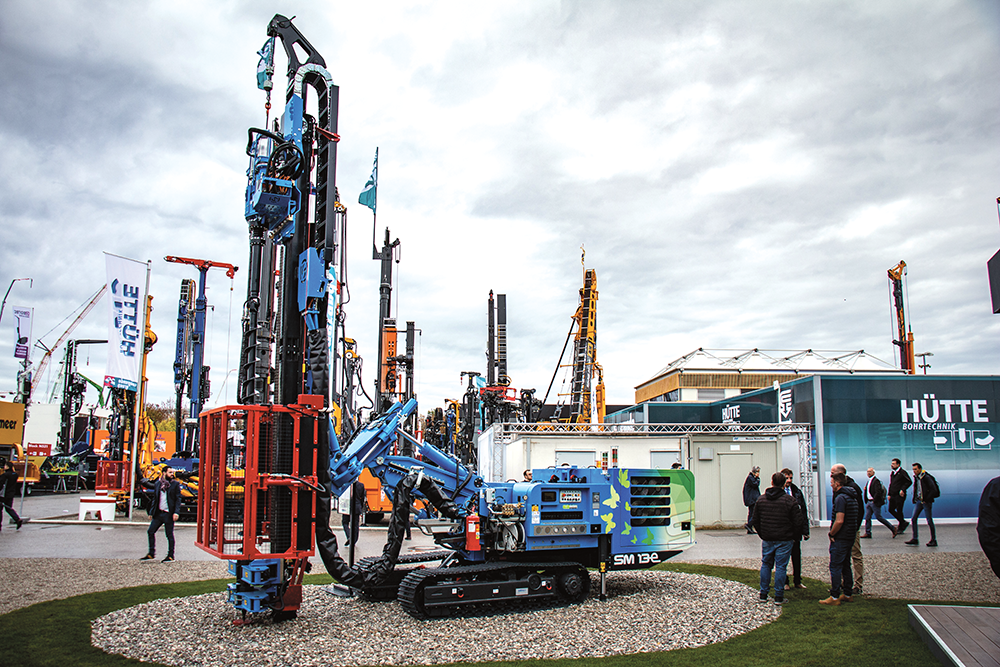
Soilmec is a leading ground engineering company with a history of over 50 years in designing, manufacturing and distributing equipment. In line with global trends toward sustainability, Soilmec has embarked on creating a zero local emission line of machines, choosing the microdrilling machine SM-13e as the first in this range. This machine is typically used in soil consolidation work, anchorage, and tunnel construction.
Parker Hannifin supplied several components for the SM-13e, including the GVM210 series motors and GVI-G650 inverters. This project aimed to meet the functional requirements for speed and power, while significantly reducing operating costs and improving performance relative to the diesel-powered machine.
The challenges of electric ground engineering machines
Ground engineering machines work in extreme conditions. Construction sites are exposed to the elements and dusty conditions associated with earthmoving. Additionally, drilling through rocky ground results in strong vibrations. Sensitive electronic components must be designed for these conditions. In the case of the Soilmec SM-13e ETECH machine, the functional requirements created some specific challenges. The SM-13e required four electric motors, each with an inverter. Two of these motors were mounted on top of the mast in the rotary head. The elevation was particularly challenging because cooling systems had to supply the motor at heights up to 10 metres, without interfering with the machine’s operation.
Two motors in the rotary head drove the rotational movement, and the other drove the push-pull movement of the drilling head. The control of the rotary’s motors had to be highly synchronised, making the inverter and motor design and control critical for machine operation. The rotational speed could vary from a high of 130 rpm to a low of 1 rpm. The push-pull motor also had a wide speed range from to 0,08 to 50 m/min.
The electric technology behind the SM-13e
Parker supplied several components for Soilmec’s electrified microdrilling machine, including motors and inverters. The design of the SM-13e utilised the following technologies: GVM210300 motor, GVI-G650 inverter, QDC-050-B hydraulic cooler, and P2075L hydraulic variable piston pump.
The SM-13e solution was designed with maximum flexibility in mind. There were three operating modes: Normal, Eco and Boost. The Normal mode delivered standard operational performance, and the Eco mode allowed for conserving energy when power demands were lower, lengthening battery life. The Boost mode enabled short periods of maximum performance.
A collaborative approach
In developing the Soilmec SM-13e machine, Parker and Soilmec engineers worked together in a collaborative approach. They went through several iterations of refining the requirements, selecting components, and designing a system that worked as an integrated whole. As a result, the first Soilmec SM-13e machine is already delivering excellent results in the field.
The benefits of electric ground engineering machines
Electric machines, like the SM-13e, deliver significant benefits to ground engineering companies. Firstly, they enable users to reduce their carbon footprint substantially. The SM-13e is much more efficient than the diesel equivalent. As the energy source is electrical, the CO2 and other greenhouse gas (GHG) emissions are vastly reduced. At the same time, electric machines are much quieter than internal combustion engines. In contrast to endothermic machines, electric motors are off when the utilities are active but the machine is not drilling. This drastically reduces both the noise to which the operator is subjected, and the energy consumption of the machine.
Secondly, improved efficiency also reduces running costs. Diesel engines tend to run on a time-based service interval. This interval is calculated based on the running time of the machine, including idle time. On the other hand, motors on electric machines can be individually monitored for running time. Thus, maintenance intervals can be significantly extended, resulting in operating costs as much as 56% lower. Additionally, the machine is more available due to reduced downtime, and jobs can progress quicker. Maintenance costs are also reduced because there are fewer maintenance tasks required on an electric motor than on a diesel engine. Lastly, electric machines offer higher performance than their diesel equivalents. This benefit is due to the constant torque availability from electric motors, regardless of speed.
| Tel: | +27 11 961 0700 |
| Fax: | +27 11 392 7213 |
| Email: | [email protected] |
| www: | www.parker.com/za |
| Articles: | More information and articles about Parker Hannifin - Sales Company South Africa |






© Technews Publishing (Pty) Ltd | All Rights Reserved

 printer friendly version