


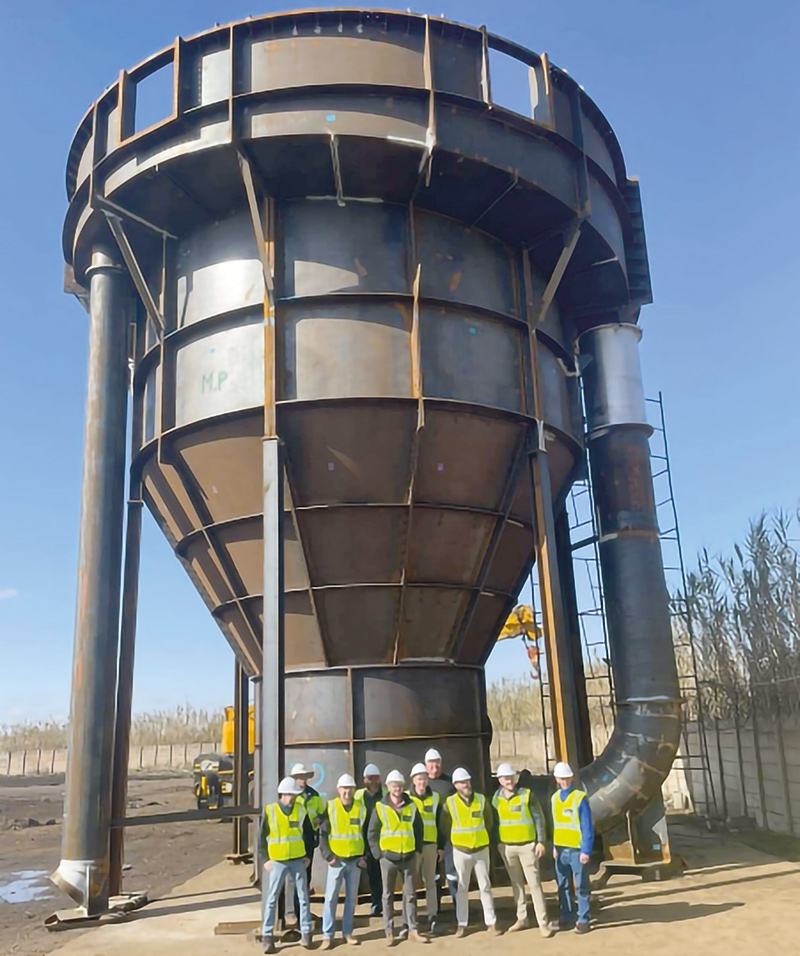
The Azmet Reactor project, a collaborative effort led by Viva Engineering, involved fabricating six massive reactors that were over three stories high in Gauteng, and then transporting these more than 2500 kilometres to a mine in the DRC - where all 3265 parts fitted perfectly, with not even one of the 26 900 bolts out of place. This was a massive achievement. This is according to Amanuel Gebremeskel, CEO of the Southern African Institute for Steel Construction (SAISC).
“The project entailed detailed design, complex geometry with finite element modelling, and an integrated support frame and platform. It exemplified precision engineering, showcasing intricate design and fabrication processes. To appreciate the complexity, consider that they had to plan, design and fabricate huge modular structures ahead of time, in such a way that they could be moved through four or five different countries by road to install on site at the mine,” Gebremeskel says.
He explains that the more conventional approach would be to use heavy concrete tanks, or set up a substantial design office and fabrication works with a highly skilled team, both of which are not readily available locally in the DRC. Using an established South African fabricator, based in Gauteng, therefore provided a viable alternative. This allowed for a controlled environment and close monitoring to ensure that all construction materials and structures met the required quality and safety standards.
Poring over the project
The Azmet Reactor project not only involved creating six huge reactors, but also several other complex tanks, platework, and plant buildings. From a technical point of view, engineers had to consider the design of the vessel in relation to permanence, material, equipment, and wind loads. Due to the nature of the spliced connections, these had to be modelled in detail, including all the bolts. Furthermore, as the vessels had to be transported and erected piece by large piece, a lifting study first had to be performed. This focused on the selection of the most appropriate lifting methodology, considering that the reactor components would need to be loaded onto conventional heavy-duty transport vehicles. On the opposite end, at the mine in the DRC, careful consideration was given to the constructability of the project.
Shaping up and shipping out
Gebremeskel says that the aspect of this project that stood out the most during the judging process was the logistics. “They designed each large structure in a modular fashion, for ease of transport and installation. However, bear in mind that these structures had a diameter of 9,9 metres and a height of 11,6 metres, which is almost the size of a three-storey building.”
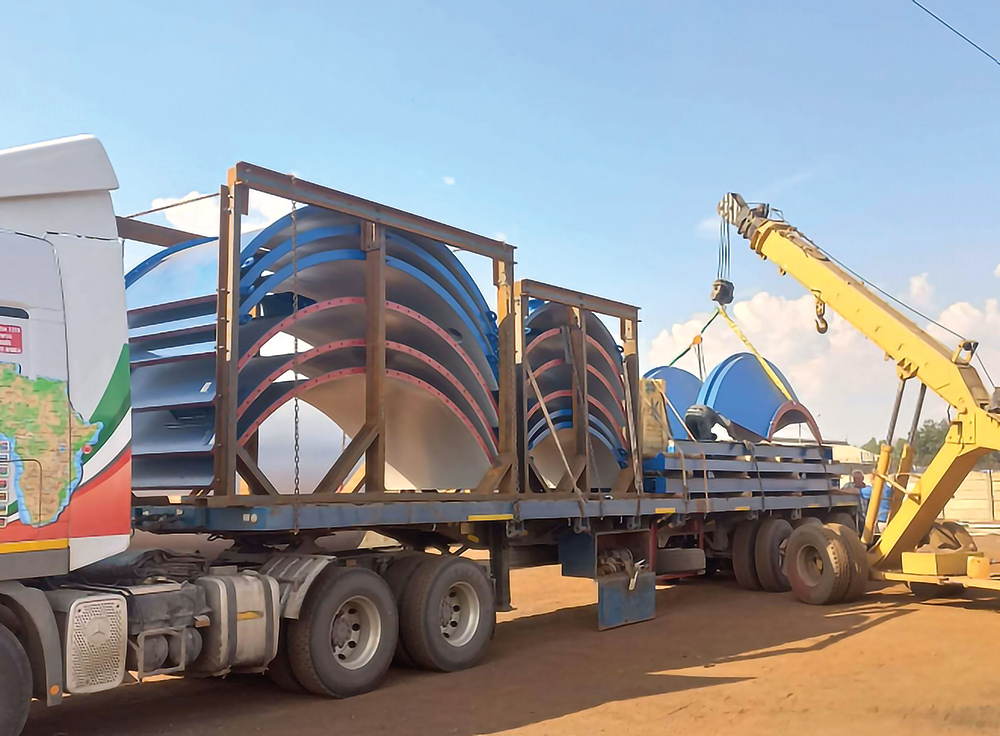
The road transportation therefore necessitated exacting tolerances to ensure safe and timely delivery to site in the DRC. Transport jigs were designed and built to brace the components and reduce vibration during transportation, while meticulous load packing optimised weight distribution for the lengthy trip. The components of each reactor were packed so that upon arrival on site they could be assembled from the designated package. The components also had to be carefully packed in specially designed cradles to optimise each load and minimise the number of loads to site.
“The essential brilliance of this project lay in the smooth coordination and orchestration of design, fabrication and erection. The process was perfectly choreographed by the project managers, who oversaw the planning down to the finest detail,” Gebremeskel observes.
Reactors are essentially large tanks that are custom-made to remove precious metals from mined ore, and must tolerate a variety of different temperatures and chemicals. A rubber bladder required to protect the steel from these compounds therefore also had to be installed prior to leaving the Viva Engineering workshop in Gauteng.
Gebremeskel says that adjectives such as ‘innovative’ and ‘ingenious’ come to mind. “The lining was put on the inside to protect the steel from whatever solvent was being used. As one can imagine, it was necessary to do some fairly detailed mockups, and even trial assemblies to test this. The reactors were eventually bolted together. This meant that the lining had to work in a bolted tank rather than a conventionally welded one,” he explains.
Maintaining the continuity of the rubber lining between the bolted faces of each component was successfully addressed, as the project brief explains: “The first reactor was trial assembled to prove that the jigs and manufacturing were correct. All six rubber-lined reactors were installed without a single flange hole out of place. Rubber lining is continuous on the bolted faces. This required that the fabrication details incorporated the lining thickness. During fabrication, spacer plates were also inserted in the connections to simulate the lining. Corrosion protection was furthermore applied to the external surfaces of the component”.
Joining quality with manufacturing excellence
Yet another innovative aspect of the Azmet Reactor project was the precision welding required to join the panels during the fabrication process, so they could be bolted together once on site. The level of welding precision and accuracy had to be very high, as the structures could not distort during the transportation process.
“The design had to cover exactly how to lift and manoeuvre these large and very heavy modular structures. The most significant load was during the lifting process − as opposed to when they were in use − entailing a very different kind of engineering. The entire design was driven by the plans to construct and then transport each structure, as opposed to its ultimate application,” Gebremeskel continues.
The benefits of steel in this project were numerous, as detailed in the project brief: “The complexity of the reactor geometry is best suited to fabrication in steel. Construction of the reactors in concrete would not be viable due to the complexity of formwork and deployment of plant onto a site of limited size. The benefit of steel for this application is a relatively lightweight structure (compared to concrete), which can be preassembled and trial-erected before being transported to site. This allows for fast and accurate erection in the final location.”
A precise and praiseworthy precedent
One of the chief challenges was completing the project on time, as late delivery would have resulted in substantial penalties. Needless to say, timeous delivery was achieved against all odds.
“The Azmet Reactors project represents a veritable feat of engineering – showcasing brilliance of design, logistics and installation – and demonstrating the South African steel sector’s capability to execute structurally and logistically complex projects with precision. This is a victory for our industry, and could certainly not have been achieved elsewhere on the continent. Considering the number of mines being constructed throughout Africa, the good news is that similar projects will no doubt be required, which our local steel supply chain can certainly deliver,” he concludes.






© Technews Publishing (Pty) Ltd | All Rights Reserved

 printer friendly version