Hydraulic connectors with residual pressure
First Quarter 2024
Editor's Choice
Hydraulic systems & components
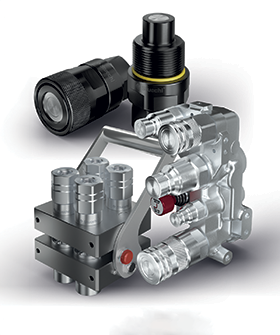
Hydraulic connections are vital in both outdoor industrial machinery, for example in agriculture and earthmoving, and in indoor industrial machinery for presses and moulding. Examples include farm tractors attaching to various implements, or excavators using tools like hydraulic hammers or buckets. The goal is to enable quick, easy swaps to enhance machine flexibility and productivity.
In the past, connecting hydraulic lines involved manually unscrewing couplings on oil-filled hoses, leading to significant oil spillage and environmental pollution. With their occlusion valves, modern quick couplings have largely addressed this by retaining fluid post-disconnection on both the hose and machine side. However, challenges arise when machines or hoses heat up in the sun, causing oil expansion and creating high residual pressure in the lines, up to 100 bar. While certain machines have circuits to mitigate this, and hoses can act as accumulators, the residual pressure often makes connecting quick couplings difficult. Under pressure, the occlusion valves become like rigid hydraulic cylinders, which are hard to connect manually. For instance a common 1,3 cm hose coupling valve has a hydraulic pushing area of 1,5 cm2, translating to a theoretical hydraulic force of 150 kg at 100 bar pressure.
Operators use various methods to overcome this challenge. Some apply excessive force, risking damage to seals and valves. Others strike occlusion valves against hard surfaces to release oil and reduce pressure, leading to environmental pollution and equipment damage. Loosening pipe fittings to drain oil is another method, although it poses safety risks like high-speed oil spray.
The residual pressure problem incurs costs like wasted time, reduced lifespan of quick valves, machine downtime and potential damage to the brand image. Thanks to the 60 years of field experience of Stucchi Italy, Stucchi South Africa offers various technical solutions to these issues. Innovations include a double internal valve system in the APM series, and A-HD and FAP couplings for manual connection without fluid loss. The screw-to-connect system used in the VP, VEP and VEP-HD series allows easier connection against internal pressure. Stucchi’s latest technology also features a manual knob on the Saturn cast iron block, activating an internal valve to drain excess oil for safe, effortless connections.
Further reading:
PC-based control for additive machine tools
Beckhoff Automation
Editor's Choice Electrical switching & drive systems & components
IRPD is a specialist in additive machine tools. Development is heavily focused on high system throughput and consistently high process quality. This goal was achieved with the help of PC- and EtherCAT-based control and drive technology from Beckhoff.
Read more...
A guide to common hydraulic system contaminants
CT Hydraulics (Nqoba)
Editor's Choice Hydraulic systems & components
Every engineer, machine designer and maintenance professional understands that the heart of any reliable hydraulic system is its fluid. But the moment that fluid is compromised, your system’s life expectancy and your peace of mind drop dramatically.
Read more...
Compressed air piping design
Artic Driers International
Editor's Choice Pneumatic systems & components
When designing a compressed air pipeline, remember that size matters. The internal size of the pipe, along with the pressure and air volume, determine the velocity of the compressed air in the pipeline.
Read more...
Top questions about pressure gauges
SA Gauge
Editor's Choice Pneumatic systems & components
Some questions never go out of date, and in our industry, a few have been asked for decades. At SA Gauge, we hear them every week. Here are the ten questions we hear most often, and the practical answers that can save time, money and frustration.
Read more...
A technological leap with the proportional valve terminal
Festo South Africa
Editor's Choice
Festo continually makes bold technological leaps to keep pace with global advancements. Controlled Pneumatics is redefining the boundaries of compressed air technology to meet the demands of today’s most advanced applications.
Read more...
PC-based control optimises robotic parts handling on plastics machinery
Beckhoff Automation
Editor's Choice
NEO is a cartesian robot developed by INAUTOM Robótica in Portugal for parts removal on plastics machinery. Its aim is to increase system productivity. NAUTOM Robótica has entered into a strategic partnership with Bresimar Automação to increase the working speed of the cartesian robots using advanced control and motion solutions from Beckhoff. The result is a comprehensive, future-proof automation solution for its entire family of cartesian robots.
Read more...
Heavy impact, smart control
Axiom Hydraulics
Editor's Choice Hydraulic systems & components
Every now and then a project lands on your desk that’s equal parts heavy machinery and fine control - a tantalising mix for any engineer. A client approached Axiom Hydraulics with a project exactly like this.
Read more...
Driving fluid power forward
Editor's Choice
The National Fluid Power Association is developing its latest Industrial Technology Roadmap for 2025, showing how hydraulics and pneumatics are changing to meet new industrial demands.
Read more...
World’s hottest engine
Editor's Choice Electrical switching & drive systems & components
Scientists have built the world’s smallest engine. It’s also the world’s hottest. It could provide an unparalleled understanding of the laws of thermodynamics on a small scale, and provide the foundation for a new, efficient way to compute how proteins fold.
Read more...
Reinventing the wheel
Editor's Choice Electrical switching & drive systems & components
Once a curiosity in the early automotive age, in-wheel motors are now re-emerging with real promise. From electric cars to commercial vehicles and even aircraft, they are on the verge of transforming transportation engineering.
Read more...










 printer friendly version